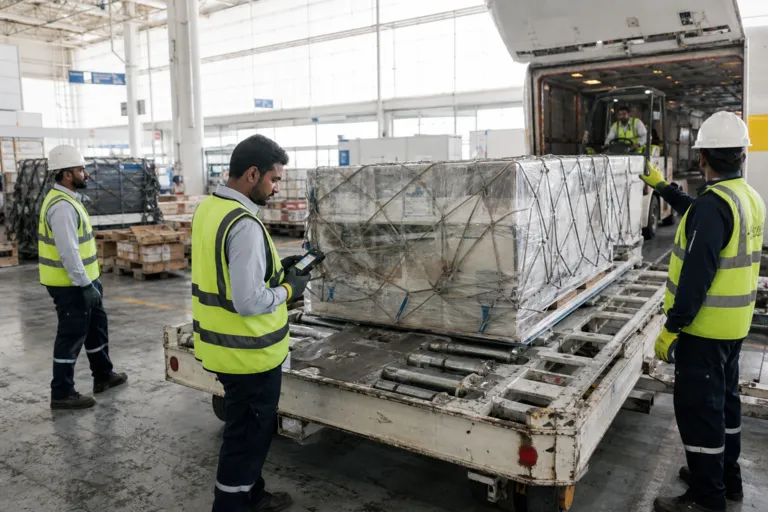
Saudi Arabia’s air freight story is getting a new catalyst with the Riyadh Air cargo launch and the broader set of new cargo operations expected to “materially expand air freight capacity in the Kingdom,” according to Makreo Research. The timing matters because air cargo already has a measurable baseline. Total air cargo volume reached 1.2 million tonnes in 2024, and the civil aviation authority is targeting a fivefold increase by 2030. That combination—today’s throughput and an explicit national target—puts pressure on airports, forwarders, and road feeders to add capability, speed, and reliability across the air cargo chain.
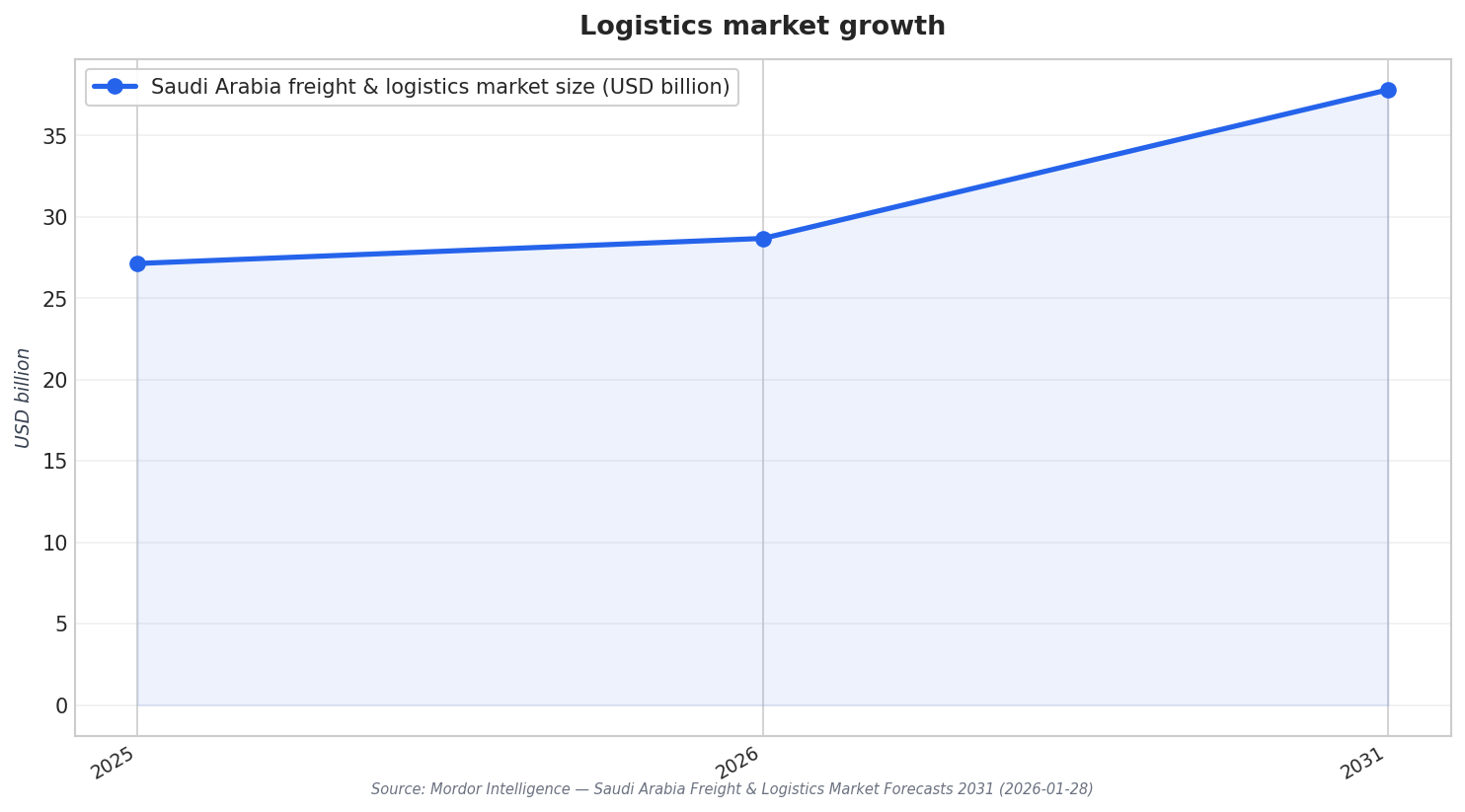
Market forecasts also point to steady momentum in air freight services. Mordor Intelligence projects the Saudi Arabia freight and logistics market to grow from USD 28.68 billion in 2026 to USD 37.82 billion by 2031, at a CAGR of 5.69%. Within freight transport modes, air freight is projected to expand at a 6.78% CAGR between 2026 and 2031, and air freight forwarding is set to post a 6.12% CAGR over the same period. These figures do not describe one airline. But they frame why a new air cargo entrant matters: it steps into a segment already expected to outpace overall market growth.
Why Riyadh Is Positioned to Benefit First
Riyadh’s role as a logistics center is repeatedly emphasized across market coverage. Nexdigm describes Riyadh as the Kingdom’s primary inland logistics hub supported by dry ports, cargo airports, and distribution centers, alongside other major nodes in Jeddah and Dammam. OMR Business Consulting adds that the Riyadh region was the dominant region for the Saudi Arabia freight and logistics market in 2022. This concentration helps explain why new capacity tied to Riyadh can ripple quickly through forwarding and distribution networks. It also underscores that the benefits are likely to show up first in inland consolidation, customs-cleared staging, and time-sensitive cargo lanes.
Infrastructure around King Salman International Airport adds another layer to the competitiveness equation. Makreo’s logistics analysis notes that the airport’s Special Integrated Logistics Zone spans 3 million m², with Apple and Shein already signed as tenants, and that the Sino-Logistics Zone at the same airport is under construction. Mordor Intelligence also links Vision 2030’s infrastructure drive to USD 133.3 billion of approved airport, rail, and port outlays. Together, these points show how the Riyadh Air cargo launch fits into a broader push: pairing flight capacity with dedicated logistics zones that attract shippers and integrators looking for predictable cross-border fulfillment.
The practical effect for KSA air freight will be felt across connected modes, not only in the air. Mordor’s data shows road freight held a 41.55% revenue share in 2025, highlighting how much the Kingdom depends on road feeders even when air freight grows. The road freight market report also notes that domestic corridors linking Riyadh, Dammam, and Jeddah accounted for roughly 70% of 2025 road tonnage, reinforcing how concentrated the main distribution triangle remains. For shippers and freight forwarders, the strategic takeaway is that more air capacity becomes most valuable when it is matched with efficient road links and logistics-zone handling that reduces dwell time and improves end-to-end service performance.
What is the Riyadh Air cargo launch expected to change for KSA air freight?
How fast is air freight expected to grow in Saudi Arabia?
Why does Riyadh matter so much in the freight and logistics market?
What airport logistics-zone developments support air cargo growth in Riyadh?
How does road freight connect to air cargo outcomes in Saudi Arabia?
Talk to us for your needs in:
- Identifying Suitable Warehouse Sites in Saudi Arabia
- Customized Logistics and Supply Chain Analytics
- Logistics Network Design and Optimization
- Green Supply Chain and Sustainable Logistics Solutions
- Supply Chain Risk Management and Compliance
- Advanced Supply Chain Resilience and Agility
- Logistics Market Research and Strategic Analysis
- In-Depth Market Survey for Logistics
- Market Intelligence and Insights in Logistics
- Feasibility Study and Assessment in Logistics
- Integrated Warehousing Management Solutions
- Smart Warehousing and Automation Systems
- Sustainable and Green Warehousing Practices
- Port and Airport Logistics Optimization
- Digital Logistics Solutions
- Saudi Logistics Benchmarking