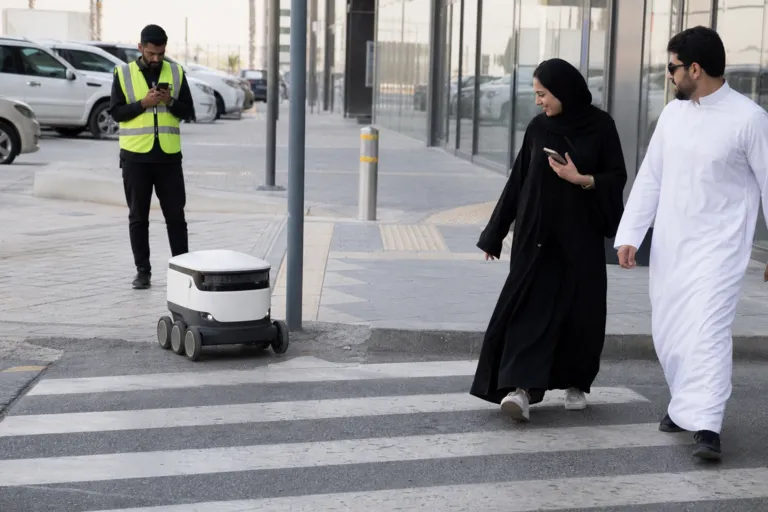
Saudi Arabia’s push for self-driving mobility is moving from concept to street-level service. In Riyadh’s ROSHN Front Business Area, Jahez and ROSHN Group launched what multiple reports describe as the Kingdom’s first commercial autonomous food delivery service. The project operates under licensing from the Transport General Authority (TGA) and is positioned as a practical test of autonomous logistics inside a controlled, monitorable district environment. The rollout includes five robots that operate daily during working hours, with operating hours reported as 9 a.m. to 5 p.m. This trial adds a visible last-mile layer to the broader national focus on AI-driven transport and logistics innovation.
The robots are described as fully autonomous Level 4 delivery units, built for navigation and safety in an active commercial area. Reported hardware includes GPS, six cameras, and over 20 sensors, plus internal cooling designed for local climate conditions. The units can interact with pedestrians through on-screen prompts, and they are described as capable of dealing with uneven terrain using built-in suspension systems. Jahez’s CTO, Mohammed Al-Barrak, framed the initiative as part of a strategy to optimize automation in logistics. In the context of Saudi autonomous delivery vehicles, these details matter because they show what capabilities are being validated in real operating conditions, not only in lab settings.
What the Riyadh Robot Rollout Shows About Scaling
Early performance figures are already being cited alongside the pilot. Delivery times in Riyadh’s ROSHN Front Business Area have been reduced by up to 50% since launch, according to one source. Activity levels were also shared: the robots completed over 50 deliveries in the commercial zone, and there were 79 deliveries during earlier trials in the Sidra residential community. Environmental impact is part of the narrative as well, with each robot estimated to reduce 1.2 tonnes of CO₂ emissions annually, aligning with ROSHN’s green mobility goals. Together, these metrics help quantify why the pilot is more than a novelty and why stakeholders may view it as a scalable last-mile model.
The Jahez and ROSHN initiative also sits inside a wider market and policy context that is being tracked with specific projections. One analysis states Saudi Arabia’s autonomous vehicle market reached USD 1.01 billion in 2024 and is projected to grow to USD 6.07 billion by 2033, a CAGR of 22.03% from 2025 to 2033. Separately, a PwC-network report is cited describing a GCC-wide autonomous vehicle opportunity forecast at USD 18.7 billion, with robo-taxis projected to generate up to USD 10 billion in value by 2035. The same discussion links Saudi mega-projects and smart city initiatives, including NEOM and ROSHN, to regulatory sandboxes and real-world testing conditions.
Other indicators suggest autonomy is being pursued across passenger and goods mobility, not just food delivery. Riyadh launched its first robotaxi pilot in July 2025 in collaboration with WeRide, Uber, and AiDriver, covering routes between King Khalid International Airport and central Riyadh. Arab News also reports a national aim for 25% of all goods transport vehicles to be fully autonomous by 2030, underscoring why last-mile robotics pilots can matter for long-term targets. For the Jahez and ROSHN trial, the near-term takeaway is that ROSHN Front offers a controlled environment for performance monitoring and rapid iteration, while its success could pave the way for broader deployment across Saudi Arabia.
Where are Jahez and ROSHN testing autonomous food delivery in Riyadh?
How many delivery robots are operating in the Jahez and ROSHN rollout?
What results have been reported so far from the Riyadh delivery robot pilot?
What does this say about the future of Saudi autonomous delivery vehicles?
How big is Saudi Arabia’s autonomous vehicle market projected to become?
Talk to us for your needs in:
- Identifying Suitable Warehouse Sites in Saudi Arabia
- Customized Logistics and Supply Chain Analytics
- Logistics Network Design and Optimization
- Green Supply Chain and Sustainable Logistics Solutions
- Supply Chain Risk Management and Compliance
- Advanced Supply Chain Resilience and Agility
- Logistics Market Research and Strategic Analysis
- In-Depth Market Survey for Logistics
- Market Intelligence and Insights in Logistics
- Feasibility Study and Assessment in Logistics
- Integrated Warehousing Management Solutions
- Smart Warehousing and Automation Systems
- Sustainable and Green Warehousing Practices
- Port and Airport Logistics Optimization
- Digital Logistics Solutions
- Saudi Logistics Benchmarking