For Saudi importers, the biggest operational shock in marine cargo cover is not always a closed lane. It can be a sudden jump in war-risk pricing that changes voyage economics before any physical shutdown occurs. The 2026 conflict disrupted two chokepoints tied to Saudi trade, the Strait of Hormuz and the Bab al-Mandeb corridor, and pricing repriced fast. S&P Global reported that additional war-risk costs in Hormuz moved from 1% to 3% of a ship’s hull value to 7.5% to 10%. In the Red Sea context, Reuters reporting summarized by Beinsure also showed how premiums can change by route and port, reshaping importer budgets without changing the underlying purchase order.
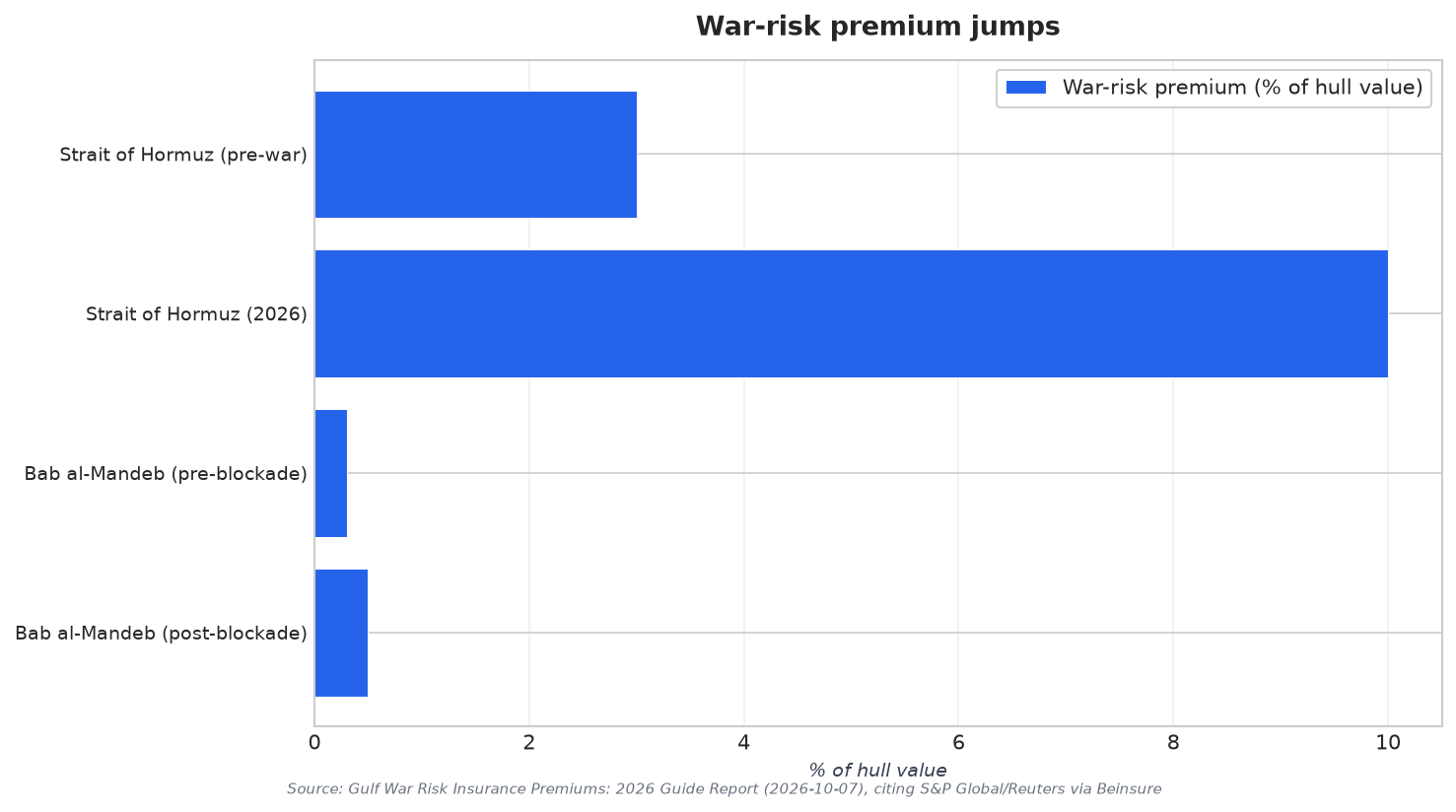
Those percentage shifts translate into planning risk because war-risk cover is often priced per voyage and can be reviewed frequently. Insurance Journal said war-risk premiums typically cover 7-day voyage periods and are reviewed every 24 hours. In the same Reuters-sourced reporting, it noted that a journey from Yanbu could cost $3 million in war-risk premium, or about $7 million from other Saudi ports further south or via Hormuz, up from at least $100,000 before the war. The market also redrew boundaries inside the Red Sea. After attacks on Saudi tankers, premiums for southern Red Sea voyages rose above 1%, and some Saudi-linked ships received quotes as high as 3% near Jizan, Al Shuqaiq, and the Bab el-Mandeb route into the Gulf of Aden, while Jeddah and Yanbu were priced near 0.1% in that earlier snapshot.
What Premium Spikes Mean for Contracts, Routes, and Cargo Budgets
Premium volatility rarely arrives alone. Freight rates can rise at the same time, compounding landed-cost variance for importers. Platts assessed the rate to carry a 270,000 metric tonne cargo of crude from the Persian Gulf to China at $77.96 per metric tonne on July 22, after edging up from $73.80 per metric tonne at the previous assessment. Al Jazeera described $77.96 per metric tonne as four times the five-year average of $18.91 per metric tonne, and noted a March peak of about $140 per metric tonne. Importers should treat war-risk pricing as a variable line item that can reset quickly by corridor and by port, and align purchase terms, shipment timing, and routing decisions to reduce surprise exposure when quotes jump within days.
Saudi Arabia is also building a domestic mechanism aimed at keeping coverage available when global reinsurance costs and risk perceptions spike. Saudi Arabia has approved a national war-risk insurance pool for cargo and vessels. The “Saudi Marine War Risks Insurance Pool for Cargo and Hull” will operate as a public-private mechanism under the supervision of the Insurance Authority. Saudi Reinsurance Company (Saudi Re) will lead and manage the pool with participation from insurers in the domestic market, while the Insurance Authority sets the regulatory framework and participating insurers distribute coverage to eligible customers. The Insurance Authority’s stated objectives include supporting trade and supply-chain continuity and limiting the effects of sharp volatility and higher reinsurance costs in global markets. Coverage is described as broad, including cargo transported by land, sea, and air, alongside marine hull insurance against covered damage and risks.
For importers, the practical takeaway is to plan for premium spikes as a recurring feature of a volatile region, not as a rare exception. The external comparison often cited is India’s marine insurance pool, which had total capacity of $1.5 billion, including a $1.4 billion sovereign guarantee. It issued more than 1,600 policies within weeks, and war-risk premiums fell by about 35% to 40% from earlier peaks during a regional escalation. That reference point does not describe Saudi outcomes, but it illustrates how pooled capacity can help keep market participation viable when rates surge. In day-to-day procurement, importers can ask brokers and carriers to specify war-risk triggers, clarify how rapid repricing is handled, and build contingencies for corridor shifts affecting war risk insurance for Saudi cargo.
Why can Saudi imports slow even if shipping lanes stay open?
How large did Hormuz war-risk costs get in 2026 reporting?
How often can war-risk pricing be reviewed during a voyage?
What is Saudi Arabia’s national war-risk insurance pool designed to do?
How should importers think about war risk insurance for Saudi cargo when premiums spike by route?
Talk to us for your needs in:
- Identifying Suitable Warehouse Sites in Saudi Arabia
- Customized Logistics and Supply Chain Analytics
- Logistics Network Design and Optimization
- Green Supply Chain and Sustainable Logistics Solutions
- Supply Chain Risk Management and Compliance
- Advanced Supply Chain Resilience and Agility
- Logistics Market Research and Strategic Analysis
- In-Depth Market Survey for Logistics
- Market Intelligence and Insights in Logistics
- Feasibility Study and Assessment in Logistics
- Integrated Warehousing Management Solutions
- Smart Warehousing and Automation Systems
- Sustainable and Green Warehousing Practices
- Port and Airport Logistics Optimization
- Digital Logistics Solutions
- Saudi Logistics Benchmarking