The Saudi logistics hub ambition rests on the Kingdom's location between Asia, Europe and Africa and on new investment in ports, railways and corridors. According to the CEO Guide to KSA, 40% of global GDP is within six hours. For companies, the real gains depend on execution, operating costs and supply chain network design.
Eurogroup Consulting's The CEO Guide to KSA: Saudi Arabia Reimagined, Are You Ready?, published in March 2024, examines the Kingdom's logistics infrastructure as part of its Vision 2030 diversification strategy, while emphasizing the operational considerations businesses must assess before establishing supply-chain operations.
What Makes the Saudi Logistics Hub Strategically Positioned?
Saudi Arabia occupies a strategic position connecting markets across three continents. Its Red Sea coastline provides access to international maritime routes, while transport connections across the Arabian Peninsula support trade and regional distribution.
According to the CEO Guide's research snapshot, more than 50 fast-growing markets are located within four hours, while approximately 40% of global GDP is within a six-hour travel radius. The guide also states that more than 80% of the world's population can be reached within seven hours. These figures describe the geographic accessibility assumptions used in the report, rather than guaranteed freight delivery times.
The guide's infrastructure snapshot also records a road network exceeding 232,000 kilometers, alongside ten ports and an established railway system, with container-handling capacity exceeding 13 million containers annually.
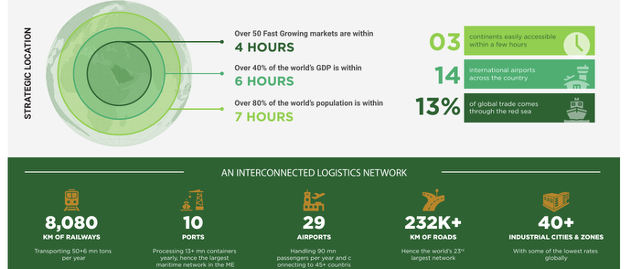
Figure 1: Strategic Location and Interconnected Logistics Network. Source: The CEO Guide to KSA, Eurogroup Consulting (p. 16).
Geographic proximity can support trade, but it does not automatically translate into logistics efficiency. Actual shipment performance depends on port capacity, customs procedures, transport services, border requirements, and the reliability of connecting infrastructure. For international businesses, Saudi Arabia's location becomes commercially valuable when these factors are coordinated within an effective distribution network.
What Are the Major Logistics Corridor Projects?
Among the major development initiatives is the Saudi Land Bridge. The guide describes a planned railway corridor of approximately 1,000 kilometers connecting Jeddah on the Red Sea with Riyadh and the Eastern Province. The proposed link is intended to improve connections between western maritime gateways and eastern commercial and industrial locations.
Another important component is the North-South Railway. This network supports the movement of minerals from northern production areas toward processing and export facilities, demonstrating the relationship between transport investment and industrial development.
King Abdullah Economic City and its surrounding logistics infrastructure also feature in Saudi Arabia's strategy to strengthen manufacturing and distribution activities.
These projects illustrate how rail, road, port, and industrial investment can reinforce one another. However, infrastructure development must be assessed against practical operating requirements, including handling capacity, connectivity, service availability, and the timing of project delivery.
How Will New Infrastructure Change Supply Chains in Saudi Arabia?
For businesses importing products into Saudi Arabia, changes in port connectivity and inland transport may affect decisions about entry points and inventory locations. Manufacturers must evaluate how suppliers, production facilities, logistics centers, and customers can be connected efficiently.
The economic implications are not limited to transportation costs. Delivery reliability, inventory requirements, customs processes, and supply-chain flexibility can influence overall competitiveness.
A logistics network that minimizes distance may not necessarily provide the best operating outcome if service frequency or reliability is insufficient. Similarly, a new railway corridor may create opportunities only when companies can access suitable terminals, handling facilities, and onward transport.
Read more about Riyadh's role in the country's evolving freight network in Riyadh Dry Port Rail Integration: Why the Capital Is Becoming the New Freight Pivot.
For logistics providers, infrastructure development can create demand for warehousing, freight forwarding, multimodal transport, and supply-chain management services. However, companies should avoid assuming that announced infrastructure capacity will immediately translate into usable commercial services.
Operating Costs and Market Entry: The Decisions That Matter
The CEO Guide to KSA also discusses factors affecting logistics operating costs. Fuel subsidy reforms and adjustments to energy pricing can influence transport economics, particularly for businesses relying on road freight. Companies must also consider workforce requirements, local regulations, and the availability of suitable logistics partners.
Julien Pescheux, former Executive Vice President of Saudi Airlines Catering Company, emphasizes a broader success factor in the guide:
"Access to financing is a big element of success today"
This observation is relevant to logistics operators because infrastructure and distribution investments can require substantial upfront commitments.
Four considerations are particularly important for market entry:
- Network design: Determine which ports, industrial areas, and distribution centers best serve target customers.
- Cost structure: Evaluate transport, warehousing, fuel, labor, and inventory costs together.
- Operational reliability: Assess service providers, handling capacity, and contingency arrangements.
- Implementation readiness: Consider financing, permits, local partnerships, and infrastructure availability.
Saudi Arabia's evolving network may create opportunities, but effective market participation requires detailed operational analysis rather than reliance on geographic advantages alone.
For tailored support, explore our Supply Chain Management Consulting or contact our team to discuss your requirements.
Frequently Asked Questions
Why is Saudi Arabia positioned as a global logistics hub?
Saudi Arabia connects trade routes between Asia, Europe and Africa and has access to major maritime corridors through the Red Sea and the Arabian Gulf. According to the CEO Guide to KSA, more than 50 fast-growing markets are within four hours and 40% of global GDP is within six hours, supported by growing port and rail infrastructure.
What is the Saudi Land Bridge?
The Saudi Land Bridge is a planned railway corridor of approximately 1,000 kilometers linking Jeddah on the Red Sea with Riyadh and the Eastern Province on the Gulf. According to the CEO Guide, it aims to move goods faster between western ports and eastern industrial centers. Businesses should verify implementation status before planning shipments around it.
How does the North-South Railway support Saudi industry?
The North-South Railway connects northern mineral-producing regions with processing and export facilities, mainly carrying minerals for the mining industry. The CEO Guide presents it as an example of how transport investment supports industrial diversification. Its commercial value depends on freight capacity, terminal access and integration with road networks and other logistics infrastructure.
What logistics opportunities exist for international businesses?
Potential opportunities include freight forwarding, warehousing, multimodal transport, distribution management, logistics technology and industrial supply-chain services. According to the CEO Guide, infrastructure investment is creating new routes and hubs, but commercial attractiveness depends on customer demand, infrastructure readiness, operating costs and competitive conditions in specific trade lanes and industries.
Are logistics costs rising in Saudi Arabia?
The CEO Guide notes that fuel subsidy reforms and energy price adjustments can increase transport and logistics operating costs, particularly for businesses that rely on road freight. Workforce requirements and Saudization rules also affect costs. These pressures make route optimization, network redesign and efficiency investments more important for companies operating supply chains in the Kingdom.
Explore Saudi Arabia's Logistics Transformation
For executives evaluating the Kingdom's evolving transport network, Eurogroup Consulting's CEO Guide provides further analysis of infrastructure development, market-entry strategies, and operational considerations.
Talk to us for your needs in:
- Identifying Suitable Warehouse Sites in Saudi Arabia
- Customized Logistics and Supply Chain Analytics
- Logistics Network Design and Optimization
- Green Supply Chain and Sustainable Logistics Solutions
- Supply Chain Risk Management and Compliance
- Advanced Supply Chain Resilience and Agility
- Logistics Market Research and Strategic Analysis
- In-Depth Market Survey for Logistics
- Market Intelligence and Insights in Logistics
- Feasibility Study and Assessment in Logistics
- Integrated Warehousing Management Solutions
- Smart Warehousing and Automation Systems
- Sustainable and Green Warehousing Practices
- Port and Airport Logistics Optimization
- Digital Logistics Solutions
- Saudi Logistics Benchmarking