Interest in the Saudi 147 billion transport investment topic reflects a broader question: how do you track a transport-and-logistics pipeline through 2030 without relying on hype. One practical approach is to anchor your monitoring to hard demand indicators from reputable logistics market datasets, then map those indicators to the parts of the ecosystem that typically receive capital. Grand View Research estimates the global logistics market generated USD 3,931.8 billion in 2024 and is expected to reach USD 5,951.0 billion by 2030, implying a 7.2% CAGR for 2025–2030. In a separate Grand View Research report, the logistics market is valued at USD 4,109.1 billion in 2025 and is projected to grow to USD 4,334.3 billion in 2026 and USD 8,496.1 billion by 2033, at a 10.1% CAGR from 2026–2033. Use these ranges as context signals for global demand, while keeping any Saudi pipeline tracking clearly scoped to Saudi Arabia and to named projects and contracts.
Next, track where logistics revenue concentrates, because pipeline spending often follows capacity constraints and revenue pools. In Grand View Research’s 2024 segmentation, transportation services were the largest logistics segment with a 29.6% revenue share in 2024, and transportation services accounted for USD 1,164.0 billion in revenue in 2024. In its 2025 view, Grand View Research again shows transportation services dominating, with a 31.9% revenue share in 2025. Technavio adds a separate lens: it estimates the logistics market size is valued to increase by USD 386.52 billion from 2025 to 2030, at a 5.3% CAGR, and it notes that roadways accounted for the largest market revenue share in 2024. Together, these points can guide what to watch in any national pipeline: road capacity, fleet modernization, and multimodal interfaces that directly improve transport services performance.
What to Monitor in a 2030 Transport-and-Logistics Pipeline
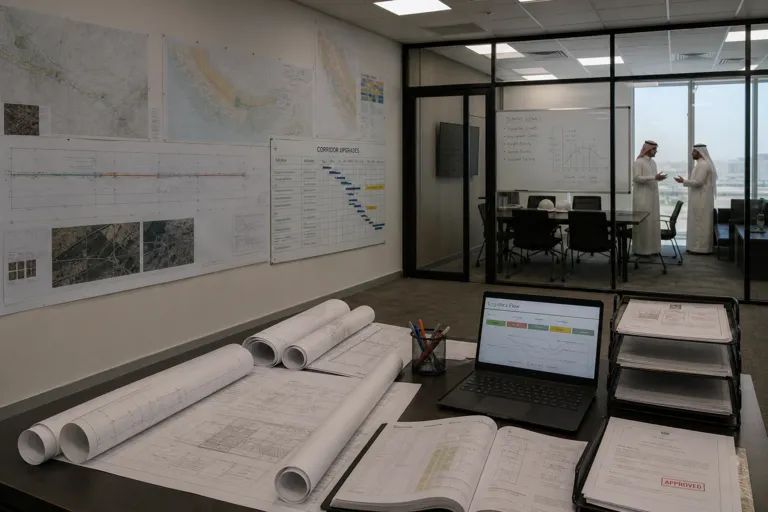
For project-level tracking, focus on corridor and connectivity programs that explicitly expand capacity or shorten lead times. Mordor Intelligence highlights “Infrastructure Upgrades and PPP Logistics Corridors” and cites examples including the 950 km Saudi Landbridge and greenfield rail spurs linking industrial parks. It also frames why these corridors matter: investments aim to ease port congestion, extend intermodal corridors, and improve hinterland connectivity, which can redirect cargo flows away from overstressed chokepoints. This is a useful template for monitoring a Saudi pipeline through 2030: list corridor projects, record their stated length or scope (such as the 950 km figure), then track milestones tied to procurement, concessions, and commissioning. Treat public-private partnership structures as another signal, because the source notes PPP structures can de-risk capital deployment and unlock operating expertise.
Demand-side pressure points are another way to validate whether a pipeline is likely to be utilized. Mordor Intelligence describes how on-demand delivery expectations are reshaping fulfillment blueprints, noting that in mature consumer markets more than one-third of shoppers now prefer same-day delivery on key purchases. Grand View Research provides a concrete U.S. datapoint that shows how e-commerce can translate into logistics infrastructure needs: it cites U.S. Census Bureau retail e-commerce sales of approximately USD 326.7 billion in Q1 2026, reinforcing demand for fulfillment centers, parcel delivery systems, and advanced warehouse operations. While these figures are not Saudi-specific, they are a clear comparison framework for what to watch in Saudi Arabia’s pipeline: micro-fulfillment, last-mile route planning, warehouse automation, and the interfaces between ports, airports, rail, and road that enable fast delivery promises.
Finally, sanity-check pipeline narratives against multiple market outlooks, because headline growth rates and totals can vary by definition. The Business Research Company estimates the freight and logistics market reached $17.96 billion in 2025 and is expected to grow to $24.46 billion in 2030 at a 6.4% CAGR, and it lists infrastructure development as a growth driver. For Insights Consultancy presents a different global framing, projecting growth from $5690 billion in 2023 to $8030.76 billion by 2030 at a 4.89% CAGR. Rather than averaging these, use them as boundary markers and then track Saudi Arabia’s pipeline with measurable checkpoints: named corridors such as the Saudi Landbridge, transport-mode emphasis (Technavio’s note that roadways led revenue share in 2024), and transport-services dominance (Grand View Research’s 29.6% in 2024 and 31.9% in 2025). This approach helps keep the 2030 tracking grounded in verifiable signals.
How should investors track Saudi Arabia’s transport pipeline through 2030 without overstating the headline number?
Which logistics segment is the biggest revenue pool to watch when tracking transport-related investment?
What global growth context is cited for the logistics market through 2030?
What consumer behavior trend can influence where logistics capacity investments go?
Why do some freight and logistics market forecasts look inconsistent across sources?
Talk to us for your needs in:
- Identifying Suitable Warehouse Sites in Saudi Arabia
- Customized Logistics and Supply Chain Analytics
- Logistics Network Design and Optimization
- Green Supply Chain and Sustainable Logistics Solutions
- Supply Chain Risk Management and Compliance
- Advanced Supply Chain Resilience and Agility
- Logistics Market Research and Strategic Analysis
- In-Depth Market Survey for Logistics
- Market Intelligence and Insights in Logistics
- Feasibility Study and Assessment in Logistics
- Integrated Warehousing Management Solutions
- Smart Warehousing and Automation Systems
- Sustainable and Green Warehousing Practices
- Port and Airport Logistics Optimization
- Digital Logistics Solutions
- Saudi Logistics Benchmarking