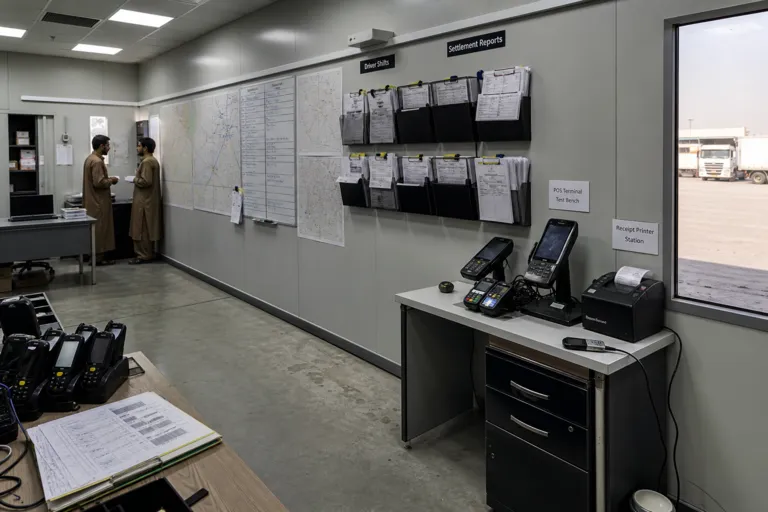
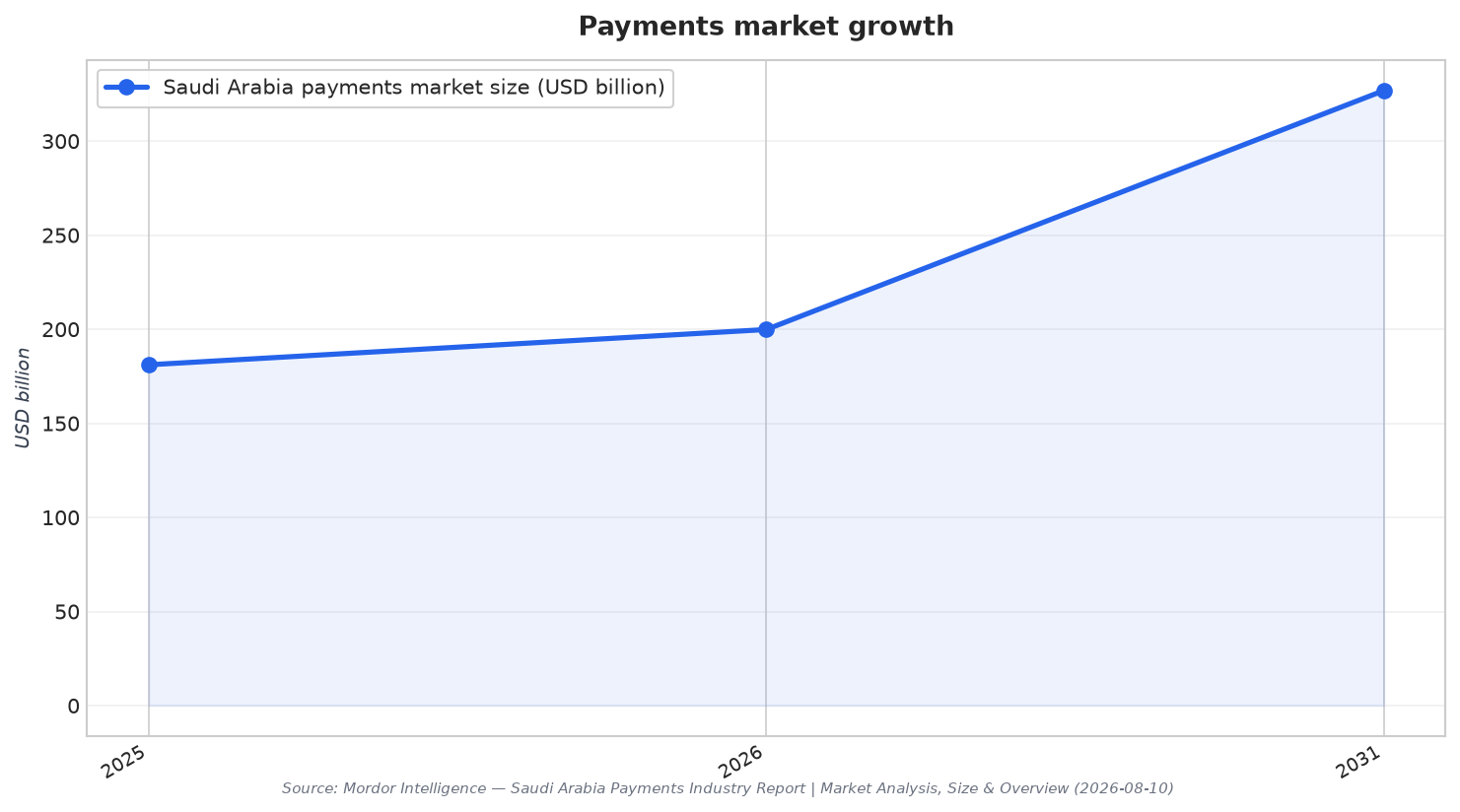
Saudi Arabia’s payment stack is shifting from card-first to rails-first. Mordor Intelligence values the Saudi Arabia payments market at USD 181.13 billion in 2025 and estimates growth from USD 199.86 billion in 2026 to USD 326.83 billion by 2031, at a 10.34% CAGR (2026-2031). In 2025, point-of-sale transactions held 66.62% share. At the same time, online payments are advancing at an 11.48% CAGR to 2031. For delivery fleets, that mix matters. Fleets live at the intersection of in-person proof-of-delivery and remote prepayment. Faster settlement and cheaper routing directly affect cash flow and reconciliation.
Instant payments are the foundation. The Saudi Central Bank’s instant-payment system is described in the sources with large throughput. One source states SARIE processed transactions worth SAR 2.5 trillion in 2024 and delivered sub-second settlement between banks. Another Mordor Intelligence mobile-payments report cites Sarie processing 10.8 billion real-time transactions in 2024, a 24% annual surge, and notes settlement fees below SAR 1. Separately, a Futurism/IMARC write-up says SARIE processed 593 million transactions in just one year and grew 50% annually since launch. These figures are reported by different sources, but all point to the same operational takeaway for fleets: instant rails make it easier to post funds quickly, shorten cash conversion cycles, and reduce dependence on slower settlement paths.
Where Google Pay and Alipay+ Plug Into Fleet Payment Workflows
SAMA confirmed a Google Pay rollout and plans to enable Alipay+ payments by 2026, according to GCC Business Watch, and Arab News similarly reports Google Pay and Alipay+ launch plans tied to market infrastructure enablement. The stated goal is to streamline the digital payment experience and support secure transactions at retail locations that support the service, including for visitors using international digital wallets connected to Alipay+. For delivery fleets, this matters because retail-like acceptance at the edge can resemble the last mile: the moment a driver needs to take a payment, confirm it, and move on. The practical win is fewer fragmented methods at the door and more standardized digital acceptance that can align with broader infrastructure upgrades.
The mobile layer is already scaling. Mordor Intelligence values the Saudi Arabia mobile payments market at USD 29.02 billion in 2026 and forecasts USD 50.8 billion by 2031, at an 11.86% CAGR (2026-2031). In this same report, proximity payments led with 57.45% share in 2025, while remote payments are on pace for a 15.05% CAGR through 2031. It also states personal users held 83.25% share in 2025, yet the business segment is growing at a 17.05% CAGR. That split mirrors fleet reality: consumer wallets drive collections, but fleet operators need business-grade reporting and controls. When wallet acceptance expands, the fleet impact depends on whether providers pair acceptance with back-office tools that make reconciliation faster and disputes easier to manage.
Gateway economics add another incentive to rewire routes away from pure card rails. Mordor Intelligence’s payment gateway report says instant-settlement networks can cut per-transaction costs by 40-60 basis points and deliver real-time settlement, boosting merchant liquidity. It also notes Visa and Mastercard lifted interchange fees by an average of eight basis points in April 2024, raising the all-in processing cost of a USD 5 purchase above 4.2% in some cases. In Saudi operations, the strategy behind Saudi digital freight payments 2026 is to blend the front-end wallet experience with back-end instant rails where possible, so fleets can pursue quicker settlement while keeping small-ticket delivery fees and add-on charges economical to collect.
What did SAMA announce about Google Pay and Alipay+ in Saudi Arabia?
Why do instant-payment rails matter for Saudi delivery fleets?
What do the sources say about Saudi Arabia’s mobile payments growth?
How can gateways and alternative rails affect small delivery payments?
What is changing in Saudi digital freight payments for 2026?
Talk to us for your needs in:
- Identifying Suitable Warehouse Sites in Saudi Arabia
- Customized Logistics and Supply Chain Analytics
- Logistics Network Design and Optimization
- Green Supply Chain and Sustainable Logistics Solutions
- Supply Chain Risk Management and Compliance
- Advanced Supply Chain Resilience and Agility
- Logistics Market Research and Strategic Analysis
- In-Depth Market Survey for Logistics
- Market Intelligence and Insights in Logistics
- Feasibility Study and Assessment in Logistics
- Integrated Warehousing Management Solutions
- Smart Warehousing and Automation Systems
- Sustainable and Green Warehousing Practices
- Port and Airport Logistics Optimization
- Digital Logistics Solutions
- Saudi Logistics Benchmarking