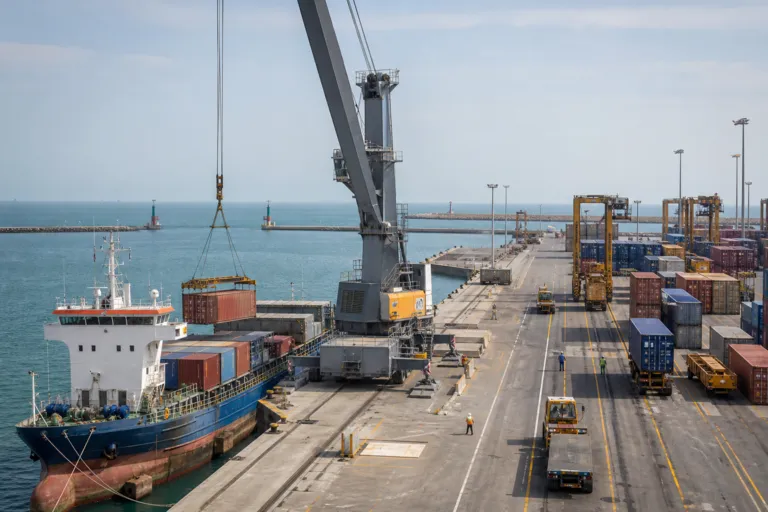
New shipping links out of Jeddah Islamic Port are reshaping how cargo can move around the Red Sea and the northern approaches to the Gulf. Multiple announcements from the Saudi Ports Authority (Mawani) describe new routes connecting Saudi ports with Oman, Djibouti, Egypt, and Jordan. The context is clear in the reporting: cargo owners and carriers are reassessing route options across the Gulf, the Red Sea, and East Africa as pressure around the Strait of Hormuz has exposed chokepoint risk. Reuters has reported the Strait of Hormuz has been effectively shut by conflict involving Iran, and that around a fifth of global daily oil and liquefied natural gas supply normally passes through the narrow waterway between Iran and Oman.
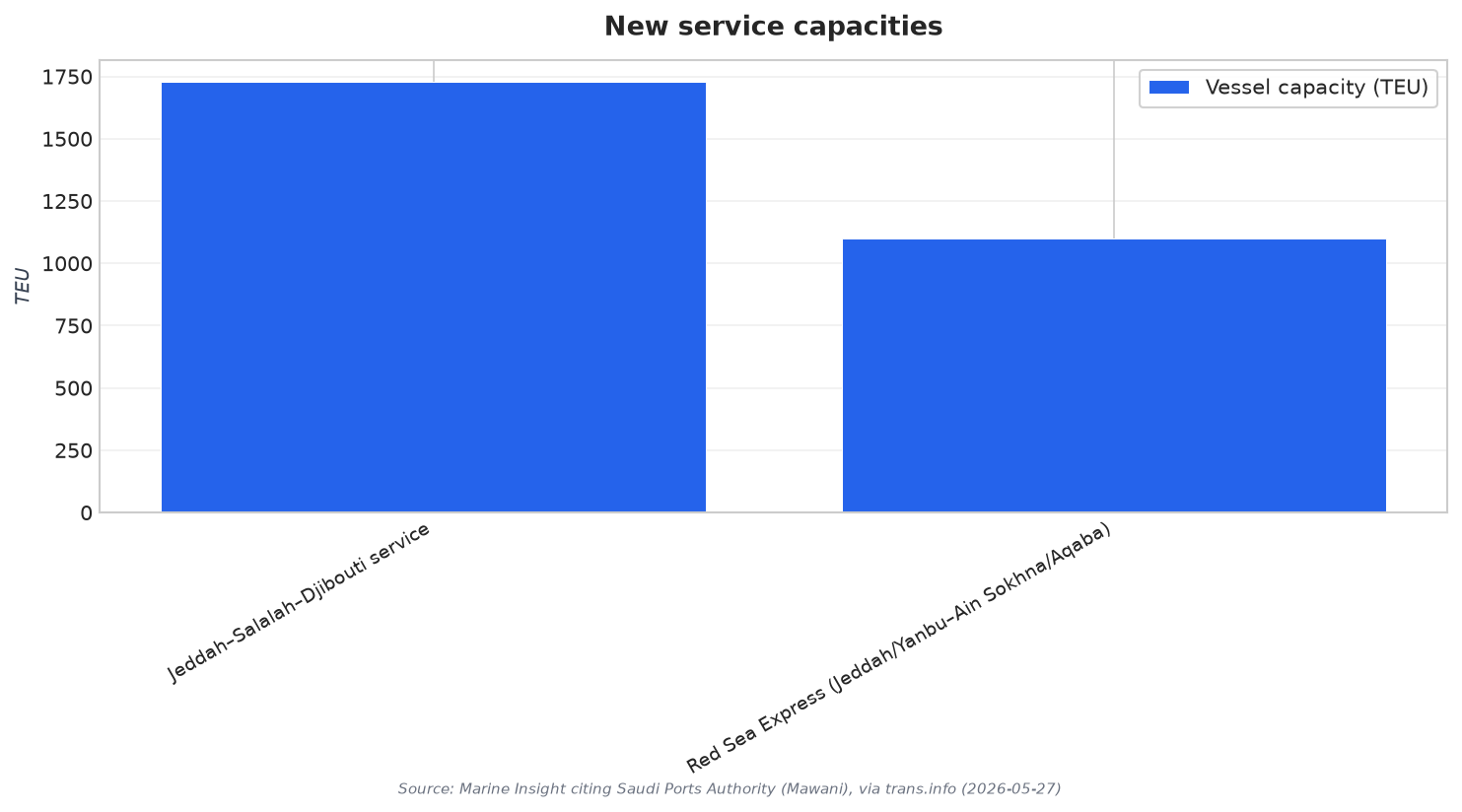
One of the newest links is a service between Jeddah Islamic Port, Salalah in Oman, and the Port of Djibouti. Marine Insight, citing Mawani, and Saudi state TV reporting also described the route and its capacity. The stated capacity is up to 1,730 TEU (also referenced as 1,730 standard containers). The same coverage frames the goal as strengthening maritime connectivity between the Kingdom and global ports, while supporting import and export activity and improving connections with regional and international ports. Several reports also note cooperation on the launch with Saudi shipping company Folk Maritime and petrochemicals company SABIC.
A Northern Red Sea Network Through Egypt and Jordan
Mawani also announced the “Red Sea Express,” a route that connects Jeddah Islamic Port and King Fahd Industrial Port in Yanbu with Ain Sokhna in Egypt and Aqaba in Jordan. The announced capacity for this service is up to 1,100 TEU (also described as 1,100 standard containers). Gulf News reports the route is expected to support Saudi Arabia’s non-oil exports and expand trade opportunities for locally produced goods, including agricultural products. Mawani said the route would help strengthen the competitiveness of Saudi exports by lowering shipping costs and shortening delivery times, while reducing cargo waiting times and increasing supply-chain efficiency.
Additional Red Sea connectivity into Egypt is also highlighted through an intra-Red Sea feeder service operated by PIL at Jeddah Islamic Port. IndexBox reports the service is set to bolster links to Egypt’s Sokhna and Safaga terminals, with a carrying capacity reaching 1,261 TEU. Mawani tied the move to its agenda to elevate Saudi Arabia’s performance in international benchmarks, boost domestic exports, and advance the National Transport and Logistics Strategy, described as aiming to position the Kingdom as a worldwide logistics nexus spanning three continents. Together, these steps add more options for Saudi Red Sea container services without claiming to replace the Gulf’s main maritime corridors.
Jeddah’s expanding service map also includes longer-reaching calls beyond the immediate Red Sea neighborhood. Arab News reports that Ocean Network Express added an RC2 shipping service linking Jeddah with Shanghai, Ningbo, and Nansha in China, alongside Aqaba in Jordan and Sokhna in Egypt, with capacity of up to 1,643 TEU. Mawani also describes Jeddah Islamic Port’s physical scale and handling footprint: it covers 12.5 sq. km and has 62 berths and three terminals. In parallel, Arab News reports definitive agreements between Red Sea Gateway Terminal and CMA CGM to jointly develop and operate Terminal 4 at Jeddah Islamic Port, reinforcing the port’s role as a key Red Sea gateway.
What is the capacity of the new Jeddah–Salalah–Djibouti service?
Which ports does the Red Sea Express connect, and what capacity was announced?
How do these Saudi Red Sea container services relate to concerns around the Strait of Hormuz?
What other Jeddah service links China, Egypt, and Jordan, and what is its stated capacity?
What size and basic facilities are reported for Jeddah Islamic Port?
Talk to us for your needs in:
- Identifying Suitable Warehouse Sites in Saudi Arabia
- Customized Logistics and Supply Chain Analytics
- Logistics Network Design and Optimization
- Green Supply Chain and Sustainable Logistics Solutions
- Supply Chain Risk Management and Compliance
- Advanced Supply Chain Resilience and Agility
- Logistics Market Research and Strategic Analysis
- In-Depth Market Survey for Logistics
- Market Intelligence and Insights in Logistics
- Feasibility Study and Assessment in Logistics
- Integrated Warehousing Management Solutions
- Smart Warehousing and Automation Systems
- Sustainable and Green Warehousing Practices
- Port and Airport Logistics Optimization
- Digital Logistics Solutions
- Saudi Logistics Benchmarking