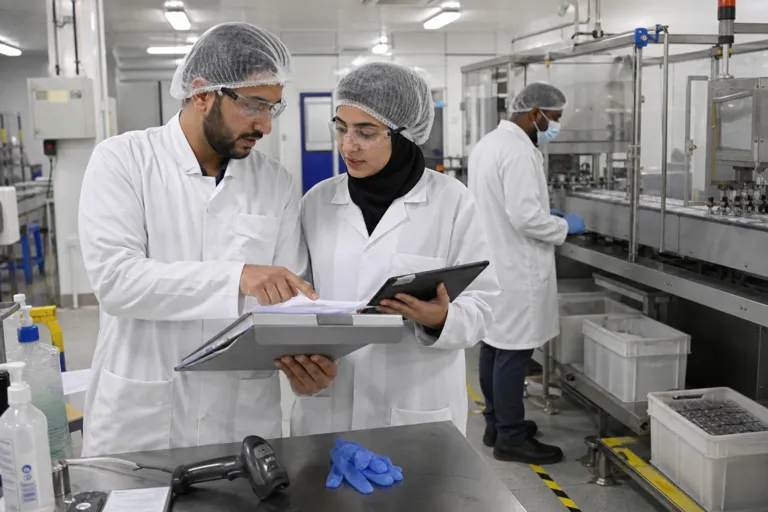
Saudi pharma momentum is getting harder to ignore. Saudi-listed pharmaceutical companies recorded a 36.8% increase in net profits, according to a November 2025 report. A separate April 2026 report said Saudi listed pharmaceutical manufacturers posted a 30% surge in net profit in 2025. Those are not small moves. They signal a sector that is scaling operations and defending margins at the same time. In that context, the next battleground becomes less about ambition and more about how consistently manufacturers can execute to recognized quality expectations.
Growth expectations add more pressure to get the basics right. One January 2026 industry analysis said the Saudi pharmaceutical market as a whole was expected to be USD $12.4 billion in 2025, and projected to reach USD $18.1 billion by 2030, described as nearly 8% CAGR. In the same analysis, Saudi CDMOs were positioned around production capacity, regulatory alignment, and location advantage. The message is clear. As volumes expand and partnerships become more global, compliance discipline becomes a competitive tool, not just a box to tick.
Why GDP-Level Competitiveness Makes GMP the New Frontier
The wider economy is also shifting toward competitiveness. PwC’s Economy Watch, cited in February 2026, said non-oil sectors account for around 56% of Saudi Arabia’s SAR 4.7 trillion economy. The same source argued the next phase should focus less on scale and more on competitiveness, productivity, and export capability. That framing matters for the Saudi pharma market 2026 GMP conversation. If competitiveness is the national lens, pharma manufacturers will feel it through procurement standards, partner audits, and expectations for repeatable, documented performance across production and quality systems.
That same competitiveness logic is reinforced by how sensitive non-oil growth can be to broader conditions. PwC’s economists cited a 20:1 ratio, meaning a 10% change in oil prices is associated with a 0.5% change in non-oil GDP. PwC also suggested a sustained 10% decline in oil prices could reduce cumulative non-oil GDP by around SAR 430 billion over three years, relative to projected growth, in 2024 constant prices. When the macro environment can tighten, manufacturers that rely on operational discipline and compliance readiness tend to be better positioned to protect continuity.
For Saudi CDMOs, the quality discussion is directly linked to deal flow. The January 2026 analysis explicitly tied competitive positioning to “regulatory alignment” alongside capacity and location. It also referenced the API CDMO market earning over USD $2.8 billion in 2024 and expected to surpass USD $4.5 billion by 2033, showing how quality-driven outsourcing markets keep expanding. Saudi players aiming to capture that demand will be judged on whether their systems can stand up to scrutiny. In practice, that pushes manufacturers toward a stronger compliance posture, because growth without consistent execution is fragile.
What does "Saudi pharma market 2026 GMP" mean in this context?
What profit signals support the case for stronger compliance execution?
What market-size projections are cited for Saudi pharma?
How does the broader economy connect to pharma competitiveness?
What macro sensitivity metric is mentioned that could affect non-oil growth planning?
Talk to us for your needs in:
- Identifying Suitable Warehouse Sites in Saudi Arabia
- Customized Logistics and Supply Chain Analytics
- Logistics Network Design and Optimization
- Green Supply Chain and Sustainable Logistics Solutions
- Supply Chain Risk Management and Compliance
- Advanced Supply Chain Resilience and Agility
- Logistics Market Research and Strategic Analysis
- In-Depth Market Survey for Logistics
- Market Intelligence and Insights in Logistics
- Feasibility Study and Assessment in Logistics
- Integrated Warehousing Management Solutions
- Smart Warehousing and Automation Systems
- Sustainable and Green Warehousing Practices
- Port and Airport Logistics Optimization
- Digital Logistics Solutions
- Saudi Logistics Benchmarking