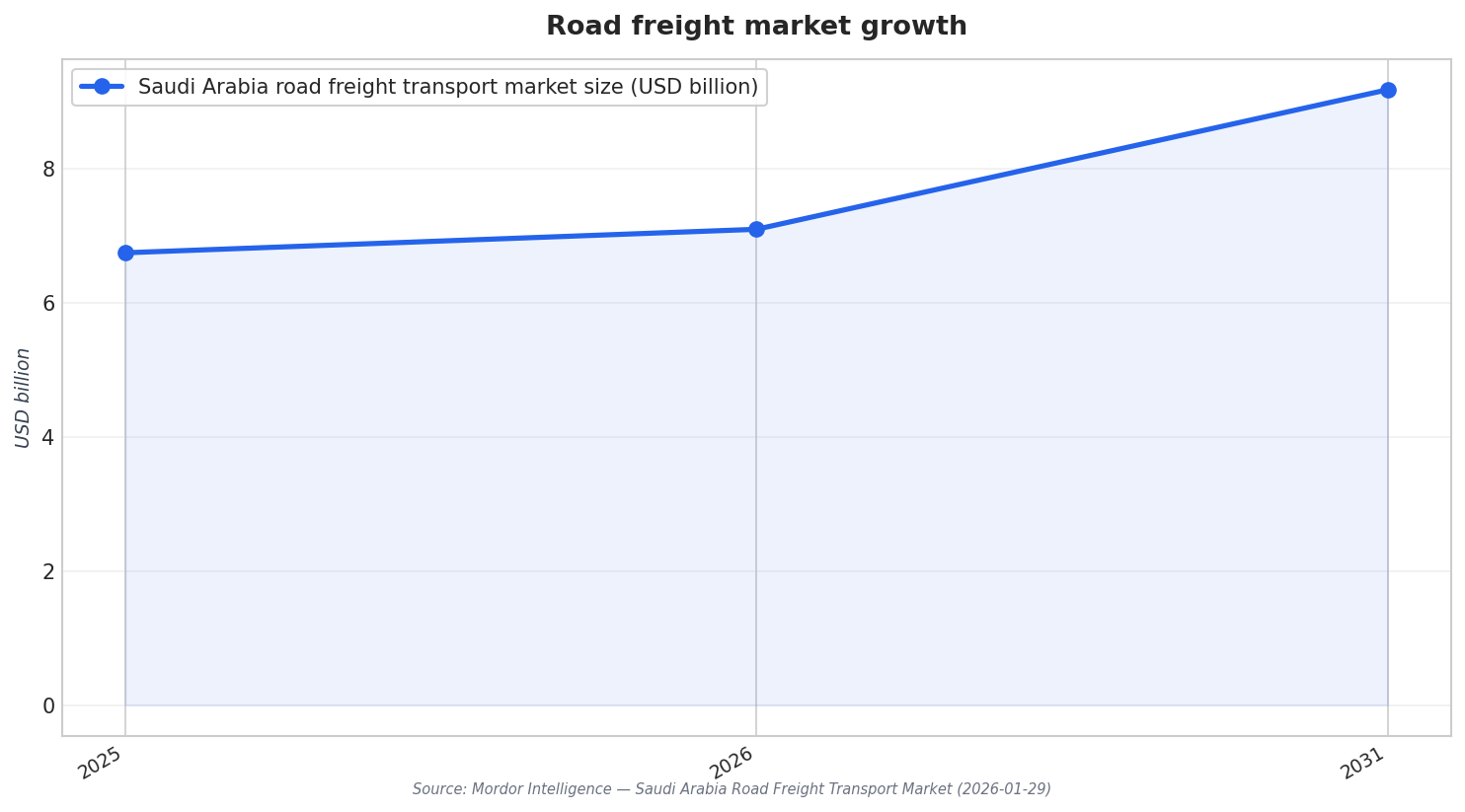
Saudi Arabia’s push to strengthen food security is unfolding alongside a transport sector that is modernizing fast. Mordor Intelligence expects the Saudi Arabia road freight transport market to grow from USD 6.74 billion in 2025 to USD 7.09 billion in 2026, and to reach USD 9.17 billion by 2031, forecasting a 5.27% CAGR over 2026–2031. Within that expansion, temperature-controlled freight is still a small slice of value at 5.72% in 2025, but it is also the fastest-growing segment at a 5.92% CAGR from 2026–2031, tied to pharmaceuticals and fresh food logistics. This matters because domestic movements already represent 61.25% of 2025 market size, meaning reliable in-country refrigerated distribution is essential after imports clear ports and after local produce is harvested.
Food demand growth makes cold-chain readiness more than an efficiency project. Mordor Intelligence values the Saudi Arabia food and beverages market at USD 36.35 billion in 2025, estimating growth from USD 38.38 billion in 2026 to USD 50.38 billion by 2031 at a 5.59% CAGR (2026–2031). The same source says Vision 2030 policies aim to reduce reliance on imports and enhance food security by strengthening local production, supported by a government investment of USD 70 billion being funneled into processing plants. It also notes a population expected to hit 40 million by 2030. Together, these factors increase the need for stable, high-integrity refrigerated transport from factories and ports to supermarkets, wholesalers, and last-mile nodes, especially as online retail stores are projected to expand at a 7.82% CAGR through 2031.
What Reefer Fleet Expansion Means for Import-Led Food Flows
On the import side, global reefer container capacity is growing, which can influence availability and service patterns into reefer-friendly terminals. MarketReportsWorld reports that the global refrigerated container fleet reached 3.87 million TEU in 2024 and is projected to exceed 4.1 million TEU by 2027. It also notes reefer container manufacturing rebounded in H1 2024 with 121,000 TEU produced, a 7% year-on-year increase, after production moved from 282,000 TEU in 2022 to 224,000 TEU in 2023. DataIntelo adds that fleet expansion announcements in 2025 include Maersk’s commitment to add 150,000 new reefer TEUs by 2027. For Saudi Arabia, this global buildout is relevant context as the same MarketReportsWorld source states Saudi Arabia has invested heavily in integrating reefer-friendly port terminals and customs clearance systems, supporting smoother handoffs from ocean reefer to domestic distribution.
Inside the Kingdom, fresh supply is expanding, but it still requires disciplined cold-chain execution to reduce spoilage and stabilize availability across the main consumption hubs. Nexdigm reports greenhouse vegetable production reached 797 thousand tons, with tomatoes at 329 thousand tons and cucumbers above 232 thousand tons. It also reports open-field vegetable production reached 2.745 million tons from 89,700 hectares, with potatoes at 624 thousand tons and watermelons at about 612 thousand tons. Nexdigm highlights that Riyadh, Jeddah, Makkah, Madinah, Dammam, and Al Ahsa dominate the market due to population density, wholesale flows, port access, pilgrim catering, retail chains, and local production clusters. This geography aligns with Mordor Intelligence’s note that congestion on the Riyadh–Dammam–Jeddah triangle elevates operating costs, reinforcing why planning, routing, and fleet utilization matter for Saudi reefer trucking and food security outcomes.
The operational picture links rising demand, a growing food market, and a transport sector balancing constraints and modernization. Mordor Intelligence says wholesale and retail trade held 40.12% of the Saudi Arabia road freight transport market share in 2025, while full-truck-load held 78.42% share in 2025. It also points to policy incentives that modernize fleets while cutting empty miles, alongside challenges such as Saudization wage floors, driver shortages, and congestion. These frictions can be especially costly for chilled and frozen loads that depend on time and temperature control. As cold-chain networks expand for pharmaceuticals and food security, coordinated investments across trucks, terminals, and digital freight matching become a practical lever for resilience, whether goods originate from local farms and processing plants or arrive in refrigerated containers through upgraded port systems.
How does reefer trucking support food security in Saudi Arabia?
What are the key growth figures for Saudi Arabia’s road freight market?
What does Vision 2030-linked investment mean for refrigerated logistics needs?
How is global reefer container capacity changing, and why does it matter?
Which Saudi cities and production figures highlight the need for strong cold-chain links?
Talk to us for your needs in:
- Identifying Suitable Warehouse Sites in Saudi Arabia
- Customized Logistics and Supply Chain Analytics
- Logistics Network Design and Optimization
- Green Supply Chain and Sustainable Logistics Solutions
- Supply Chain Risk Management and Compliance
- Advanced Supply Chain Resilience and Agility
- Logistics Market Research and Strategic Analysis
- In-Depth Market Survey for Logistics
- Market Intelligence and Insights in Logistics
- Feasibility Study and Assessment in Logistics
- Integrated Warehousing Management Solutions
- Smart Warehousing and Automation Systems
- Sustainable and Green Warehousing Practices
- Port and Airport Logistics Optimization
- Digital Logistics Solutions
- Saudi Logistics Benchmarking