
In late 2025, the industry started talking seriously about a Red Sea container shipping return. Xeneta noted carriers were “testing the water” with select Suez Canal voyages, often on backhaul legs to Asia when there was less cargo onboard. CMA CGM took the most visible step, announcing its INDAMEX service would transit Suez on both fronthaul and backhaul between India/Pakistan and the U.S. East Coast. Maersk also confirmed a first test transit through the Red Sea and Bab el-Mandeb Strait in December 2025, while stressing no additional sailings were planned at that time.
These moves were not a clean “all clear.” Multiple sources warned that a wider return would be gradual and conditional. CMA CGM management previously described delays when relying on escorts from EUNAVFOR’s Operation Aspides, even though escorts helped it maintain some services. Peter Sand at Xeneta said carriers would run risk assessments focused on the Houthis’ ability, opportunity, and intent to attack ships. The backdrop stayed severe: during the Gaza conflict, Iran-backed Houthis sank four ships and killed at least eight seafarers using ballistic missiles, drones, and unmanned-boat strikes over two years.
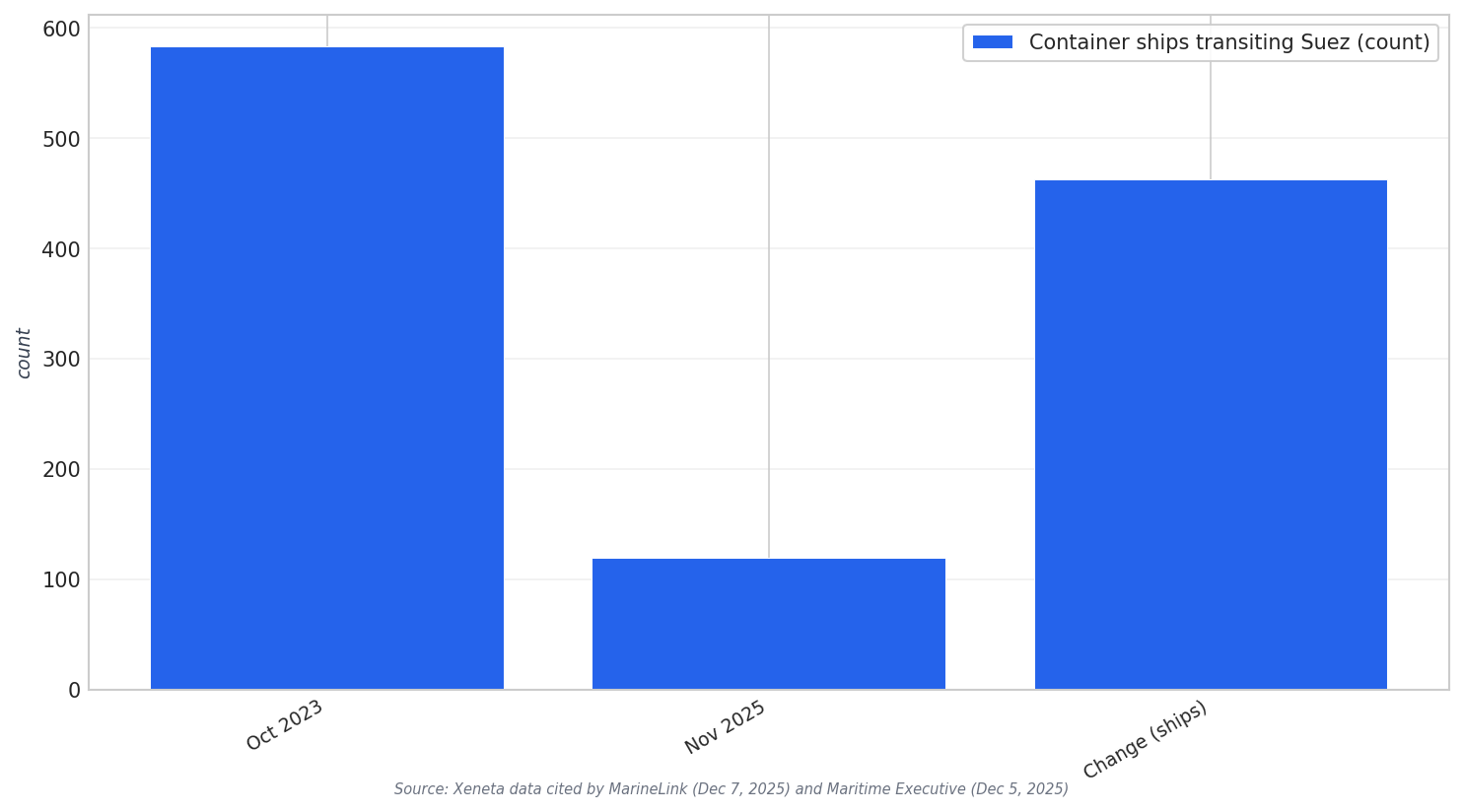
Operationally, the attraction of Suez is obvious when it works. CMA CGM’s INDAMEX loop via Suez was expected to reduce full loop transit time by two weeks, down to 77 days versus the Cape of Good Hope alternative, using eeSea data cited by Xeneta. But the market signal still said “limited.” Xeneta data showed 120 container ships transited Suez in November 2025, compared with 583 in October 2023, the last month before attacks began. That gap mattered for Saudi planners, because capacity, schedules, and reliability depend on what the majority of the fleet actually does.
2026 Lessons for Saudi Shippers: Plan for Reversals, Not Just Faster Schedules
For Saudi shippers, the most practical lesson is that “return” can mean a handful of trial sailings, not a stable corridor. In January 2026, Reuters reporting via MarineLink said Maersk would resume sailings via the Red Sea and Suez for one service starting January 26, departing Oman's port of Salalah, as part of a staggered return. Yet Sand later warned that if Houthi militia resume attacks, carriers will reverse decisions to return and “shelve” any phased 2026 return until security becomes clearer. That means contracts and inventory plans should assume sudden diversions around Africa can reappear with little notice.
Insurance and regional escalation risks add another layer Saudi shippers must watch. Sand highlighted that carriers also had to deal with the closure of the Strait of Hormuz and the declaration of a designated high risk area for much of the Gulf of Oman. Iran threatened to attack Western shipping interests in the Strait and had already struck at least half a dozen tankers. In response, leading P&I clubs and reinsurers were pulling war risk cover for the entire region, effectively putting the Arabian Gulf off-limits for insurance purposes. This is why shippers should demand clear routing contingencies and insurance assumptions from logistics partners.
What does “Red Sea container shipping return” mean in 2026?
How much faster was CMA CGM’s INDAMEX loop expected to be via Suez?
How did Suez Canal container transits compare before and after the disruptions?
Why could carriers reverse a return to the Red Sea in 2026?
What risk beyond the Red Sea should Saudi shippers monitor?
Talk to us for your needs in:
- Identifying Suitable Warehouse Sites in Saudi Arabia
- Customized Logistics and Supply Chain Analytics
- Logistics Network Design and Optimization
- Green Supply Chain and Sustainable Logistics Solutions
- Supply Chain Risk Management and Compliance
- Advanced Supply Chain Resilience and Agility
- Logistics Market Research and Strategic Analysis
- In-Depth Market Survey for Logistics
- Market Intelligence and Insights in Logistics
- Feasibility Study and Assessment in Logistics
- Integrated Warehousing Management Solutions
- Smart Warehousing and Automation Systems
- Sustainable and Green Warehousing Practices
- Port and Airport Logistics Optimization
- Digital Logistics Solutions
- Saudi Logistics Benchmarking