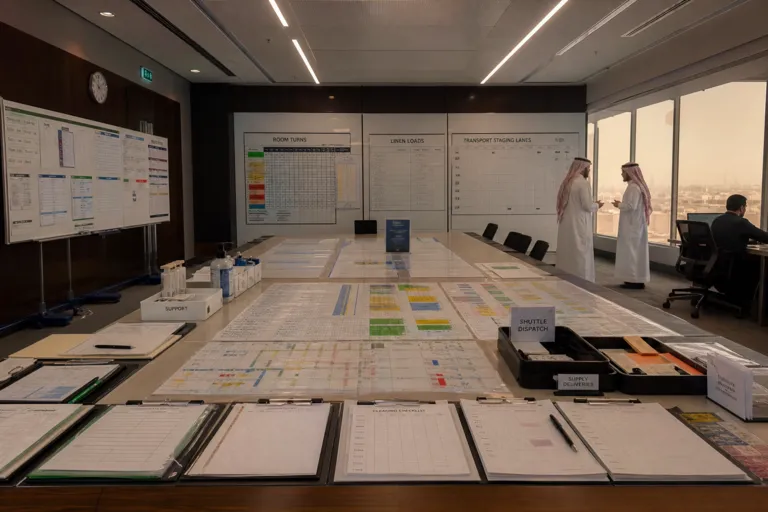
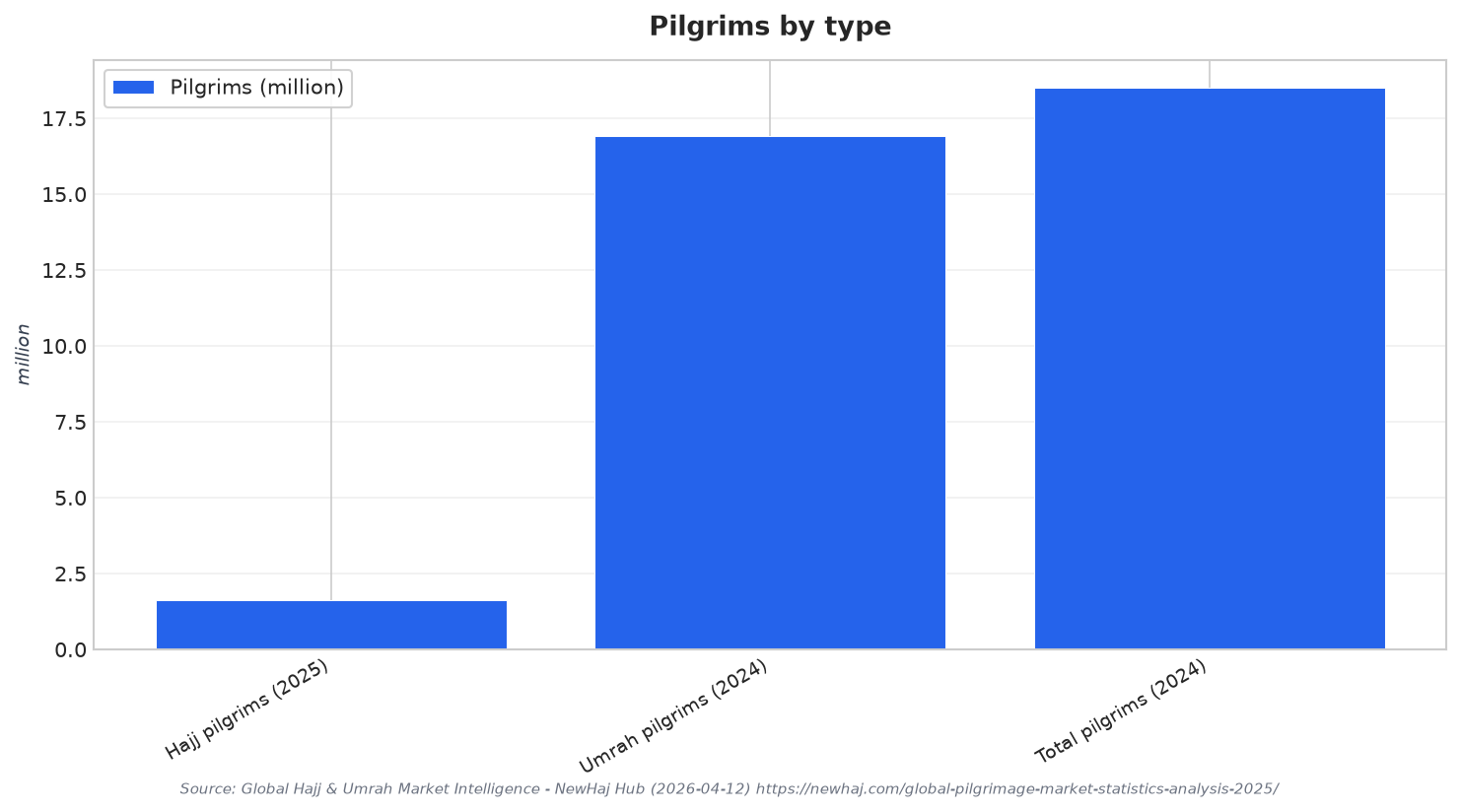
Makkah’s operating reality is extreme seasonality. Saudi religious tourism KPIs show 18.5 million pilgrims in 2024, including 16.92 million Umrah arrivals and roughly 1.61 million Hajj pilgrims. That split matters for planning. Umrah behaves like mass, year-round tourism, while Hajj remains quota-limited and time-bound, with demand exceeding physical capacity at holy sites. The logistics challenge is not only volume. It is timing, density, and the need to coordinate accommodation, transport, retail supply, and ritual movement under tight constraints.
International arrivals amplify the planning load. Over 87% of Hajj pilgrims come from abroad, and 171 countries participated in Hajj 2025, according to NewHaj Hub reporting. That mix changes service needs across languages, payment behaviors, and travel patterns. It also heightens reliance on digital coordination. Nusuk is described as unifying visa issuance, accommodation booking, and ritual planning, with 30 million users from 190 countries. For Makkah operators, this is not just a distribution channel. It is a demand signal that can be monitored, translated into staffing plans, and connected to inventory and dispatch workflows.
Operational Levers That Keep Peak Weeks Stable
Start with capacity realism and then build buffers. Qoyod Reports states that Makkah’s licensed hotel capacity has surpassed 268,000 rooms, a scale that still must absorb sharp peaks. Hospitality market data adds context: the Makkah–Jeddah corridor held 26.62% of Saudi Arabia’s hospitality market size in 2025, and OTAs accounted for 41.65% of transactions that year, while direct digital channels are projected to grow at a 14.78% CAGR through 2031. For surge readiness, that points to two levers: protect room allocation discipline across channels, and strengthen direct digital control so operators can adjust terms and availability faster when the city tightens.
Next, treat finance systems as part of logistics. Qoyod frames seasonal readiness around ZATCA-compliant e-invoicing that issues in seconds, real-time inventory that anticipates Ramadan and Hajj peaks, and cash-flow reports that guide seasonal hiring and expansion decisions. When transaction volumes multiply, slow billing and unclear stock positions become operational failures, not back-office issues. This is where the keyword topic—Makkah Hajj demand surge logistics—becomes practical: inventory, invoicing, and cash timing shape how quickly suppliers can replenish, how accurately hotels can forecast consumption, and how reliably SMEs can scale without running out of working capital mid-peak.
Finally, align safety and movement tech with service delivery. Vision2030.ai notes real-time crowd-density sensors at the Mataf, Jamarat, and Mina pedestrian routes, with anonymous mobile-signal heat-mapping to redirect flows during peaks. It also cites 24/7 multilingual Ministry of Health emergency dispatch tied to Nusuk app GPS and drone medical delivery to remote Hajj stations during the 2025 season as a first. NewHaj Hub also flags a “50°C+” peak temperature during Hajj 2024 as a safety crisis. Logistics plans should therefore integrate heat and crowd signals into staffing, shuttle timing, and guest communications so operations remain predictable even when conditions are not.
What recent figures show how big the Hajj and Umrah load is for Makkah operations?
Why does international mix complicate peak-season planning?
What capacity benchmark can hotels use when planning surge weeks in Makkah?
How can digital platforms reduce pressure in Makkah’s Hajj demand surge logistics?
Talk to us for your needs in:
- Identifying Suitable Warehouse Sites in Saudi Arabia
- Customized Logistics and Supply Chain Analytics
- Logistics Network Design and Optimization
- Green Supply Chain and Sustainable Logistics Solutions
- Supply Chain Risk Management and Compliance
- Advanced Supply Chain Resilience and Agility
- Logistics Market Research and Strategic Analysis
- In-Depth Market Survey for Logistics
- Market Intelligence and Insights in Logistics
- Feasibility Study and Assessment in Logistics
- Integrated Warehousing Management Solutions
- Smart Warehousing and Automation Systems
- Sustainable and Green Warehousing Practices
- Port and Airport Logistics Optimization
- Digital Logistics Solutions
- Saudi Logistics Benchmarking