Saudi Arabia’s delivery market is shifting from pure restaurant aggregation to faster, broader “basket” missions. In 2026, the Saudi food delivery market reached SAR 26.5 billion in gross booking value, supported by 65,000+ restaurant locations and 110,000+ monthly active riders. At the same time, the broader delivery apps market was valued at USD 9.59 billion in 2026, with forecasts pointing to USD 19.45 billion by 2031 at a 15.18% CAGR. Those top-line dynamics are pushing operators to compete on speed and convenience, and dark stores are becoming a central lever for groceries and essentials, not just an add-on.
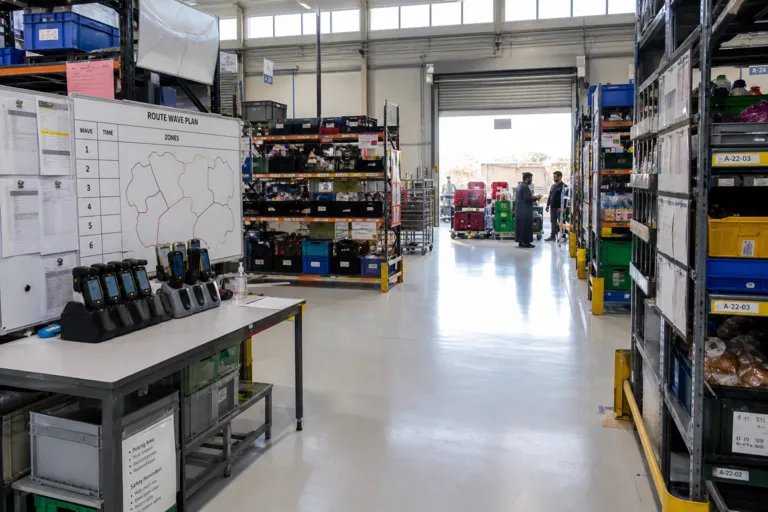
Jahez is repeatedly positioned as a leader in Saudi Arabia’s online delivery transactions, and sources note it is extending its footprint beyond food into fast-moving consumer categories. That expansion favors fulfillment models with tight inventory control and faster pick-pack-dispatch cycles. Dark stores and integrated supermarket back-rooms address the economics of delivering low-value baskets by enabling optimized picking and routing, which can matter more than app marketing in a crowded field. Operators are also using technology to defend margins. Jahez has tested machine-learning route optimization that trimmed average drop-off time by 11%, a practical advantage when customers expect rapid, reliable delivery.
Why Dark Stores Are Becoming the Battleground
Grocery-first platforms have leaned hard into dark-store operations and curated assortments, and industry events are reflecting that focus. Seamless Saudi 2025 included a session titled “Illuminating Dark Stores: The Secret to Fast E-Commerce Delivery,” featuring the Head of Dark Store Operations at Nana, signaling the sector’s investment and operational attention. Competition is not only local. In June 2025, Egypt-based Rabbit established operations in Riyadh and built a dark store network that already covers 50% of the city since launching in early 2024, with a stated target of 20 million item deliveries by 2026 and expansion into multiple Saudi cities by 2027. Riyadh also remains a concentration point for dark stores, according to market coverage.
Scale alone does not guarantee profitability, so companies are rethinking growth tactics as costs rise. Discount intensity hit 36% of gross booking value in 2025, up from 20%, absorbing SAR 3.2 billion in platform profits. Sources describe a shift away from free delivery toward subscription-based loyalty programs as platforms seek steadier revenue to underwrite fulfillment investments, including temperature-controlled fleets in some cases. Regulation is tightening, too. In 2025, rules such as the Balady home delivery permit, GAC competition guidelines, and new motorcycle standards raised the bar for operators and filtered out informal players. Those pressures make disciplined, standardized dark-store fulfillment more attractive.
Quick commerce investment is also being framed as part of a broader modernization push. MarkNtel estimates Saudi Arabia’s quick commerce market at around USD 293 million in 2025, projecting USD 1029 million by 2032 and a CAGR of around 19.66% for 2026–32, with on-demand models targeting 30–60 minute service windows. Jahez is also testing newer operating concepts. In July 2025, Jahez and ROSHN Group launched what is described as Saudi Arabia’s first commercial autonomous food delivery service at the ROSHN Front Business District in Riyadh, using five self-driving robots equipped with more than 20 sensors and six cameras. As operators scale, partnerships such as Jahez-Noon are highlighted as a way to plug portfolio and network gaps, reinforcing the idea that speed, selection, and infrastructure are converging into a single race.
How are dark stores shaping Saudi Arabia’s quick commerce competition?
What delivery efficiency improvement has Jahez reported from AI routing?
What key market figures show the scale of delivery demand in Saudi Arabia?
How did discounts affect platform economics in 2025?
Which external quick commerce player expanded a dark-store network in Riyadh?
Talk to us for your needs in:
- Identifying Suitable Warehouse Sites in Saudi Arabia
- Customized Logistics and Supply Chain Analytics
- Logistics Network Design and Optimization
- Green Supply Chain and Sustainable Logistics Solutions
- Supply Chain Risk Management and Compliance
- Advanced Supply Chain Resilience and Agility
- Logistics Market Research and Strategic Analysis
- In-Depth Market Survey for Logistics
- Market Intelligence and Insights in Logistics
- Feasibility Study and Assessment in Logistics
- Integrated Warehousing Management Solutions
- Smart Warehousing and Automation Systems
- Sustainable and Green Warehousing Practices
- Port and Airport Logistics Optimization
- Digital Logistics Solutions
- Saudi Logistics Benchmarking