Saudi Arabia is described as the largest healthcare market in the GCC, and government bodies are presented as the dominant buyer of medical devices and supplies. One source values the Kingdom’s pharmaceutical and medical device market at approximately SAR 30 billion for pharmaceuticals alone, and says government purchasing represents 54% of total market spend. Against that backdrop, NUPCO (the National Unified Procurement Company) is positioned as the centralized procurement, warehousing, and distribution engine for public healthcare. It was established by Royal Decree in 2009 and is wholly owned by the Public Investment Fund (PIF), which helps explain why decisions made inside the centralized model can cascade quickly across providers and contractors.
NUPCO’s centralized procurement scale is described in financial and operational terms that matter directly to logistics partners. One guide states NUPCO’s annual procurement exceeds SAR 25 billion (about $6.7 billion), and that the government tender market alone is valued at SAR 21 billion (about $5.6 billion). The same source says NUPCO serves over 500 public hospitals and health centers and integrates with nearly 5,000 private pharmacies through Wasfaty. Another source describes NUPCO’s workforce as 500–1,000 employees and notes it serves over 80 healthcare entities. For 3PLs, that concentration of demand means fewer buyer nodes, but higher expectations for service consistency and data readiness across a large national footprint.
How Centralized Tenders Change the 3PL Playbook
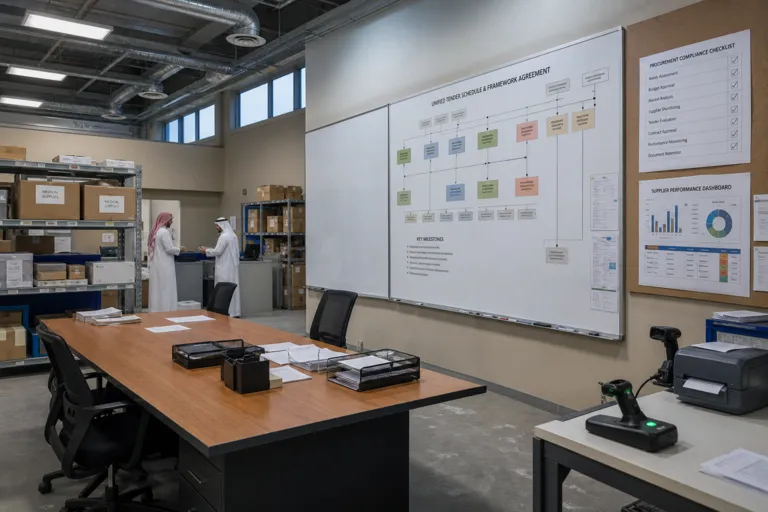
Centralized procurement also changes how contracts are built and evaluated. A market access source states NUPCO remains the exclusive centralized purchaser for public-sector pharmaceuticals and devices, with procurement increasingly built around unified tenders, framework agreements, and strategic purchasing to drive savings and standardization. It also notes that in 2024 NUPCO piloted value-based purchasing tenders for medical devices—described as the first of their kind in the region—signaling movement away from price-only selection toward outcome-linked contracts. For healthcare 3PLs, that shift can elevate the importance of measurable delivery performance, inventory management discipline, and documentation that supports quality and continuity.
Localization pressure is another operational reality that can reshape lanes and warehouse strategies. A procurement guide states that in 2026 NUPCO began actively rejecting foreign bids when a local alternative exists, citing alignment with the Local Content and Government Procurement Authority (LCGPA) and the “Made in Saudi” program. This policy focus can alter product flows, packaging and labeling coordination, and supplier onboarding timelines, especially for imported device portfolios. For 3PLs supporting manufacturers, it also increases the value of flexible capacity planning, clear country-of-origin data handling, and execution models that can support local manufacturing partnerships where required.
Digital integration is repeatedly framed as part of NUPCO’s operating model, not an add-on. NUPCO’s own communications describe an integrated digital ecosystem, and reference cooperation themes such as unified procurement, health supply chain management, digital transformation, and data exchange. The same channel notes an MoU with the Ministry of Health of Uzbekistan aimed at collaboration in areas including inventory management, digital transformation, capacity building, localization, and investment—signaling the topics NUPCO prioritizes when it exports its procurement and supply chain playbook. In practice, a “NUPCO medical supply chain” project for a 3PL becomes as much about systems, data, and process standardization as it is about trucks and storage.
What is NUPCO’s role in Saudi Arabia’s public healthcare procurement?
How large is NUPCO’s procurement activity according to the sources?
What does NUPCO’s Wasfaty integration imply for distribution networks?
How does localization policy affect foreign suppliers and their logistics partners?
What should 3PLs focus on when supporting a NUPCO medical supply chain program?
Talk to us for your needs in:
- Identifying Suitable Warehouse Sites in Saudi Arabia
- Customized Logistics and Supply Chain Analytics
- Logistics Network Design and Optimization
- Green Supply Chain and Sustainable Logistics Solutions
- Supply Chain Risk Management and Compliance
- Advanced Supply Chain Resilience and Agility
- Logistics Market Research and Strategic Analysis
- In-Depth Market Survey for Logistics
- Market Intelligence and Insights in Logistics
- Feasibility Study and Assessment in Logistics
- Integrated Warehousing Management Solutions
- Smart Warehousing and Automation Systems
- Sustainable and Green Warehousing Practices
- Port and Airport Logistics Optimization
- Digital Logistics Solutions
- Saudi Logistics Benchmarking