Saudi Arabia’s third-quarter delivery picture has a simple headline: more than 54 million shipments and parcels were delivered during Q3 2026, according to the Transport General Authority (TGA) quarterly statistical bulletin. For teams planning around Saudi courier parcel volumes Q3 2026, that single number is not only a market snapshot. It is a planning input. It can shape decisions on sort-center throughput, line-haul schedules, and last-mile staffing. The same TGA bulletin also surfaces service-resolution risk through its index of complaints that were escalated to the authority after carriers failed to resolve them within the set timeframe.
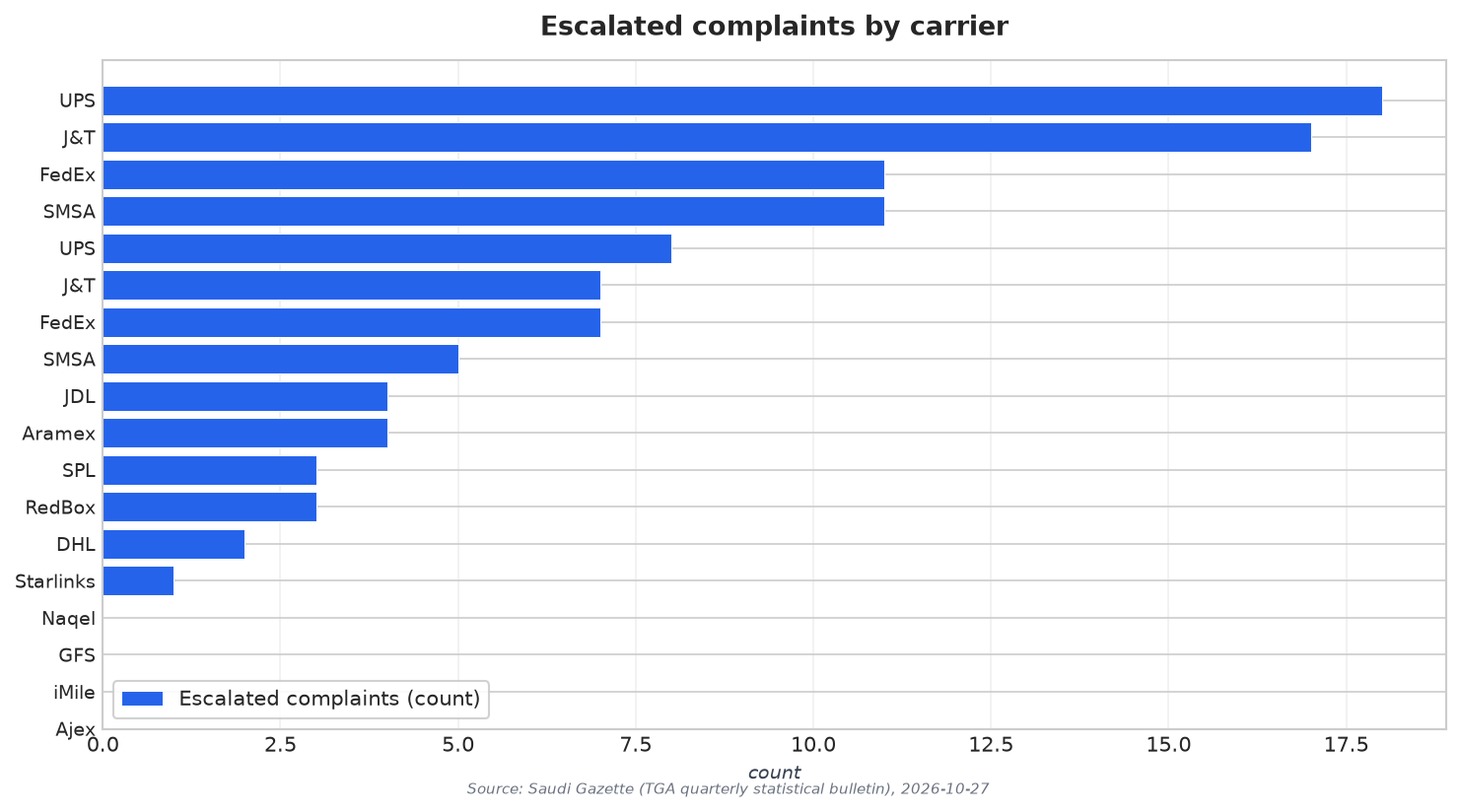
The escalated-complaint index offers a carrier-by-carrier view that is useful for capacity and quality governance. Ajex recorded one escalated complaint, followed by iMile with two. GFS and Naqel recorded three each. Starlinks and DHL recorded four each, and RedBox recorded five. Aramex and SPL recorded seven each, JDL eight, SMSA and FedEx 11 each, J&T 17, and UPS 18. Operationally, escalations matter because they represent cases not resolved inside the normal customer-service window. That is often where network strain shows up first, such as delayed scanning, missed delivery attempts, or backlog in exception handling.
Connecting Parcel Demand to Line-Haul and Intermodal Capacity
Network planning improves when parcel demand is read alongside freight-mobility indicators. In Q3 2026, Saudi Arabia’s railways transported 3.9 million tons of freight and 46,300 containers, also reported through TGA-linked quarterly reporting. Even though this is not parcel-only data, it is a relevant capacity context for planners building resilient line-haul options, especially where containerized flows and time-sensitive replenishment affect courier injection points. The same quarter also saw more than 40.9 million rail passengers, a reminder that shared infrastructure and peak-period constraints can influence service design, especially around terminal access, staffing, and urban congestion windows.
For longer-horizon capacity design, sector commentary points to structural demand drivers, but planners should separate forward-looking narrative from hard counts. One market report ties express and parcel activity to e-commerce and digital payments, and cites grocery orders increasing at an 18.2% CAGR to 2028 and annual revenue per user exceeding USD 600 for online food services. Those figures are not Q3 2026 delivery totals, but they help explain why quarter-level parcel counts can stay elevated. The same report references the National Address Unit’s 4-alphanumeric schema supporting geocoding, a practical lever for route accuracy and fewer manual confirmations when volume is high.
Global context can also sharpen local benchmarking, without substituting for Saudi data. A separate industry statistics source states the global parcel delivery market size reached USD 529.6 billion in 2023, and that e-commerce generated 60% of parcel volumes globally. It also notes UPS moved 5.6 billion packages in the US. These are not Saudi Arabia figures, but they help planners sanity-check scale and anticipate the kinds of cost and capacity pressures that can accompany sustained parcel growth. In Saudi Arabia, the most actionable starting point remains the TGA’s Q3 2026 delivery count, paired with escalated-complaint patterns as an early warning system for network saturation.
What did the TGA report say about Saudi parcel deliveries in Q3 2026?
Which carriers had the highest escalated complaint counts in the TGA bulletin?
How should planners interpret escalated complaints in capacity and network planning?
What other Q3 2026 transport capacity indicators can support parcel network planning in Saudi Arabia?
How can I use the Saudi courier parcel volumes Q3 2026 topic to plan carrier capacity?
Talk to us for your needs in:
- Identifying Suitable Warehouse Sites in Saudi Arabia
- Customized Logistics and Supply Chain Analytics
- Logistics Network Design and Optimization
- Green Supply Chain and Sustainable Logistics Solutions
- Supply Chain Risk Management and Compliance
- Advanced Supply Chain Resilience and Agility
- Logistics Market Research and Strategic Analysis
- In-Depth Market Survey for Logistics
- Market Intelligence and Insights in Logistics
- Feasibility Study and Assessment in Logistics
- Integrated Warehousing Management Solutions
- Smart Warehousing and Automation Systems
- Sustainable and Green Warehousing Practices
- Port and Airport Logistics Optimization
- Digital Logistics Solutions
- Saudi Logistics Benchmarking