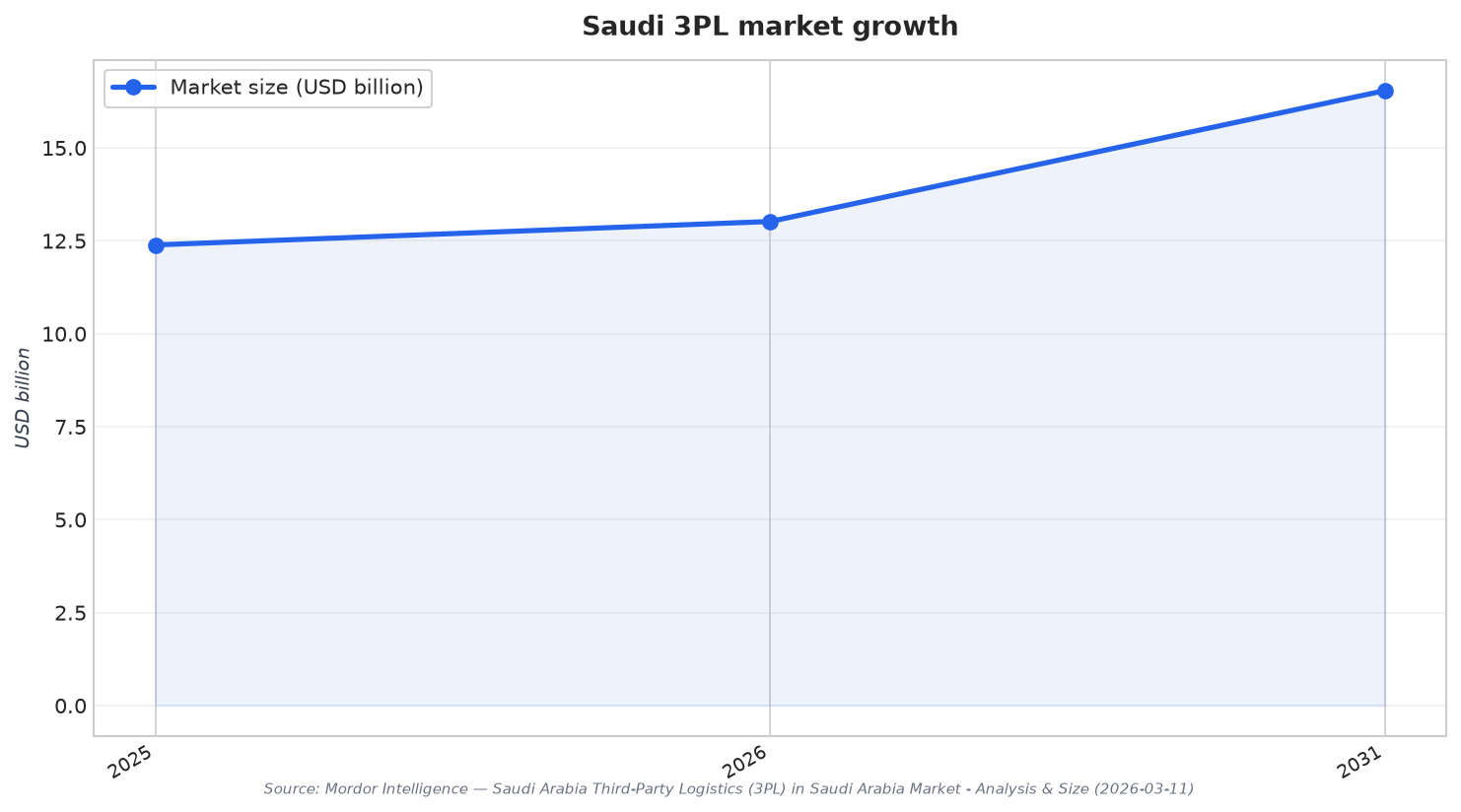
Saudi 3PL contract pricing 2026 is being renegotiated in a market that is growing and becoming more compliance-led. Mordor Intelligence values the Saudi Arabia third-party logistics (3PL) market at USD 12.39 billion in 2025 and estimates it will reach USD 13.02 billion in 2026, on the way to USD 16.54 billion by 2031 (4.91% CAGR for 2026–2031). In parallel, IMARC forecasts the broader Saudi Arabia logistics market expanding from USD 55.29 billion in 2025 to USD 57.88 billion in 2026, reaching USD 83.41 billion by 2034. With that growth, shippers are buying more than “space and trucks.” They are buying measurable service levels, compliance, and data visibility under multi-year SLAs.
Open-book pricing is gaining attention because tender qualification is increasingly tied to sustainability and traceability. Mordor Intelligence highlights the 2025 SASO carbon-disclosure rule as a structural shift that embeds emissions transparency into procurement and contract renewals. The same source says providers investing in solar rooftops, electric fleets, and carbon-tracking platforms can command 8–12% pricing premiums, while fleet-heavy laggards face margin pressure and weaker tender scores. In practice, open-book mechanisms can make those cost drivers auditable, especially when the shipper wants clarity on what is “pass-through” versus what is operational improvement. It also fits the trend toward gain-share clauses in contract logistics, where many global shippers reward 3PLs for continuous improvement savings rather than forcing purely transactional rebids.
Open-Book vs Cost-Plus vs Volume-Based: Where Each Model Fits in 2026
Cost-plus pricing tends to expand when compliance requirements and investment cycles rise, because it reduces uncertainty for both parties. Mordor’s contract logistics report notes the Saudi Arabia contract logistics market is worth USD 1.27 billion in 2026 and is projected to reach USD 1.51 billion by 2031 (3.52% CAGR). It also points to tighter parcel rules from 1 January 2026, when operators must reject shipments without a valid National Address, increasing onboarding and address-data capture work. Add the TGA’s autonomous vehicle framework introduced in April 2026 and a 27 August 2026 deadline for correcting land-transport status, and carriers face near-term documentation and compliance workload. Cost-plus can fund these mandatory processes, but it also increases scrutiny on productivity and the scope of reimbursable cost items.
Volume-based pricing remains attractive where demand is measurable and repeatable, but 2026 is making “volume” more complex than pallets in a bay. Mordor’s 3PL warehousing report says Saudi Arabia’s delivery sector processed more than 118 million orders in Q1 2026, up 49% year over year, after 124 million orders in Q4 2025 and 103 million in Q3 2025. That kind of swing pushes contracts toward tiered rate cards, minimums, and peak definitions. Warehousing economics are also shifting toward chargeable workflows. In Saudi Arabia’s 3PL warehousing market, storage led with 60.21% of market size in 2025, while value-added services are projected to grow fastest at an 8.55% CAGR through 2031. Manual warehousing still held 63.83% share in 2025, yet fully automated warehousing is forecast to expand at an 11.39% CAGR through 2031, supporting more activity-based pricing around accuracy, speed, and traceability.
In 2026, the pricing model choice also reflects how fast Saudi Arabia is building logistics capacity and re-routing trade. The National Industrial Development and Logistics Program activated 24 logistics centers by 2025 under a 60-center master plan, and the Budget Forum 2026 confirmed SAR 280 billion (USD 74.60 billion) in total transport and logistics contracts, with 80% of the pipeline open to private investment. Mordor also notes Mawani signed seven contracts worth SAR 1 billion (USD 262 million) in July 2026 to develop and expand logistics centres at Jeddah Islamic Port and Al Khumra Logistics Zone. As bonded and port-adjacent footprints expand, and as special economic zone rules took effect on April 16, 2026 with suspended customs duties and zero VAT on inter-SEZ transfers for qualifying operators, shippers often balance open-book transparency, cost-plus risk sharing, and volume-based incentives to match their mix of growth, compliance, and service specialization.
What is changing most in Saudi 3PL contract pricing in 2026?
Why do open-book contracts matter more now?
When does cost-plus make the most sense for shippers and 3PLs?
How does order growth affect volume-based pricing in 2026?
How should leaders think about Saudi 3PL contract pricing in 2026 when comparing open-book, cost-plus, and volume-based models?
Talk to us for your needs in:
- Identifying Suitable Warehouse Sites in Saudi Arabia
- Customized Logistics and Supply Chain Analytics
- Logistics Network Design and Optimization
- Green Supply Chain and Sustainable Logistics Solutions
- Supply Chain Risk Management and Compliance
- Advanced Supply Chain Resilience and Agility
- Logistics Market Research and Strategic Analysis
- In-Depth Market Survey for Logistics
- Market Intelligence and Insights in Logistics
- Feasibility Study and Assessment in Logistics
- Integrated Warehousing Management Solutions
- Smart Warehousing and Automation Systems
- Sustainable and Green Warehousing Practices
- Port and Airport Logistics Optimization
- Digital Logistics Solutions
- Saudi Logistics Benchmarking