Saudi Arabia was formally confirmed by FIFA on 11 December 2024 as the host of the 2034 FIFA World Cup, in an uncontested bidding process. Multiple sources describe it as the first time a single country will solely host a 48-team tournament. For planners, that decision turns into a single overriding challenge: connecting stadiums, training sites, airports, hotels, and fan spaces in a way that works under real match-day pressure. Saudi officials have cited a record 419.8 out of 500 technical evaluation score, but execution still depends on how smoothly the on-the-ground system performs during arrivals, peak crowd flows, and rapid turnover between matches.
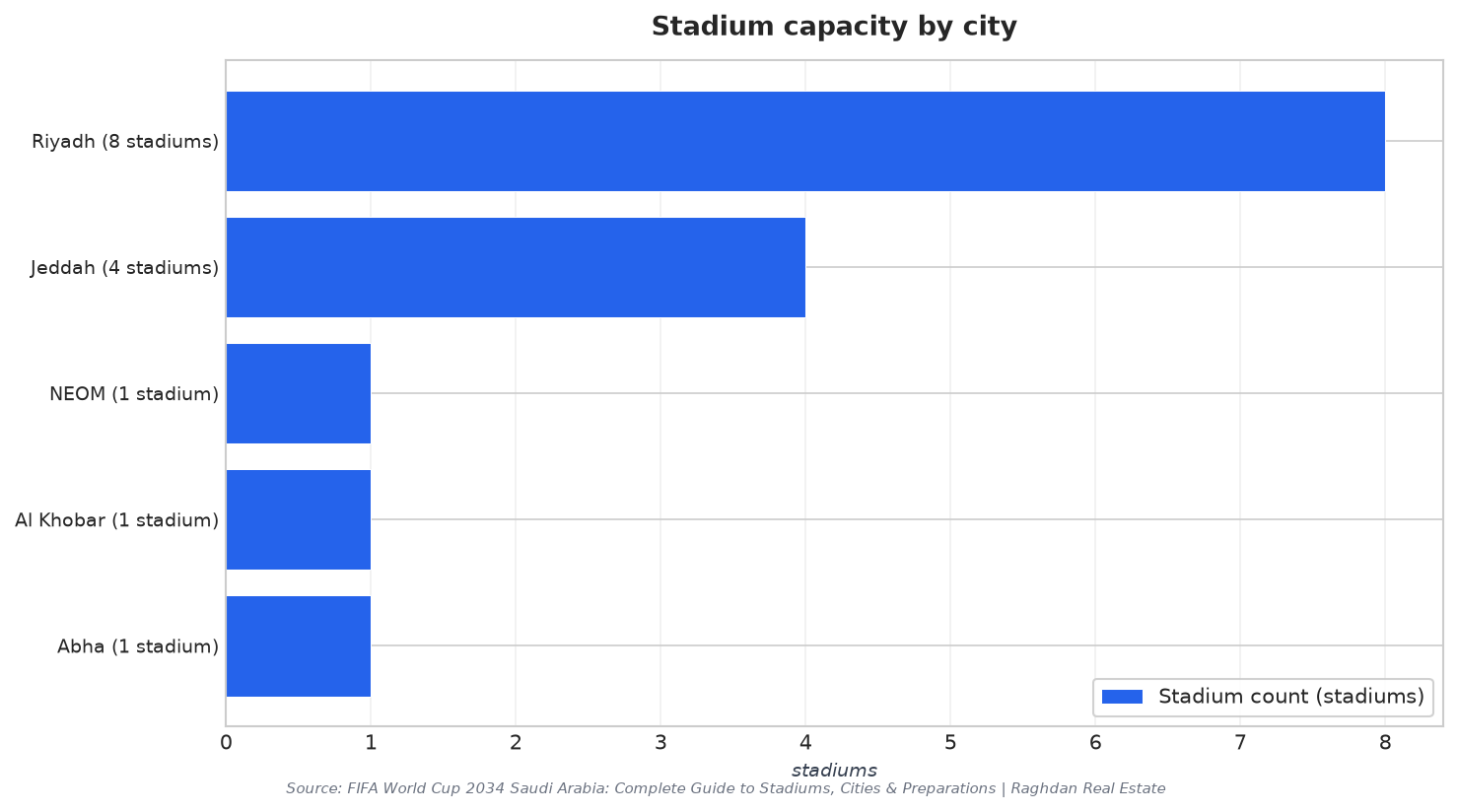
The infrastructure footprint described in the bid materials is large and geographically concentrated. The tournament is planned to be held in five cities—Riyadh, Jeddah, Khobar, NEOM, and Abha—with a total of 15 stadiums. Sources summarize the mix as 11 new builds and four renovated venues, while another listing frames it as four renovations alongside new builds and venues already under construction. For crowd and transport modeling, the headline capacities matter: a stated total seating capacity of 770,000+ across the stadium program, plus venue-by-venue peaks such as King Salman International Stadium at 92,000, and a NEOM stadium planned for 46,000 spectators suspended 350 meters high in The Line.
What Match-Day Logistics Must Solve Across Stadiums and Fan Zones
Stadium operations do not stand alone, because fan zones and citywide movement shape the same demand curve. Wikipedia notes that two FIFA Fan Festival locations have been proposed in each host city, adding another layer of crowd management beyond stadium gates. Transport references point to city systems and event shuttles: within host cities, the Riyadh Metro, Jeddah bus rapid transit, and dedicated World Cup shuttle services are described as key tools to move fans to and from venues. The World Data also highlights a scale marker for arrivals and dispersal capacity: 16 international airports are cited alongside the 15 stadiums and 230,000 hotel rooms.
Accommodation and scheduling decisions will directly affect how FIFA World Cup 2034 Saudi logistics performs in practice. Sources cite 230,000 hotel rooms as part of the hosting commitment, and one guide expects Riyadh alone to have over 127,000 hotel rooms by 2034, including 51,000 five-star units. Host-city design also spans very different environments, which changes staffing, security, and service planning. Abha is listed at 2,200 meters elevation, while NEOM’s venue concept includes solar and wind power and a complex site profile. The Middle East Insider also describes an operational approach using evening kickoffs, mountain venues, and covered fan zones to help manage conditions and fan experience.
Timeline discipline becomes a logistics input, not just a construction concern. The Middle East Insider calls the construction timeline the most significant risk, because multiple stadiums, transportation networks, and accommodation facilities must be completed simultaneously, and it notes that FIFA typically conducts readiness inspections beginning 4–5 years before the tournament. The World Data points to a phased readiness example: Al Khobar’s Aramco Stadium is targeted for completion in 2026, and is also described as hosting 2027 Asian Cup matches before 2034, creating an earlier real-event test. Separately, Vision2030.AI frames stadium construction at $25–30B, reflecting how delivery pressure shapes procurement, staffing, and operational testing long before opening day.
How many stadiums and host cities are planned for the 2034 tournament in Saudi Arabia?
What headline capacity and accommodation figures are cited for 2034 preparations?
How many fan festival locations are proposed in each host city?
What transport options are mentioned for moving fans on match days?
What makes FIFA World Cup 2034 Saudi logistics a distinct planning challenge?
Talk to us for your needs in:
- Identifying Suitable Warehouse Sites in Saudi Arabia
- Customized Logistics and Supply Chain Analytics
- Logistics Network Design and Optimization
- Green Supply Chain and Sustainable Logistics Solutions
- Supply Chain Risk Management and Compliance
- Advanced Supply Chain Resilience and Agility
- Logistics Market Research and Strategic Analysis
- In-Depth Market Survey for Logistics
- Market Intelligence and Insights in Logistics
- Feasibility Study and Assessment in Logistics
- Integrated Warehousing Management Solutions
- Smart Warehousing and Automation Systems
- Sustainable and Green Warehousing Practices
- Port and Airport Logistics Optimization
- Digital Logistics Solutions
- Saudi Logistics Benchmarking