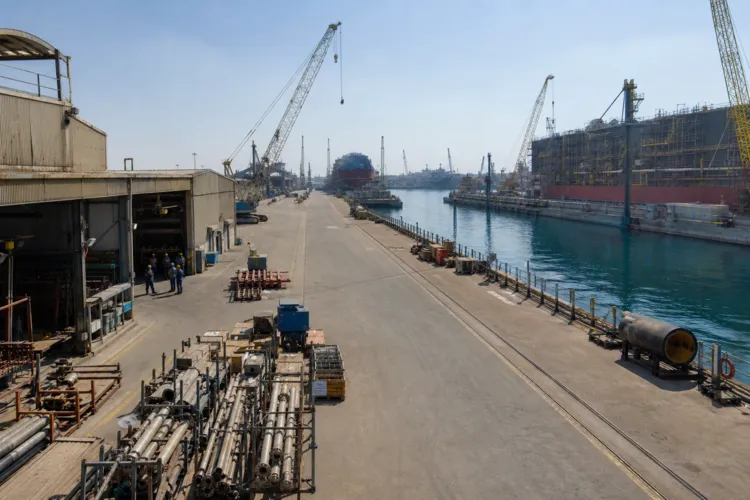
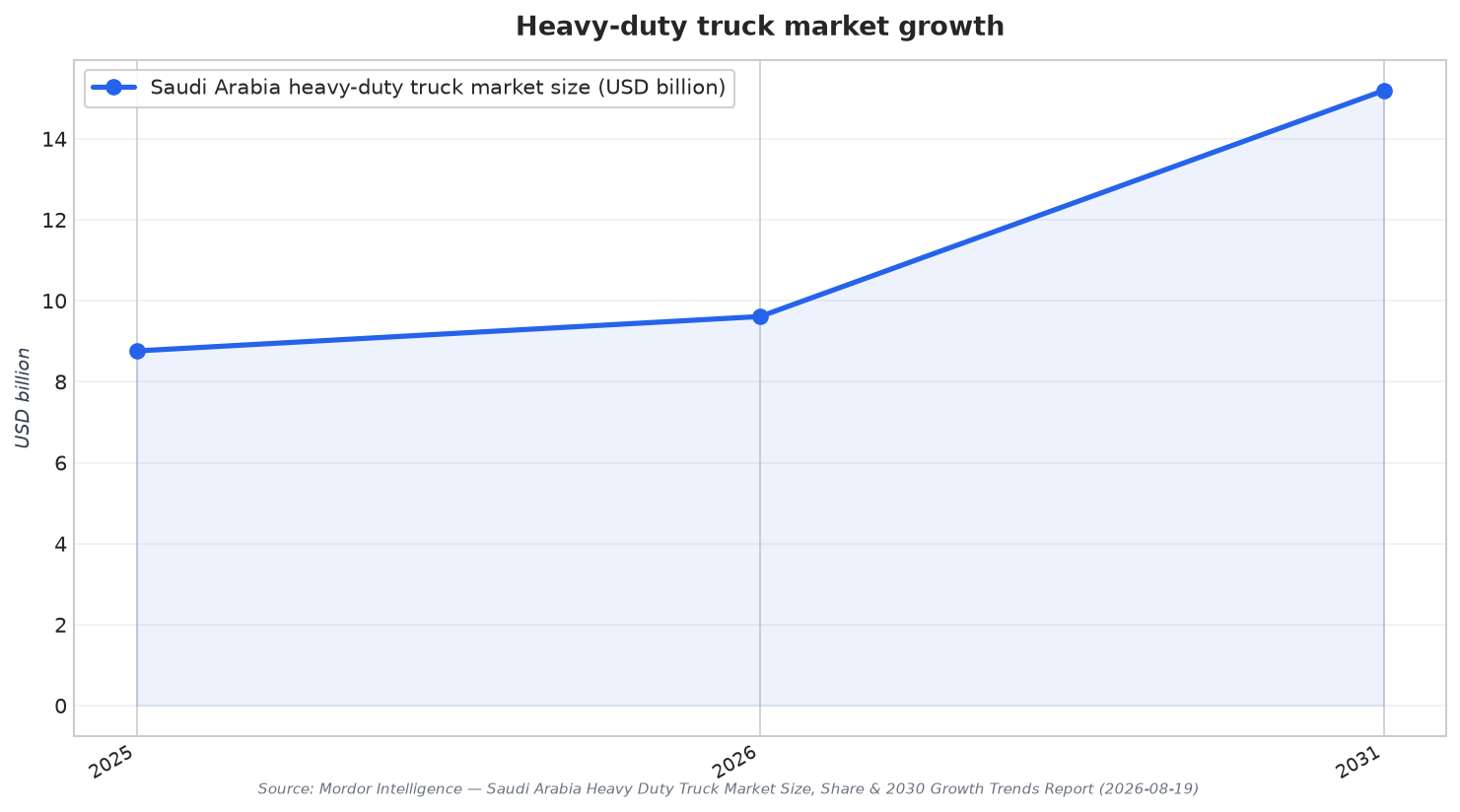
Saudi Arabia’s trucking economy is expanding fast, and that matters for how and where electrification can scale. Mordor Intelligence values the Saudi Arabia heavy-duty truck market at USD 8.76 billion in 2025, estimates USD 9.61 billion in 2026, and projects USD 15.19 billion by 2031 at a 9.61% CAGR (2026–2031). That growth is tied to Vision 2030 infrastructure programs, mining momentum, and e-commerce distribution corridors, plus port expansions at Jeddah Islamic Port and King Abdulaziz Port and the Saudi Landbridge rail-and-road corridor. Regulations that cap truck operating life at 20 years add pressure to renew fleets, which can open windows for electrified options when routes and charging are workable.
Electrification is visible in forecasts, even as diesel remains dominant. In 2025, internal-combustion engines account for 87.71% of heavy-duty truck shipments in Saudi Arabia, while electrified powertrains (battery-electric, hybrid, and fuel-cell) are projected to be the fastest-growing at a 9.66% CAGR to 2031. On the demand side, construction and mining hold 45.54% revenue share in 2025, while freight and logistics are the most dynamic use cases with a 9.77% CAGR through 2031. Geography matters too: the Eastern Province commands 34.28% of 2025 demand and is projected to grow at 9.75% CAGR, supported by industrial free zones around Jubail and Dammam and Ras Al-Khair’s metals clusters.
Charging Corridors: From “Charging Desert” to Highway Stations
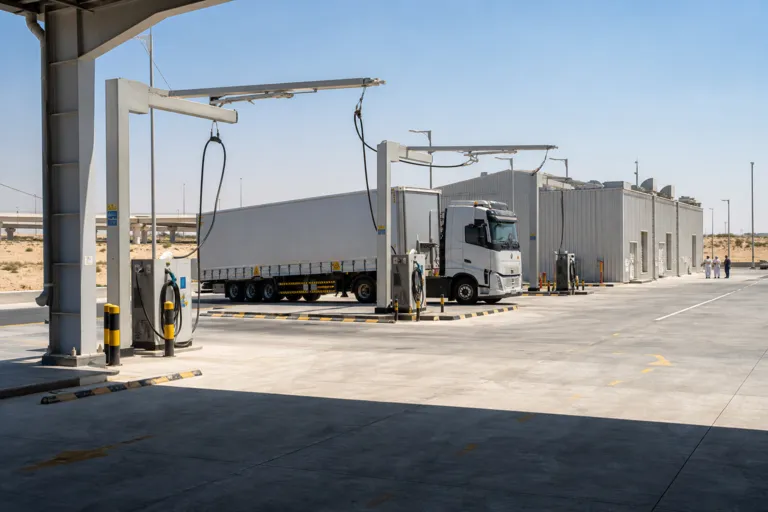
Highway charging coverage is a practical gatekeeper for long-haul use, and Saudi sources describe clear gaps alongside early moves. Mordor Intelligence notes a planned debut of the inaugural highway station along the Riyadh–Qassim corridor in early 2025, linked to EVIQ with support from the Public Investment Fund (PIF) and the Saudi Electricity Company. The same source calls a 950 km Riyadh–Jeddah corridor a “charging desert,” limiting intercity travel and curbing utilization rates for ride-hailing fleets, while also saying EVIQ’s initial rollout left secondary cities such as Mecca, Taif, and Abha dependent on home charging. In broader GCC context, Mordor Intelligence reports EVIQ, ADNOC, DEWA, and Kahramaa collectively plan over 5,500 additional chargers by 2030, with ultra-fast sites spaced at 150-kilometer intervals on intercity corridors and 15-minute recharge windows aimed at commercial-fleet uptime requirements.
Fleet economics, not just technology, drive early electrification decisions. In Saudi Arabia’s EV market analysis, Mordor Intelligence says fleet economics “tilt adoption” because centralized overnight charging reduces peak-tariff exposure, warranty management is streamlined, and kilometer accumulation accelerates parity with subsidized gasoline. For commercial operators, that points to depot-centric operations first, then corridor-enabled routes as highway sites expand. IndexBox adds a useful comparison from light commercial fleets: as of 2026, electric light commercial vehicles account for less than 2% of the total LCV parc in the kingdom, with the LCV parc estimated at approximately 1.1–1.3 million units. IndexBox also says total cost of ownership advantages become apparent at annual mileages above 25,000–30,000 km, which helps explain why logistics companies, e-commerce platforms, and government fleets show up as early adopters in major urban corridors.
Context from global markets shows where heavy-duty electric trucking is headed, but it should not be mistaken for Saudi-specific penetration. Grand View Research values the global heavy-duty electric trucks market at USD 1.9 billion in 2025, estimates USD 2.4 billion in 2026, and projects USD 6.4 billion by 2033, at a 15.1% CAGR (2026–2033), with Asia Pacific holding 85.1% revenue share in 2025. Back in Saudi Arabia, the near-term playbook for electric heavy trucks in Saudi Arabia looks route-specific: target high-utilization freight lanes, anchor charging at depots, and expand onto highways as corridor stations close the gap between Riyadh and other major cities. For some long, heavy routes, Mordor Intelligence also notes hydrogen truck pilots aimed at overcoming payload losses from lithium-ion batteries, reinforcing that multiple electrified paths may develop in parallel.
What is driving heavy-duty truck growth in Saudi Arabia through 2031?
How dominant are internal-combustion engines in Saudi heavy-duty trucks today?
Where are the biggest charging-corridor gaps on Saudi highways?
What fleet economics factors support electrification in Saudi Arabia?
What should fleet managers consider for electric heavy trucks in Saudi Arabia?
Talk to us for your needs in:
- Identifying Suitable Warehouse Sites in Saudi Arabia
- Customized Logistics and Supply Chain Analytics
- Logistics Network Design and Optimization
- Green Supply Chain and Sustainable Logistics Solutions
- Supply Chain Risk Management and Compliance
- Advanced Supply Chain Resilience and Agility
- Logistics Market Research and Strategic Analysis
- In-Depth Market Survey for Logistics
- Market Intelligence and Insights in Logistics
- Feasibility Study and Assessment in Logistics
- Integrated Warehousing Management Solutions
- Smart Warehousing and Automation Systems
- Sustainable and Green Warehousing Practices
- Port and Airport Logistics Optimization
- Digital Logistics Solutions
- Saudi Logistics Benchmarking