Saudi parcel demand is rising alongside broader digital commerce growth. In urban centers such as Riyadh, Jeddah, and Dammam, parcel volume growth is cited at 15–20% year on year, which creates direct pressure on warehousing, sortation, and last-mile reliability. At the same time, Saudi Arabia’s e-commerce market has multiple ways to size the opportunity: B2C online retail is described at roughly USD 16–20 billion in 2025, while broader digital commerce is described at roughly USD 27–31 billion. Another estimate places Saudi Arabia’s e-commerce market size at USD 27.96 billion in 2025 and USD 31.29 billion in 2026, framing why fulfillment footprints have become a competitive lever rather than a back-office function.
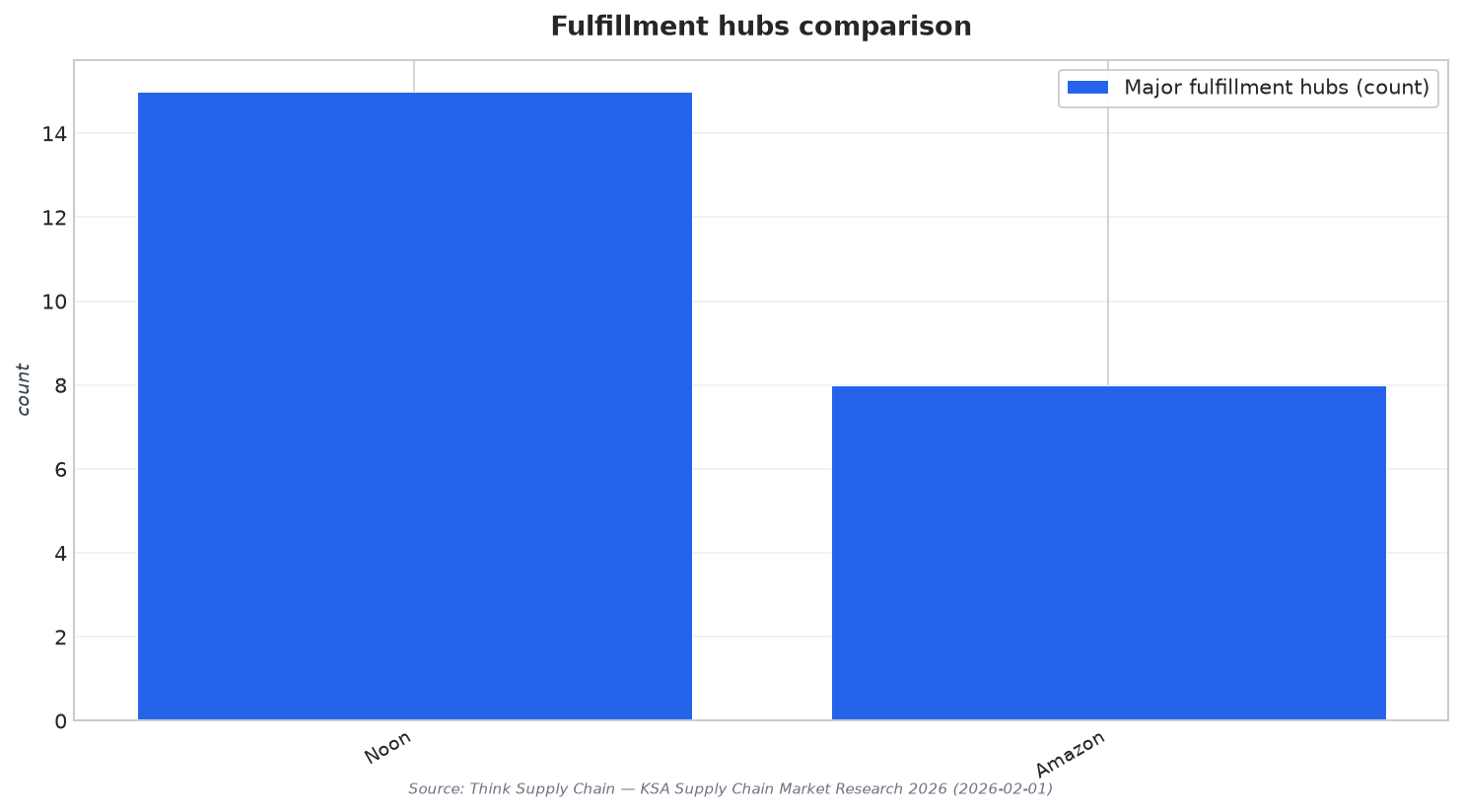
When comparing Amazon and Noon fulfillment footprints, the clearest reported difference is scale of sites. A 2026 supply chain research note states Noon operates 15+ regional centers, while Amazon operates 8 major hubs. That gap matters most where demand clusters. In 2025, Riyadh is cited with a 35.01% revenue share by geography in one market analysis, reinforcing why operators prioritize capacity and speed around the capital and its surrounding corridors. The same analysis points to smartphones generating 77.98% of B2C e-commerce revenue share in 2025, which intensifies expectations for fast delivery windows and accurate availability signals because shopping behavior is always-on and highly reactive to delivery promises.
How Network Footprints Translate Into Delivery Pressure
Footprint numbers only become meaningful when they map to execution in the cities where orders concentrate. One report notes that in January 2024, Noon launched a new fulfillment center in Riyadh to enhance logistics capabilities and improve delivery times across Saudi Arabia. That kind of node expansion aligns with cited challenges around nationwide coverage costs, since high rural fulfillment costs are explicitly flagged as a factor that can temper adoption even as the market grows. Separately, practitioners focused on platform data extraction highlight that Saudi delivery windows differ across three distinct metro markets—Riyadh, Jeddah, and Dammam—underscoring why companies often treat the Kingdom as multiple operational theaters rather than one homogeneous service area.
Market structure helps explain why both platforms keep investing in fulfillment and last-mile execution. B2C transactions are cited at 73.54% of Saudi Arabia e-commerce market share in 2025, keeping consumer delivery expectations at the center of the competitive battle. Payment and connectivity indicators support the same view: credit/debit cards are cited with a 42.62% share of B2C e-commerce payment mode in 2025, while internet penetration is cited at 99% and 5G coverage at 78%. In practical terms, this combination encourages higher purchase frequency and tighter delivery-time expectations, making the difference between a network of 15+ regional centers and 8 major hubs a strategic distinction, not a detail.
For brands planning inventory placement and carrier strategy, the Amazon Noon fulfillment Saudi Arabia topic is ultimately about aligning SKU availability with where demand and logistics capacity meet. Saudi transaction value for e-commerce is described at SAR 90–100 billion in 2024, with a forecast range of SAR 130–150 billion for 2027, adding urgency to decisions about where to hold stock. In parallel, Mada-card e-commerce volume is cited at SAR 197.4 billion in 2024, capturing card-not-present activity beyond pure retail. Those figures do not describe one platform’s throughput, but they do show why fulfillment footprints are treated as infrastructure for a fast-expanding digital economy, especially in the Kingdom’s main metros.
How do Amazon.sa and Noon compare on fulfillment footprint in Saudi Arabia?
What concrete fulfillment expansion has Noon announced in Saudi Arabia?
Where does e-commerce demand concentrate geographically in Saudi Arabia?
What market indicators suggest rising pressure on delivery performance?
How large is Saudi Arabia’s e-commerce market in the sources?
Talk to us for your needs in:
- Identifying Suitable Warehouse Sites in Saudi Arabia
- Customized Logistics and Supply Chain Analytics
- Logistics Network Design and Optimization
- Green Supply Chain and Sustainable Logistics Solutions
- Supply Chain Risk Management and Compliance
- Advanced Supply Chain Resilience and Agility
- Logistics Market Research and Strategic Analysis
- In-Depth Market Survey for Logistics
- Market Intelligence and Insights in Logistics
- Feasibility Study and Assessment in Logistics
- Integrated Warehousing Management Solutions
- Smart Warehousing and Automation Systems
- Sustainable and Green Warehousing Practices
- Port and Airport Logistics Optimization
- Digital Logistics Solutions
- Saudi Logistics Benchmarking