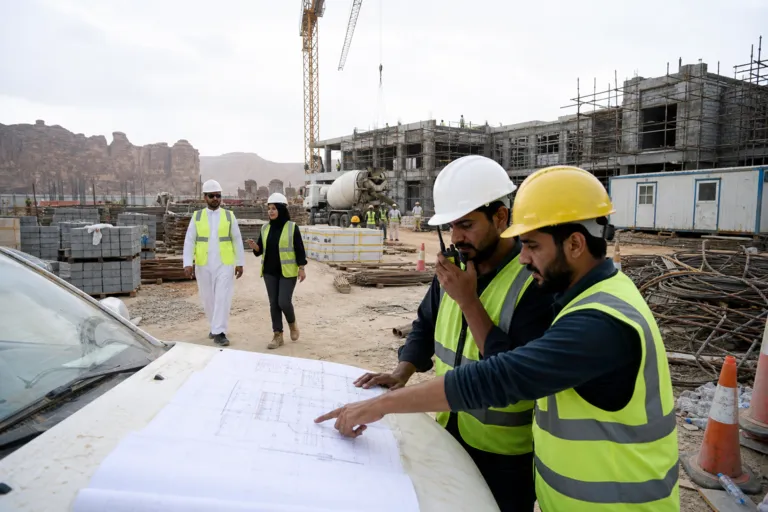
Construction has started on NUMAJ, Autograph Collection in AlUla, with AlUla Development Company (UDC), a Public Investment Fund company, beginning works on the site. The project is planned as a 250-key hotel and is expected to open in 2027. Marriott International will operate the property under the Autograph Collection Hotels brand. For AlUla, new hotel capacity is not only about rooms. It also sets a longer runway for procurement, staffing, and delivery planning that shapes AlUla NUMAJ hospitality logistics from construction through opening.
NUMAJ’s design is by GioForma, described as the architects behind Maraya, and the concept draws inspiration from AlUla’s natural landscapes, cultural heritage, and celestial history. The name “NUMAJ” is derived from the star system Nu Ursae Majoris, historically associated with AlUla as a guiding reference for ancient travelers. A groundbreaking ceremony brought together senior officials including John Pagano, Managing Director of UDC, and Abeer AlAkel, Chief Executive Officer of the Royal Commission for AlUla (RCU). These elements matter for supply chains because design intent and cultural positioning influence vendor selection, fit-out materials, and the guest experience standards that must be delivered consistently.
Why the 2027 Opening Matters for Heritage Tourism Supply Chains
AlUla’s development strategy is also being framed as an investment story. RCU is seeking to attract private investors and is pitching $11 billion in tourism deals as it transitions beyond government-led funding into public-private partnerships. In that same plan, AlUla aims to increase annual visitors from 300,000 to one million by expanding hotel capacity and partnering with major global hotel brands, with wellness tourism highlighted as a focus. For logistics, higher visitor targets can translate into tighter operating windows and more frequent replenishment cycles, making forward contracting and delivery coordination more critical as capacity grows toward 2027.
Across Saudi Arabia, the pipeline and demand narrative adds pressure to plan supply early. The Ministry of Tourism reported 122 million domestic and international visitors in 2025, a 5% increase year over year, while tourism spending gained 6% to nearly 300 billion riyals ($81 billion). Saudi’s Vision 2030 goal is 150 million visitors. Mega events were also cited, including the 2027 Asian Cup, the World Expo 2030, and the 2034 FIFA World Cup. In this context, AlUla projects such as NUMAJ become part of a national rhythm where procurement, staffing, and operating readiness must align with rising travel volumes and event-driven peaks.
Heritage-led development elsewhere in the Kingdom shows how large programs create parallel supply-chain demands, even when the sites differ. In Jeddah’s historic Al Balad district, Al Balad Development Company launched a USD3.6 billion hospitality portfolio and plans to deliver more than 3,300 hotel keys from 2025 to 2038. The redevelopment was described as covering approximately 2.5 million m total development area with 3.7 million m built up area, including 9,300 residential units, 1,800 hotel units, and around 1.3 million m commercial/office space. Separately, Diriyah Company awarded Parsons a $56m five-year contract covering design and construction supervision for parks, open spaces, and more than 55km of streetscapes. Together, these examples reinforce that heritage destinations often require integrated logistics across construction, public realm, and hospitality operations.
NUMAJ’s timeline to 2027 provides a defined window to industrialize readiness without losing the “sense of place” that modern guests expect. An industry view on Saudi hospitality investment noted a shift from asset development to experience creation, where guests want cultural connection, wellness, convenience, and authenticity. For AlUla NUMAJ hospitality logistics, that implies planning beyond basic deliveries: aligning brand standards, local sourcing choices, and service workflows with the hotel’s heritage narrative. With construction now underway and the operator and brand identified, the supply chain can be shaped to support a consistent opening in 2027 and sustain AlUla’s wider capacity goals.
What is NUMAJ in AlUla, and when is it expected to open?
Who will operate NUMAJ, Autograph Collection in AlUla?
How does AlUla NUMAJ hospitality logistics connect to AlUla’s visitor targets?
What investment figure is AlUla pitching to attract private partners?
What national tourism demand signals could affect supply planning through 2027?
Talk to us for your needs in:
- Identifying Suitable Warehouse Sites in Saudi Arabia
- Customized Logistics and Supply Chain Analytics
- Logistics Network Design and Optimization
- Green Supply Chain and Sustainable Logistics Solutions
- Supply Chain Risk Management and Compliance
- Advanced Supply Chain Resilience and Agility
- Logistics Market Research and Strategic Analysis
- In-Depth Market Survey for Logistics
- Market Intelligence and Insights in Logistics
- Feasibility Study and Assessment in Logistics
- Integrated Warehousing Management Solutions
- Smart Warehousing and Automation Systems
- Sustainable and Green Warehousing Practices
- Port and Airport Logistics Optimization
- Digital Logistics Solutions
- Saudi Logistics Benchmarking