Agentic AI is poised to change supply chains in 2026 by moving from pilots into production-grade workflows. One 2026 outlook says agentic AI will manage logistics and production end-to-end, including rerouting inventory in real time, expediting shipments, allocating maintenance resources, and dynamically adjusting manufacturing based on need. Another 2026 manufacturing outlook frames the moment as turning AI from proof-of-concept into proof-of-value. Together, these views point to a practical shift. Supply chain leaders are not just testing agents. They are aiming to operationalize them inside the workflows that run planning, execution, maintenance, and quality.
Saudi Arabia’s readiness for this shift is visible in workforce behavior and investment direction. A Saudi workforce report says four out of ten Saudi workers use AI daily. It also reports that among Saudis who say they have a healthy work relationship, 34% use AI tools provided by their employer every day. That matters for supply chain teams because agentic systems reshape daily work patterns, not only IT roadmaps. On the investment side, Saudi Arabia’s Public Investment Fund is backing a new company called HUMAIN, launched in May 2025, which plans to set up a $10 billion fund and has signed $23 billion in deals with major U.S. technology firms to help build new data centers with capacity of about 6.6 gigawatts by 2034.
What “Production” Means for Agentic AI in Saudi Supply Chains
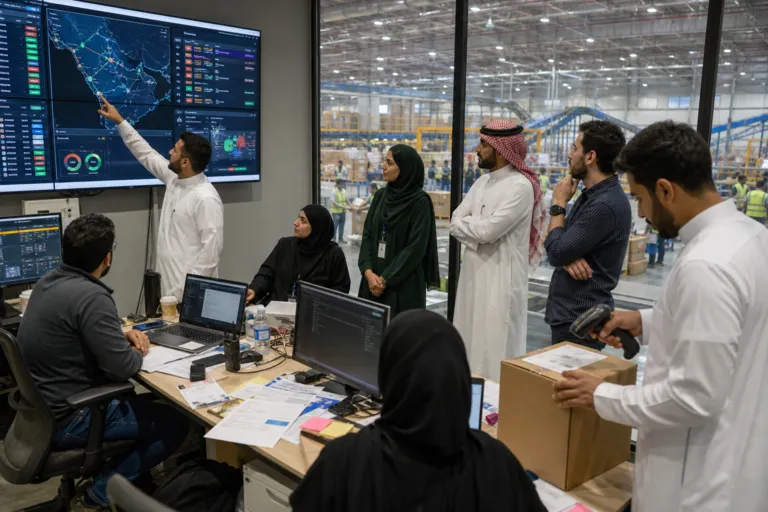
In production, agentic AI is expected to run longer, more complex workflows than a single chatbot or scripted automation. One 2026 prediction says single agents will evolve into orchestrated multi-agent systems, described as dozens or hundreds of specialized agents collaborating on complex, long-running tasks like supply chain optimization. On the industrial side, agentic AI is described as trained on sector-specific data and able to proactively recommend actions, test and correct code, and support predictive maintenance to reduce downtime and improve efficiency. These are not isolated experiments. They are operational loops that touch plant operators, engineers, and facility managers, and they can extend into upstream logistics and downstream distribution.
Saudi supply chain discussions are also explicitly centering on AI and data as resilience levers. FedEx shared perspectives during an AmCham Saudi Arabia webinar titled “Building Resilient Supply Chains: Technology, AI, and the Future of Business Continuity.” The framing emphasized the need for adaptable networks to maintain cross-border movement and operational continuity as Saudi Arabia navigates an increasingly complex global trade environment. That matches a separate 2026 supply chain outlook that calls for networks designed to flex across geographies, supported by continuous AI insights and strong data governance. For an Agentic AI Saudi supply chain program, this implies that data readiness and governance are not side tasks. They are core requirements for scaling beyond pilots.
Governance pressure rises as autonomy increases. One 2026 prediction warns that Forrester cautions about a major agentic breach without proper orchestration. Another industrial outlook points to a stronger push for transparent agentic AI as governance frameworks around “black box” AI mature, noting the EU AI Act coming into force on 2 August 2026. For Saudi supply chain leaders, the takeaway is procedural. If agents can reroute inventory or adjust production logic, then oversight, explainability, and orchestration become operational controls, not just legal reviews. Production deployment is therefore a combined change: technical autonomy, stronger orchestration, and disciplined governance.
Sector-linked supply chains add another practical angle. In agriculture modernization, a 2025 MEWA program invested USD 3.2 billion in AI-powered precision farming technologies and smart irrigation systems across 2,000 farms, targeting 30% improvement in crop yields and a 40% reduction in water consumption by 2027. The same set of updates notes that in March 2025, PIF launched a “Smart Agriculture Initiative,” establishing five advanced agricultural research centers with AI-driven crop monitoring systems and controlled environment agriculture facilities, investing USD 1.8 billion. These initiatives are not described as agentic systems by name, but they expand AI-driven operations that feed into food and beverage manufacturing and logistics, where agentic AI is forecast to become a cornerstone of industrial innovation in 2026.
What is Agentic AI in a Saudi supply chain context?
Why is 2026 a turning point from pilots to production?
What signals show Saudi workforce readiness for AI-enabled workflows?
What governance risks are mentioned for agentic systems?
How does infrastructure investment connect to Agentic AI Saudi supply chain ambitions?
Talk to us for your needs in:
- Identifying Suitable Warehouse Sites in Saudi Arabia
- Customized Logistics and Supply Chain Analytics
- Logistics Network Design and Optimization
- Green Supply Chain and Sustainable Logistics Solutions
- Supply Chain Risk Management and Compliance
- Advanced Supply Chain Resilience and Agility
- Logistics Market Research and Strategic Analysis
- In-Depth Market Survey for Logistics
- Market Intelligence and Insights in Logistics
- Feasibility Study and Assessment in Logistics
- Integrated Warehousing Management Solutions
- Smart Warehousing and Automation Systems
- Sustainable and Green Warehousing Practices
- Port and Airport Logistics Optimization
- Digital Logistics Solutions
- Saudi Logistics Benchmarking