
Saudi Arabia’s Ministry of Human Resources and Social Development (MHRSD) has changed what counts in Saudization, and it directly affects how employers earn Nitaqat credit. Effective April 15, 2026, Saudization rates are calculated based on Saudi employees whose employment contracts are documented electronically through the Qiwa platform. Any Saudi national worker whose contract is not documented in Qiwa can no longer be included in a company’s Saudization calculation. For logistics employers that depend on stable Nitaqat positioning to keep workforce operations running, this turns contract documentation from a back-office activity into a core compliance control.
This shift matters because Nitaqat is not just a scorecard. It is a nationalization (Saudization) program that classifies private-sector establishments into five categories: Platinum, High Green, Mid Green, Low Green, and Red. The classification is based on the nationalization percentage (the percentage of Saudi employees) and the total number of employees, and the calculation differs by industry and establishment size. Employers also use their band to determine whether they can issue new work visas, transfer sponsorships, and renew Iqamas. In practice, an employer can have Saudi nationals on staff, but if those contracts are not logged in Qiwa, the Saudization ratio can drop and the Nitaqat band can change quickly.
What Changed in 2026: Digital Contract Status Became the Gate
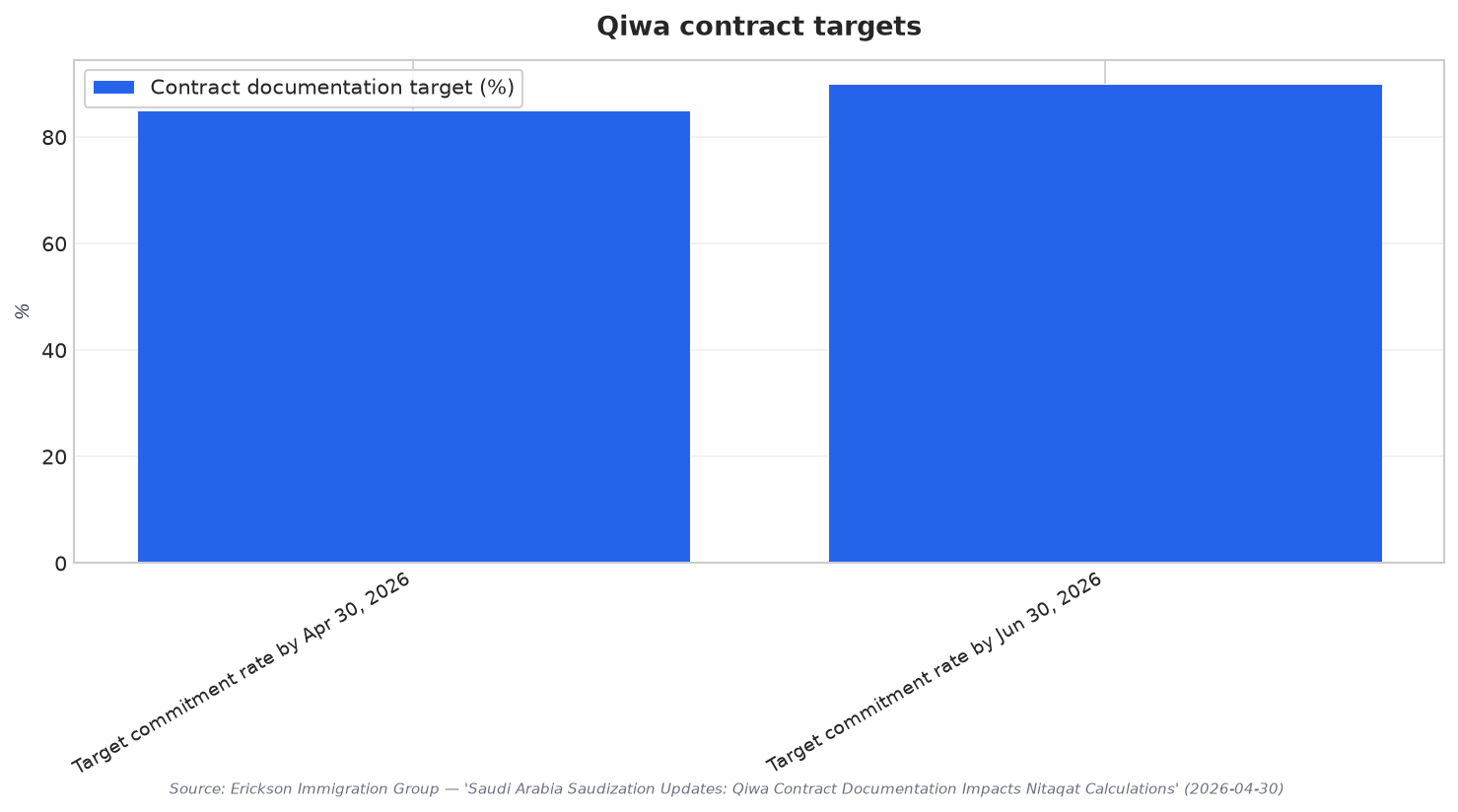
The updated mechanism is not only about how the ratio is computed; it also adds a timeline that employers must manage. MHRSD increased the target commitment rate for documenting employment contracts on Qiwa to 85% by April 30, 2026, and to 90% by June 30, 2026. Authorities have called on establishments to review undocumented employment contracts and complete documentation procedures through Qiwa to avoid difficulties that may affect access to services related to compliance indicators. This is where the Qiwa digital contract Saudization topic becomes practical: the platform record is now the deciding evidence for whether Saudi headcount is recognized for Nitaqat credit.
For logistics organizations, the operational risk is straightforward. When digitally documented contracts determine who counts toward the ratio, contract gaps can push an otherwise compliant employer into a lower band. The Nitaqat bands are explicitly tied to permissions and restrictions, including visa issuance, sponsorship transfers, and Iqama renewals. Red-band consequences can include new visas blocked and work permit renewals blocked, and expat staff may be able to leave for higher-band employers without the employer’s approval. Qiwa also lets employers track Saudization percentage, view Nitaqat classification, and identify issues before they turn into penalties, which is why internal HR and legal teams increasingly treat Qiwa entries as compliance artifacts, not optional admin data.
The compliance response is also procedural, not theoretical. Legal guidance on Qiwa emphasizes controlled access for authorized HR, legal, or administrative users, along with reviewing employee data, professions, wages, permits, and contract status. Businesses can create or update employment contracts, send them to employees for review, and monitor contract documentation alongside Saudization information and official notifications. For logistics employers that run multiple branches, it also helps to remember that the 2026 Nitaqat cycle shifted assessment to the entity level, with same-activity branches counted together. That makes consistent Qiwa documentation across sites essential, because documentation gaps in one place can affect the consolidated Saudization picture.
What is the rule change that links Saudization credit to Qiwa contracts?
What are the Qiwa contract documentation commitment targets mentioned by MHRSD?
How does a Nitaqat band affect hiring and workforce actions in Saudi Arabia?
How should logistics employers manage the Qiwa digital contract Saudization requirement?
Talk to us for your needs in:
- Identifying Suitable Warehouse Sites in Saudi Arabia
- Customized Logistics and Supply Chain Analytics
- Logistics Network Design and Optimization
- Green Supply Chain and Sustainable Logistics Solutions
- Supply Chain Risk Management and Compliance
- Advanced Supply Chain Resilience and Agility
- Logistics Market Research and Strategic Analysis
- In-Depth Market Survey for Logistics
- Market Intelligence and Insights in Logistics
- Feasibility Study and Assessment in Logistics
- Integrated Warehousing Management Solutions
- Smart Warehousing and Automation Systems
- Sustainable and Green Warehousing Practices
- Port and Airport Logistics Optimization
- Digital Logistics Solutions
- Saudi Logistics Benchmarking