Saudi Arabia is betting that export reliability comes from integration, not isolated projects. Market research on the Saudi Arabia infrastructure market values it at USD 81.6 billion in 2025 and projects growth at a 7.8% CAGR to USD 148.7 billion by 2033. Within that broad push, transport corridors and logistics hubs are repeatedly highlighted as a major opportunity set, with rail and logistics hub expansion creating demand for engineering, automation, and digital systems. For mining-linked exports, the practical question is simple: can rail, dry ports, and seaports operate as one system that moves bulk minerals and containerized cargo to the right coast, at the right time, with fewer road chokepoints?
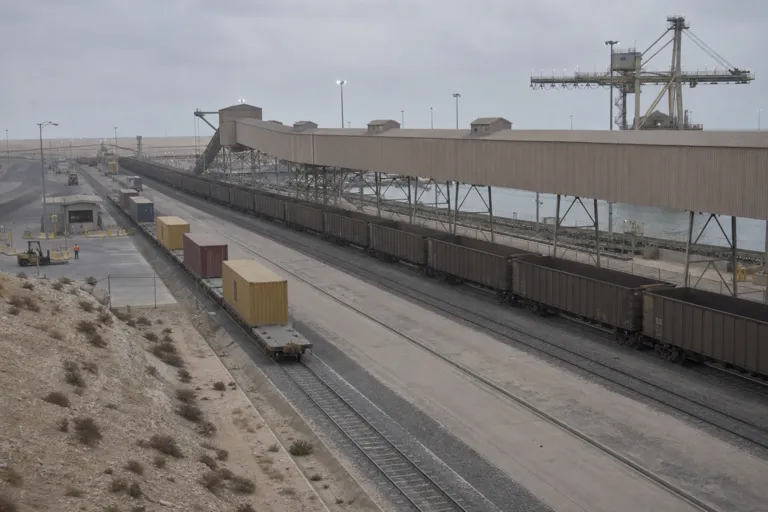
The anchor for a mining-export backbone already exists on the North freight line. Saudi sources describe a route of about 1,550 km running from Al Jalamid mine in the Northern Province through Jouf and Hail to Al Baithah Junction in Qassim, then east to processing and export facilities at Ras Al Khair on the Arabian Gulf. This is the industrial logic of a Saudi mining logistics minerals corridor: mines connect to processing nodes and then to an export gateway designed for heavy flows. The system also has measurable operating scale. Official 2024 railway statistics cited in analysis report 6,807 SAR freight trips, more than 15.6 million tons of goods moved, and about 887,900 standard containers transported on the East Train.
From Mineral Backbone to Multicargo Export Routing
What changes the corridor’s role is the ability to mix minerals with higher-frequency container flows. Reporting on a new rail freight corridor to the Jordan border says the line adds containerised general cargo to an existing mineral backbone. It also details how Gulf ports now feed a single rail corridor that terminates at Al-Haditha: King Abdulaziz Port in Dammam, King Fahd Industrial Port in Jubail, and Jubail Commercial Port. The service design is explicitly container-led, with each train carrying more than 400 standard containers. In other words, the same rail infrastructure that supports mineral movements can also be used to scale container throughput from major ports, then push cargo to border markets via rail-to-road handoffs.
Planners are also looking at coast-to-coast rail as a way to broaden export options beyond a single seaboard. Government planning documents cited in reporting describe the Saudi Landbridge as a proposed 1,300-kilometre railway connecting the Arabian Gulf coast at Dammam and Jubail to the Red Sea coast at Jeddah. Those same documents state a target capability to move more than 50 million tonnes of cargo and over three million passengers annually, if completed. Separate industry commentary on “SAR new logistics corridors 2026” describes five new freight corridors linking west and east coasts, emphasizing access from hubs including Dammam, Jubail, Ras Al Khair, Al Kharj, and Hail to Red Sea ports. Together, these moves point to export resilience through routing choice, not a single fixed path.
Institutional setup and operating discipline will decide how much value this wiring creates. Saudi Arabia Railways (SAR) is described as fully owned by PIF, founded by a Council of Ministers decision in May 2006, and entrusted in 2016 as the sole owner and operator of intercity rail infrastructure across the Kingdom. That matters because a corridor is only as strong as the intermodal handoffs it can standardize, from port gates to dry ports to inland terminals. The national freight-and-logistics outlook also frames rail integration as a strategic lever, noting 1,018 km of operational rail and positioning future connectivity as a tool to improve end-to-end performance. The corridor story is therefore not only about track length, but about turning rail-plus-port nodes into a predictable export machine for minerals and beyond.
What is the core rail route behind Saudi Arabia’s mining export backbone?
How much freight has Saudi rail moved in recent official statistics?
How do ports in the Eastern Province feed the rail corridor to Jordan?
What is planned for the proposed Saudi Landbridge rail line?
How are rail and ports shaping Saudi Arabia’s mining-and-export logistics corridor?
Talk to us for your needs in:
- Identifying Suitable Warehouse Sites in Saudi Arabia
- Customized Logistics and Supply Chain Analytics
- Logistics Network Design and Optimization
- Green Supply Chain and Sustainable Logistics Solutions
- Supply Chain Risk Management and Compliance
- Advanced Supply Chain Resilience and Agility
- Logistics Market Research and Strategic Analysis
- In-Depth Market Survey for Logistics
- Market Intelligence and Insights in Logistics
- Feasibility Study and Assessment in Logistics
- Integrated Warehousing Management Solutions
- Smart Warehousing and Automation Systems
- Sustainable and Green Warehousing Practices
- Port and Airport Logistics Optimization
- Digital Logistics Solutions
- Saudi Logistics Benchmarking