The Strait of Hormuz shock in 2026 was not just an energy headline. It quickly became a real-world systems test for containerized trade, industrial inputs, and shipment execution. Dun & Bradstreet notes that about 20% of the world’s oil and liquified natural gas (LNG) typically transits the strait, but the disruption also hit flows such as petrochemicals, fertilizers, metals, and agricultural commodities. By March 12, Dun & Bradstreet maritime container booking data showed more than 44,000 businesses across 174 economies had at least one shipment exposed. Saudi Arabia accounted for 6.51% of exposed entities, highlighting why shippers need to design tests that focus on chokepoints, contracts, and alternative gateways.
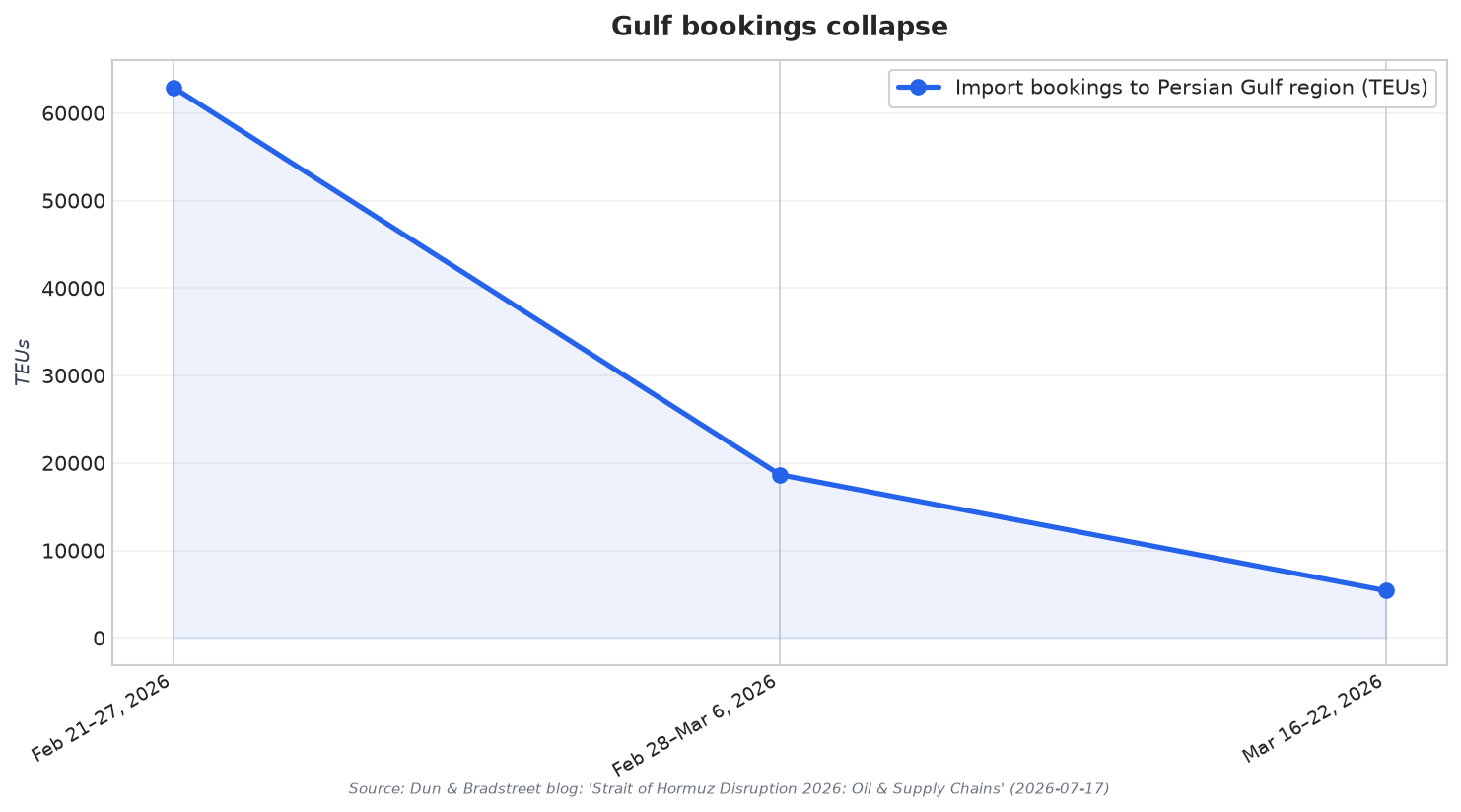
The fastest way to operationalize Saudi supply chain stress testing is to ground scenarios in what actually happened to bookings and cancellations. In the Persian Gulf region, import bookings were 62,935 TEUs in the seven days before the conflict (February 21–27). They then declined 70% to 18,663 TEUs in the next seven days, and fell a total of 91% to 5,395 TEUs between March 16 and March 22. Cancelled import bookings surged 463%, from 17,374 TEUs (February 21–27) to 97,897 TEUs (February 28–March 6), and later remained higher than booking volumes. Export activity mirrored the contraction: export bookings fell from 20,804 TEUs (February 21–27) to 8,022 TEUs (February 28–March 6), then to 1,320 TEUs (March 16–22), while export cancellations rose from 2,732 TEUs to 9,891 TEUs across the same initial window. These are the stress signals shippers should build into trigger thresholds.
What Rerouting Really Looked Like—and Where It Broke
One clear lesson from the Hormuz shock is that alternatives exist, but they do not replace capacity evenly. Dun & Bradstreet observed significant redirection to Saudi ports in the Red Sea. Import bookings there increased 68%, from 13,569 TEUs (February 21–27) to 22,861 TEUs (March 16–22). Export bookings increased 86%, from 10,396 TEUs to 19,323 TEUs across the same dates. However, even when combined with Omani volumes, Dun & Bradstreet estimates these alternatives covered 50–60% of lost export volume, but only around 20% of lost import volume. In parallel, vessels were increasingly diverted around the Cape of Good Hope, adding 10 to 14 days to transit times. A practical stress test should therefore separate “export recoverability” from “import recoverability,” and explicitly test lead-time extensions.
Shippers should also test for compounding chokepoints, not single-route failures. BCG notes that a Saudi exporter can face constraints at the Strait of Hormuz, Bab al-Mandab, and the Suez Canal, limiting reroute options across different parts of its export network. Gulf News, citing PwC analysis, adds that gateway access itself can be restricted and that cargo volumes fell sharply, with about 0.5 million containers stranded across Gulf logistics networks. PwC described the response to date as “responsive resilience” but warned that “responsive resilience alone is no longer sufficient,” calling for investment in alternative corridors, more integrated rail-ports-aviation networks, wider use of digital supply-chain tools for real-time visibility, and stronger cross-border coordination across Gulf economies. These points translate into testable requirements for visibility, corridor switching, and multimodal playbooks.
Finally, stress testing should model second-order effects that arrive through markets, not just physical stoppages. The SKEMA analysis frames Hormuz as a stress test that spills into manufacturing, aviation, global logistics, insurance, food processing, and consumer goods through higher input costs, longer lead times, and rising risk premiums. Roland Berger similarly calls the closure a systemic supply chain shock, noting the strait carries around 30% of global seaborne oil trade and roughly 20% of LNG flows each day, with key regional producers relying heavily on it. For food-linked shippers, a Systems journal study finds that in a hypothetical Hormuz stress test, trade squeeze accounts for 92.1–94.5% of modeled normalized import availability pressure, while only 39 of 161 alerted countries cross to model-Crisis or higher. The actionable takeaway is to test procurement and allocation rules under scarcity-driven “trade squeeze,” not only under direct route disruption.
How should Saudi Arabia-focused shippers structure supply chain stress testing after the Hormuz shock?
What happened to Persian Gulf import bookings right after the conflict began in 2026?
Which rerouting signal matters most for Saudi ports on the Red Sea?
Why isn’t it enough to assess the Strait of Hormuz in isolation?
In food-system modeling, what drives most import availability pressure in a Hormuz-style stress test?
Talk to us for your needs in:
- Identifying Suitable Warehouse Sites in Saudi Arabia
- Customized Logistics and Supply Chain Analytics
- Logistics Network Design and Optimization
- Green Supply Chain and Sustainable Logistics Solutions
- Supply Chain Risk Management and Compliance
- Advanced Supply Chain Resilience and Agility
- Logistics Market Research and Strategic Analysis
- In-Depth Market Survey for Logistics
- Market Intelligence and Insights in Logistics
- Feasibility Study and Assessment in Logistics
- Integrated Warehousing Management Solutions
- Smart Warehousing and Automation Systems
- Sustainable and Green Warehousing Practices
- Port and Airport Logistics Optimization
- Digital Logistics Solutions
- Saudi Logistics Benchmarking