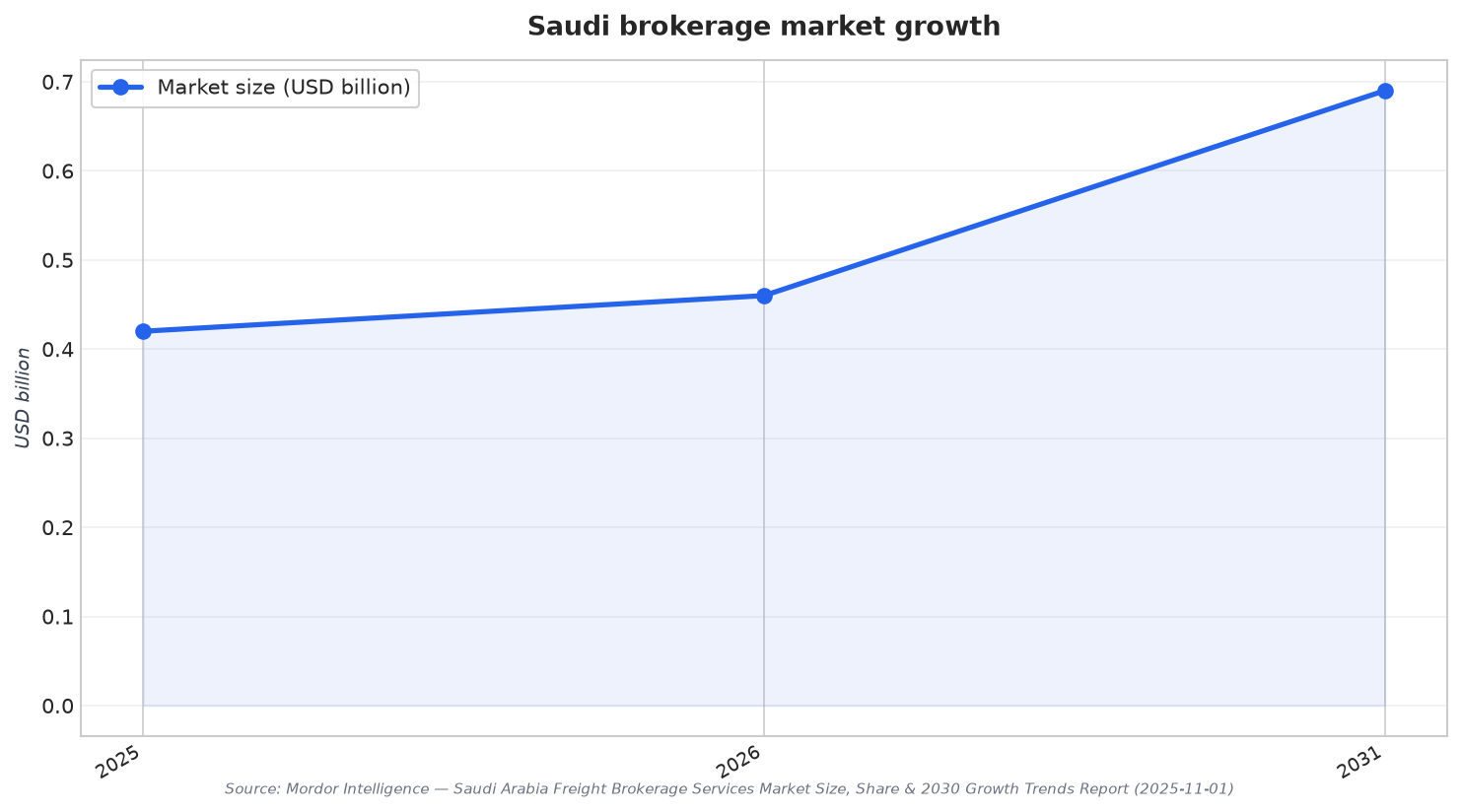
Digital freight brokers are moving from “nice-to-have” to standard operating practice in Saudi shipping, especially as the broader logistics ecosystem grows. IMARC values the Saudi Arabia logistics market at USD 55.29 billion in 2025 and expects it to reach USD 83.41 billion by 2034 at a 4.67% CAGR. In parallel, Mordor Intelligence estimates the Saudi freight brokerage services market at USD 0.42 billion in 2025, rising from USD 0.46 billion in 2026 to USD 0.69 billion by 2031, at an 8.58% CAGR (2026–2031). For shippers, this growth matters because it signals more platform-driven capacity access, more specialized service options, and more formalized compliance expectations as brokerage becomes a core logistics function.
A key operational driver is documentation and data exchange. Mordor notes that mandatory e-transport documentation, phased in nationwide through 2026, is accelerating digital platform adoption while sidelining manual operators that cannot meet real-time data-sharing requirements. This shift is visible in business-model mix: traditional brokers accounted for 89.10% of 2025 revenue, but digital freight brokerage is projected to surge at a 29.07% CAGR over 2026–2031 in Saudi Arabia. For shipper procurement teams, the practical implication is that broker evaluation increasingly includes API readiness, shipment-status visibility, and audit-friendly documentation workflows, not only price and carrier relationships.
How to Vet Digital Brokers Under TGA Licensing Expectations
When shippers talk about TGA freight broker licensing Saudi requirements, the conversation often turns into a practical checklist: can the broker support compliant e-documentation, and can it operate reliably across the lanes you ship? Market structure gives clues on where to focus. Full-truckload is the dominant service line in Saudi freight brokerage, holding 80.58% share in 2025, while less-than-truckload is projected to grow at an 11.26% CAGR through 2031. Long-haul also leads at 68.06% share in 2025, while local services are forecast to grow at 13.97% CAGR. A strong broker should show lane coverage aligned with your freight profile, and demonstrate the data capabilities needed for e-transport processes rolling through 2026.
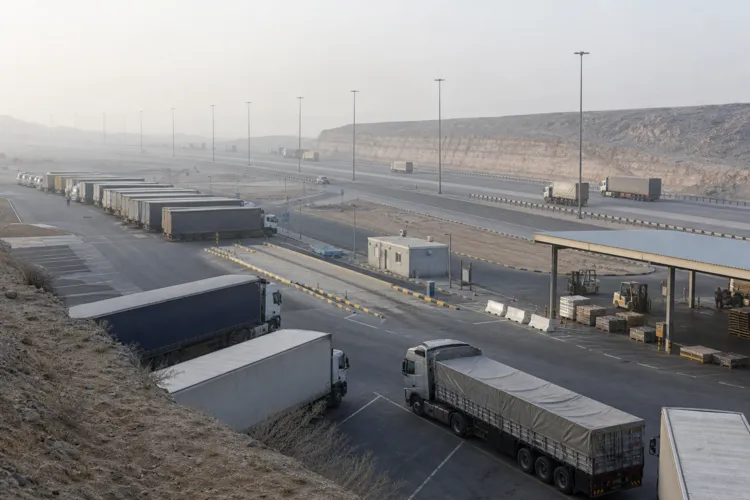
Cross-border road freight trends reinforce the need for strong digital execution, because border performance and corridor upgrades can shift routing decisions quickly. Mordor values Saudi Arabia’s cross-border road freight transport market at USD 2.57 billion in 2025, estimating USD 2.65 billion in 2026 and USD 3.54 billion by 2031, at a 5.96% CAGR (2026–2031). The same source links volume gains to factors including the four-laning of the Batha–Al Ghuwaifat corridor and near-universal two-hour electronic customs clearance via the FASAH system. Cross-border flows are also concentrated: the UAE held 47.47% of Saudi Arabia’s cross-border road freight market share in 2025. For shippers, digital brokers that can adapt routing, provide real-time visibility, and manage cross-border documentation become more valuable as these corridors scale.
Shippers can also use segment signals to choose a broker that matches commodity and handling needs. In cross-border road freight, non-refrigerated accounted for 89.07% share in 2025, yet temperature-controlled freight is advancing at a 9.57% CAGR, the steepest among segments. In domestic brokerage services, dry van accounted for 32.25% of the market in 2025, while refrigerated vans are expanding at a 14.53% CAGR through 2031. If you ship fast-moving consumer goods, pharmaceuticals, or other sensitive loads, that growth suggests more broker specialization and tighter carrier qualification. Global context also points to continued platform investment: one report values the global digital freight brokerage market at USD 4.90 billion in 2025 and expects USD 8.61 billion by 2035 (5.82% CAGR), illustrating why software-driven brokerage features like visibility and automation keep improving.
What is changing for Saudi shippers using freight brokers through 2026?
How fast is digital freight brokerage expected to grow in Saudi Arabia?
How should shippers think about TGA freight broker licensing in Saudi Arabia when selecting a digital broker?
What does the cross-border road freight outlook suggest for broker selection?
Which service types dominate Saudi freight brokerage today?
Talk to us for your needs in:
- Identifying Suitable Warehouse Sites in Saudi Arabia
- Customized Logistics and Supply Chain Analytics
- Logistics Network Design and Optimization
- Green Supply Chain and Sustainable Logistics Solutions
- Supply Chain Risk Management and Compliance
- Advanced Supply Chain Resilience and Agility
- Logistics Market Research and Strategic Analysis
- In-Depth Market Survey for Logistics
- Market Intelligence and Insights in Logistics
- Feasibility Study and Assessment in Logistics
- Integrated Warehousing Management Solutions
- Smart Warehousing and Automation Systems
- Sustainable and Green Warehousing Practices
- Port and Airport Logistics Optimization
- Digital Logistics Solutions
- Saudi Logistics Benchmarking