Saudi Arabia is expanding aviation through new airlines, airport projects, and cargo infrastructure. Spherical Insights describes a Saudi Aviation Strategy backed by approximately USD 100 billion in government and private-sector investment. The same strategy targets 330 million annual passengers by 2030, connectivity to more than 250 destinations, and 4.5 million tonnes of annual air-cargo capacity. For shippers using Riyadh as an origin, that combination matters because it links passenger growth to cargo lift. More flights and more long-haul capacity can translate into more available belly space, which can broaden routing options and make planning less dependent on a narrow set of uplift days.
Within that national push, Riyadh Air is positioned as a catalyst for new capacity centered on the capital. The Traveler reports that Riyadh Air began rolling out scheduled services after experimental operations in 2025. It also states that, in June 2026, Riyadh Air inaugurated regular flights between Riyadh and London Heathrow, adding premium long-haul capacity from the capital to a major European hub. For air freight buyers, this kind of route development can matter even when the aircraft are primarily configured for passengers. When more passenger flights operate on trunk routes, the cargo market often gains incremental lift in the hold, creating additional alternatives for time-sensitive or high-value shipments that fit belly constraints.
What Belly-hold Lift Means for Freight Choices From Riyadh
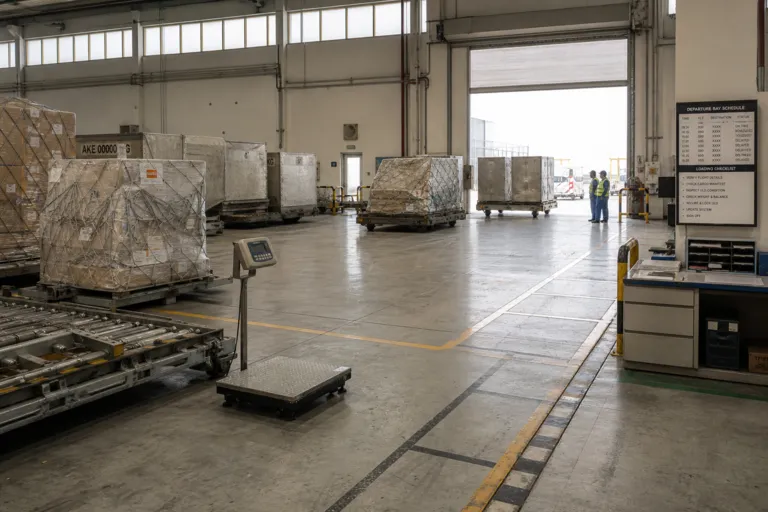
Riyadh Air’s cargo plan is explicit in its strategy coverage. Vision2030.ai reports that Riyadh Air launched Riyadh Cargo as a core pillar of commercial operations in January 2026 and described belly-hold cargo capacity across its widebody fleet as part of the strategy. The same analysis ties Riyadh Air to the wider national targets of 330 million passengers annually, more than 250 destinations, and 4.5 million tons of cargo capacity by 2030. This matters for forwarders because belly capacity is typically accessed through combination-carrier processes that move with passenger schedules. As the passenger network scales, the cargo component can improve aircraft economics, which Vision2030.ai notes as part of the logistics ambition, and that can support more consistent commercial focus on cargo sales.
Market context helps clarify why belly capacity gets attention even when freighters remain essential. Mordor Intelligence states that freighter aircraft delivered 55.60% of 2025 lift globally and remain indispensable for oversized, hazardous, or temperature-controlled cargo. It also notes that as global RPKs recover, belly capacity expands, driving a 4.22% CAGR for the belly segment through 2031. From Riyadh, this mix suggests a clearer split: freighters for loads that require main-deck flexibility, and passenger-belly space for shipments that can be built into ULDs and flow with scheduled passenger networks. In practice, added belly availability can reduce the number of scenarios where shippers must wait for a dedicated freighter departure to secure uplift.
Riyadh’s freight options are also being shaped by broader logistics spending and infrastructure development. Makreo Research says Saudi Arabia is committing significant public capital to logistics infrastructure development, including SAR 10 billion allocated to logistics parks and port expansion projects, and adds that new cargo operations, including those launched by Riyadh Air, are set to materially expand air freight capacity in the Kingdom. Taken together with the national air-cargo capacity target of 4.5 million tonnes by 2030, the direction is clear: Riyadh is being built as a stronger origin and transfer point. For shippers, the practical takeaway is more choice in uplift, more potential routings as destination connectivity expands, and a stronger business case for planning air freight directly from the capital rather than routing through alternative regional gateways.
How does Riyadh Air’s belly cargo capacity change freight options from the capital?
What cargo capacity target is Saudi Arabia aiming for by 2030?
When did Riyadh Air start a regular long-haul route that could add belly space?
Do freighters still matter if belly capacity expands?
What logistics funding is cited for Saudi infrastructure expansion?
Talk to us for your needs in:
- Identifying Suitable Warehouse Sites in Saudi Arabia
- Customized Logistics and Supply Chain Analytics
- Logistics Network Design and Optimization
- Green Supply Chain and Sustainable Logistics Solutions
- Supply Chain Risk Management and Compliance
- Advanced Supply Chain Resilience and Agility
- Logistics Market Research and Strategic Analysis
- In-Depth Market Survey for Logistics
- Market Intelligence and Insights in Logistics
- Feasibility Study and Assessment in Logistics
- Integrated Warehousing Management Solutions
- Smart Warehousing and Automation Systems
- Sustainable and Green Warehousing Practices
- Port and Airport Logistics Optimization
- Digital Logistics Solutions
- Saudi Logistics Benchmarking