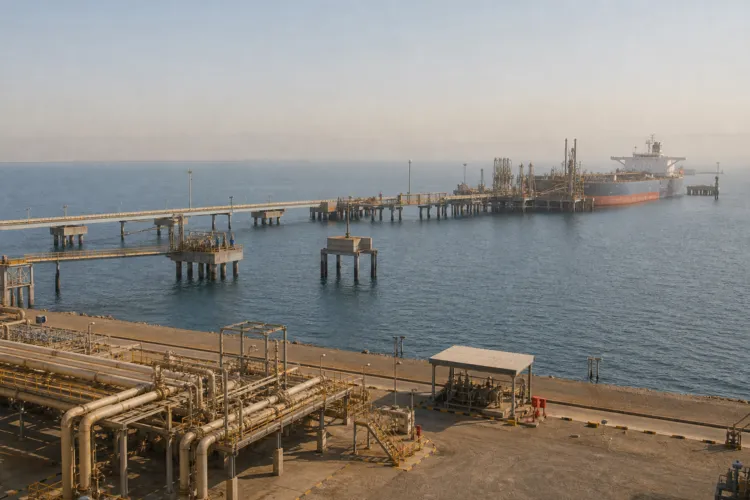
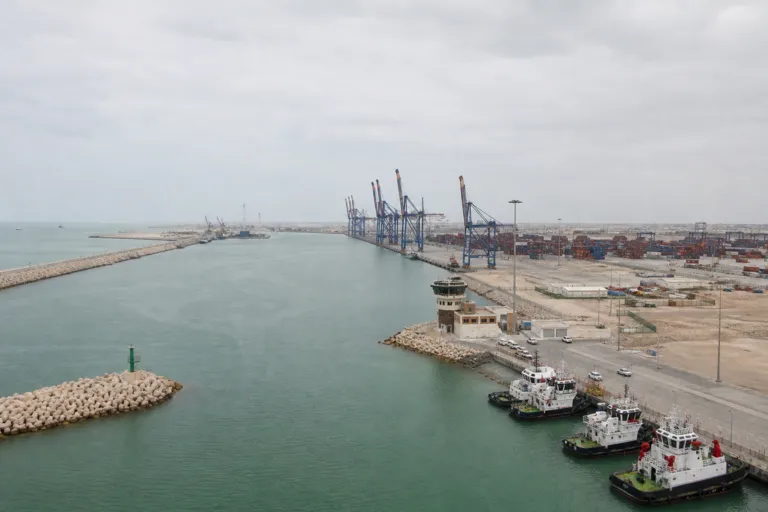
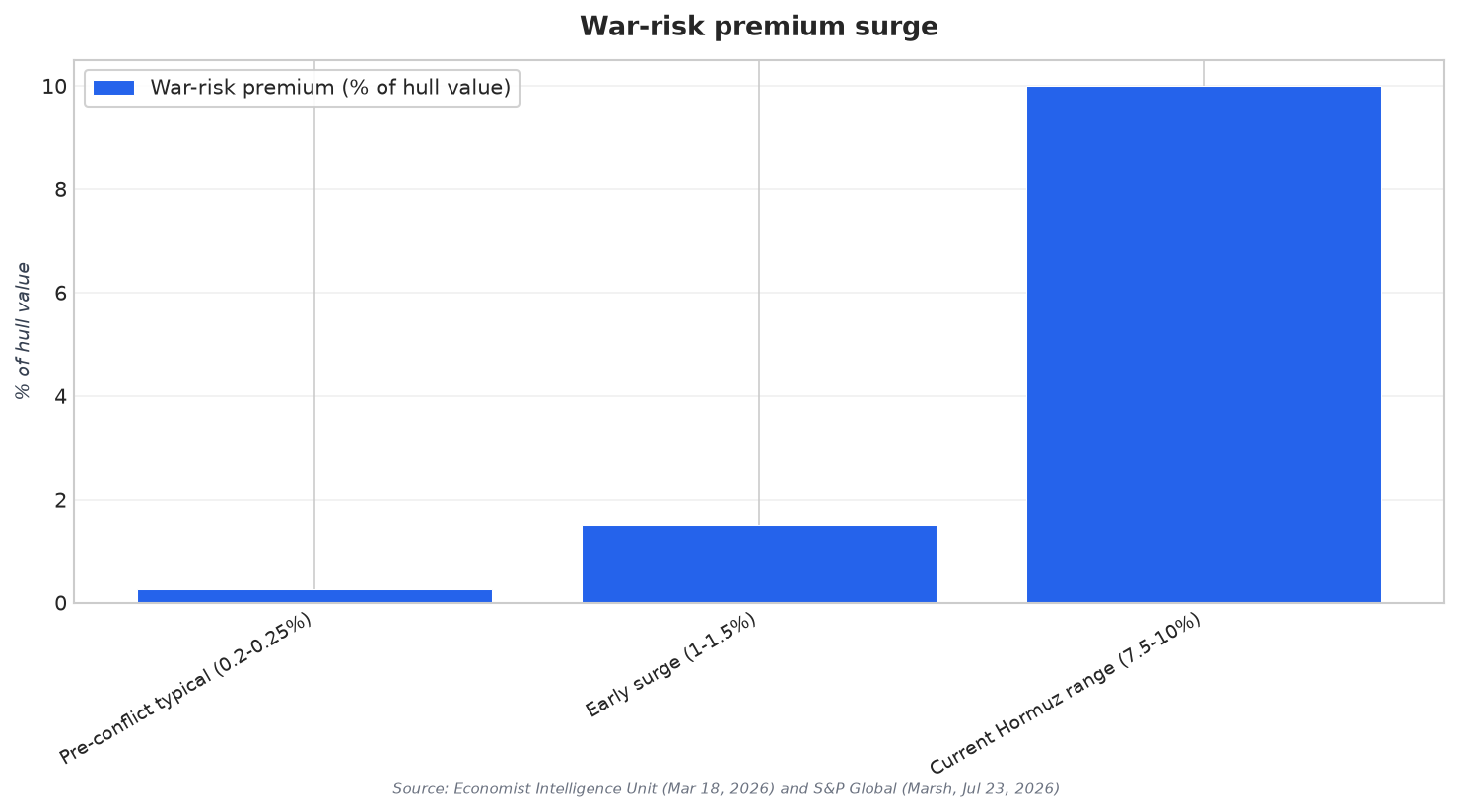
Marine insurance pricing has repriced fast as the 2026 war disrupted two chokepoints tied to Saudi trade: the Strait of Hormuz and the Bab al-Mandeb corridor. In Hormuz, S&P Global reported that additional war-risk costs that used to run between 1% and 3% of a ship’s hull value increased to between 7.5% and 10%. Traffic also fell hard versus pre-war norms. Al Jazeera cited an estimated 120-140 vessels a day before the war, then as few as two tankers a day at the height of the crisis, while S&P Global data showed 10 vessels passing on a Tuesday after 16 the prior day.
Freight rates are another layer of cost being pulled upward by risk pricing. Platts assessed the rate to carry a 270,000 metric tonne cargo of crude from the Persian Gulf to China at $77.96 per metric tonne on July 22, stable since July 20, after edging up from $73.80 per metric tonne at the previous assessment. Al Jazeera also described the $77.96 per metric tonne level as four times the five-year average of $18.91 per metric tonne, and noted a March peak of about $140 per metric tonne. This combination matters for Saudi-linked shipments because it raises delivered costs even when cargo moves.
Why Saudi-Linked Voyages Price So Differently by Port and Route
War-risk pricing is not uniform, and the Red Sea illustrates how quickly the market can redraw risk boundaries for Saudi ports. Reuters reporting summarized by Beinsure said indicative war-risk premiums rose to about 0.75% of vessel value after Yemen’s Iran-linked Houthis declared a naval blockade against Saudi Arabia, versus near 0.3% before. After attacks on Saudi tankers, premiums for southern Red Sea voyages rose above 1%, and some Saudi-linked ships received quotes as high as 3% near Jizan, Al Shuqaiq, and the Bab el-Mandeb route into the Gulf of Aden. Northern ports drew lower quotes at the time, with Jeddah and Yanbu priced near 0.1% in that snapshot.
As risk designations changed, quoted pricing for Saudi-linked liftings rose again. Beinsure reported that the Joint War Committee moved its Red Sea notification line north after attacks on Saudi-linked vessels, and Reuters later reported premiums for ports north of Jizan, including Jeddah and Yanbu, jumping to 1% from 0.25% earlier that week. By late September, Insurance Journal reported Reuters-sourced quotes putting war-risk premiums for Saudi-linked tankers calling at Yanbu at around 3% of a vessel’s value. The same report said ports south of Yanbu, including Jizan, could see quoted premiums rise as high as 7%, while Hormuz transits ranged between 6% and 9%.
For planners, the practical issue is how often these costs can reset and how large they can become over a single voyage. Insurance Journal said war-risk premiums typically cover 7-day voyage periods and are reviewed every 24 hours, meaning a journey from Yanbu could cost $3 million, or some $7 million from other Saudi ports further south or via Hormuz, up from at least $100,000 before the war. The Economist Intelligence Unit noted earlier in the conflict that premiums that previously averaged 0.2%-0.25% of a vessel’s value climbed to 1%-1.5% in recent days, and added that most tankers are valued between $200 million and $300 million. In this environment, route choice, port calls, and ship affiliation can change the insurance bill as much as distance does.
What is driving Gulf war risk insurance premiums higher in 2026?
How much did Hormuz war-risk pricing change versus earlier levels?
What freight rate did Platts assess for Gulf-to-China crude during the surge?
How do Red Sea war-risk quotes differ across Saudi ports?
How often are war-risk premiums reviewed, and what voyage costs were reported?
Talk to us for your needs in:
- Identifying Suitable Warehouse Sites in Saudi Arabia
- Customized Logistics and Supply Chain Analytics
- Logistics Network Design and Optimization
- Green Supply Chain and Sustainable Logistics Solutions
- Supply Chain Risk Management and Compliance
- Advanced Supply Chain Resilience and Agility
- Logistics Market Research and Strategic Analysis
- In-Depth Market Survey for Logistics
- Market Intelligence and Insights in Logistics
- Feasibility Study and Assessment in Logistics
- Integrated Warehousing Management Solutions
- Smart Warehousing and Automation Systems
- Sustainable and Green Warehousing Practices
- Port and Airport Logistics Optimization
- Digital Logistics Solutions
- Saudi Logistics Benchmarking