Saudi Arabia is opening a new overland trade path to Jordan. Saudi Arabia Railways (SAR) launched an international rail logistics corridor that links ports in the Kingdom’s Eastern Region with the Al-Haditha border crossing. The goal is a direct land route for cargo to Jordan and countries north of the Kingdom. This matters for supply chains that need stable and predictable routes.
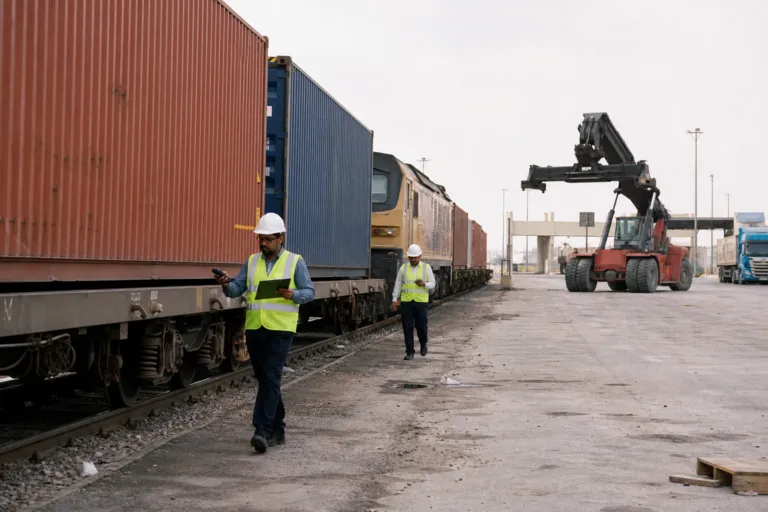
The Saudi-Jordan rail freight service connects three major ports to the northern border through the national rail network. The linked ports are King Abdulaziz Port, King Fahd Industrial Port, and Jubail Commercial Port. Cargo moves by rail to Al-Haditha, and then it can continue onward into Jordan and the wider region. SAR also designed the corridor for return flows, so goods can move back to the ports using the same network.
Three figures define the corridor’s scale: it extends for more than 1,700 kilometres, each train can carry more than 400 standard containers, and one report says it “halves transit times for containerised cargo.” These numbers show why the corridor is positioned as a faster option than existing land freight choices.
Why This Corridor Changes Levant-Gulf Logistics
The corridor is built to improve efficiency and reliability in freight transport. SAR frames it as support for export and re-export activity. Moving some cargo from road to rail may also reduce the number of heavy goods vehicles on highways, with potential impacts on road maintenance, safety, and emissions. For shippers, the biggest operational change is a continuous rail path between Gulf ports and the northern border.
Saudi statements also link the launch to wider supply chain planning. Transport Minister Saleh Al-Jasser described the corridor as a “practical model for integrating modes of transportation.” He added that SAR supports diversification of trade routes and boosting the flow of goods movement. He also pointed to limiting reliance on long-distance trucking and improving how logistics assets and supply chain operations are used.
Jordan’s role grows as this rail link reaches the border. One report says the Al-Haditha border point is a key land entry on Saudi Arabia’s northern frontier and handles goods flows between Saudi Arabia, Jordan, and onward to markets in the Levant and beyond. Another source says Saudi Arabia and Jordan have deepened trade ties, with bilateral trade reaching $29.7 billion over the six years from 2018 to 2024, based on data from the Amman Chamber of Commerce. Together, these points explain why a border-connected rail corridor can reshape the Levant-Gulf supply chain corridor.
What is the Saudi-Jordan rail freight service?
Which ports are connected to Al-Haditha on this corridor?
How long is the corridor and how much can each train carry?
Can the corridor support cargo moving both ways?
Why does this corridor matter for Saudi-Jordan trade?
Talk to us for your needs in:
- Identifying Suitable Warehouse Sites in Saudi Arabia
- Customized Logistics and Supply Chain Analytics
- Logistics Network Design and Optimization
- Green Supply Chain and Sustainable Logistics Solutions
- Supply Chain Risk Management and Compliance
- Advanced Supply Chain Resilience and Agility
- Logistics Market Research and Strategic Analysis
- In-Depth Market Survey for Logistics
- Market Intelligence and Insights in Logistics
- Feasibility Study and Assessment in Logistics
- Integrated Warehousing Management Solutions
- Smart Warehousing and Automation Systems
- Sustainable and Green Warehousing Practices
- Port and Airport Logistics Optimization
- Digital Logistics Solutions
- Saudi Logistics Benchmarking