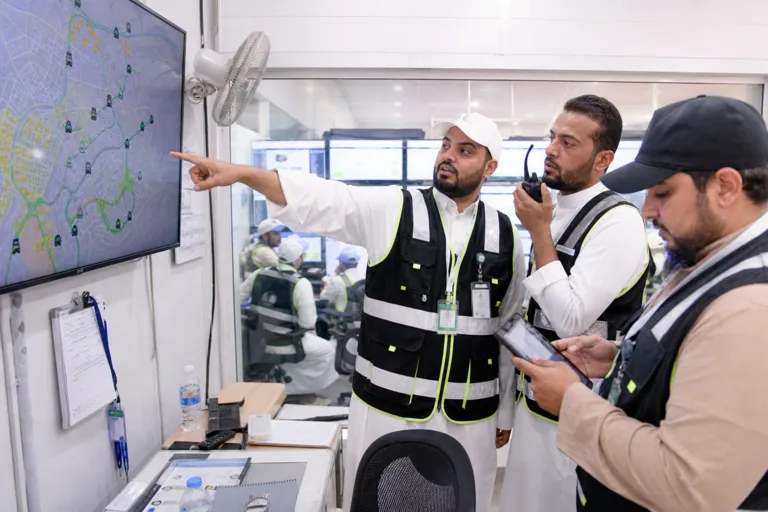
Hajj 1447 logistics operations can be understood as a system built to move, cool, and protect pilgrims through a fixed set of rituals and locations under tight timing. The Hajj is one of Islam’s five pillars and happens once a year during a specific period in the final month of the Islamic calendar. It is also one of the largest annual human gatherings in the world, which turns pilgrimage planning into crowd management, transport coordination, and safety enforcement. Saudi Arabia holds significant authority over pilgrimage logistics, including visa issuance and access, and officials frame that control as a response to overcrowding and safety concerns.
Scale is the first operational constraint. In 2025 reporting, Saudi Arabia said 1,475,230 pilgrims from abroad had arrived since Sunday, and the BBC separately reported that more than 1.4 million Muslims had begun the pilgrimage that year. Those figures illustrate why operational plans must prioritize flow and access, not only religious guidance. The New York Times also described how most pilgrims travel to Saudi Arabia well in advance, using the time to visit Medina, pray in Mecca’s grand mosque, and perform Umrah. That staging period still depends on permissions and regulated entry points, which are part of the logistics control system.
Heat, Permits, and Movement: The Operational Core
Heat risk shapes the most visible safety steps and becomes central to Hajj 1447 logistics operations. The BBC reported temperatures forecast to reach 44C (111F), and said Saudi authorities planted thousands of trees and installed hundreds of cooling units to help alleviate conditions. The Saudi health ministry urged strict guidelines, including avoiding exposure to the sun between 10:00 and 16:00, using umbrellas, and drinking water regularly. These are operational controls, not just advice, because they are intended to reduce preventable harm during peak movement hours when congestion and exposure are highest.
Permit enforcement is also presented as a safety tool. The New York Times reported that last year the Saudi government said more than 1,300 pilgrims died, many from Egypt, and that most of those who perished had been unregistered, meaning they had made the trip without the permits that gave them access to heat protections. That connection between registration and access indicates why logistics planning links identity checks, controlled entry, and service eligibility. In this framing, the operational system is designed to limit unmanaged crowding and align protective resources with permitted pilgrim flows.
Physical movement between sites is another core planning challenge. The BBC described pilgrims heading to Mecca’s Grand Mosque and then traveling to Mina, 5km (3 miles) away, where they spend the night in a tent city before heading to Mount Arafat. Managing those transitions requires timed departures, route control, and integration with transport capacity. Newsweek noted Saudi Arabia’s emphasis on access and connectivity, quoting a Public Investment Fund statement that King Salman Gate would have a “seamless connection to public transportation networks” to ensure “easy access and comfort.” Even when projects are broader than Hajj itself, the stated transport linkage aligns with crowd movement needs.
Long-term intent sits behind these operational priorities. Newsweek reported Saudi Arabia aims to host 30 million pilgrims annually for both Hajj and year-round Umrah by 2030, reinforcing why transport access, safety controls, and capacity planning are treated as strategic infrastructure issues. At the same time, sources stress that the Hajj can be daunting because of its scale, practical difficulties, physical exertion, and the pressure to get it right. The operational playbook for Hajj 1447 logistics operations, as reflected in these reports, is therefore built around controlled access, managed movement, and heat mitigation in the places and time windows where risk concentrates.
What does “Hajj 1447 logistics operations” focus on, based on reported details?
Why are permits tied to safety during Hajj?
What heat precautions were highlighted for pilgrims?
What scale indicators show why logistics planning is complex?
What longer-term capacity goal was reported for pilgrimage volumes?
Talk to us for your needs in:
- Identifying Suitable Warehouse Sites in Saudi Arabia
- Customized Logistics and Supply Chain Analytics
- Logistics Network Design and Optimization
- Green Supply Chain and Sustainable Logistics Solutions
- Supply Chain Risk Management and Compliance
- Advanced Supply Chain Resilience and Agility
- Logistics Market Research and Strategic Analysis
- In-Depth Market Survey for Logistics
- Market Intelligence and Insights in Logistics
- Feasibility Study and Assessment in Logistics
- Integrated Warehousing Management Solutions
- Smart Warehousing and Automation Systems
- Sustainable and Green Warehousing Practices
- Port and Airport Logistics Optimization
- Digital Logistics Solutions
- Saudi Logistics Benchmarking