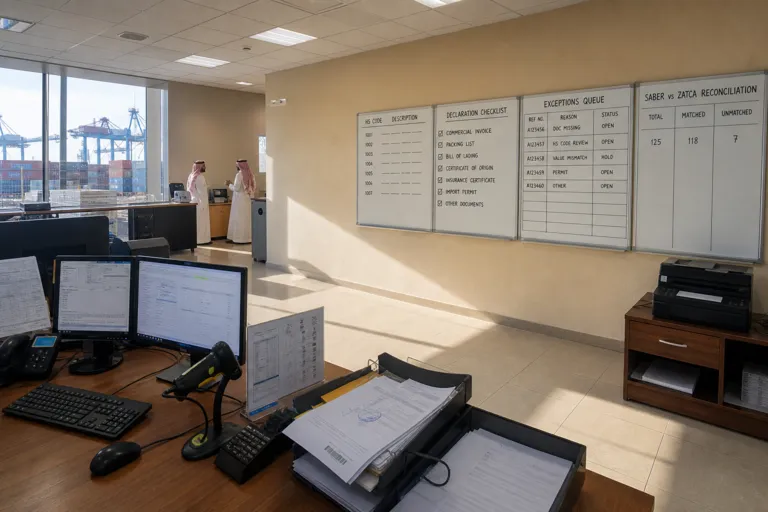
In Saudi Arabia, shipment clearance is no longer only about having documents in hand. It is about getting the same product identity to match across digital systems run or supervised by different authorities. SABER manages product registration and conformity for SASO-regulated goods, while ZATCA administers customs procedures and tariffs. FASAH, Saudi Arabia’s unified digital single-window for trade clearance, is the point where customs declarations, duty and VAT payment, permit validation, and release notifications come together. This is why synchronization matters: if the data does not align, the shipment does not move smoothly through the gate.
The most common technical trigger is HS code inconsistency. HS codes are described as the “primary gateway for customs compliance and regulatory approval,” and in Saudi Arabia they sit in a 12-digit HS code system. The same classification also determines how a product maps inside SABER to the applicable technical regulations and the safety and quality standards required by SASO and, where relevant, SFDA. Customs processes rely on HS codes for tariff determination, and accurate coding reduces the likelihood that shipments are flagged for manual inspection or delayed by disputes. When the product classification is wrong or outdated, the risk becomes operational, not theoretical.
Where the Mismatch Happens: SABER Certificates vs. ZATCA’s 2026 Tariff
Multiple sources describe the same bottleneck: a shipment can be held when the HS code on the customs declaration does not match the HS code recorded on the SABER certificate. Carra Globe warns that existing Product Certificates registered in SABER before an update may carry HS codes that no longer match the current 2026 ZATCA tariff list. When the importer files the FASAH declaration using a 2026 HS code that differs from the code registered in SABER, the system can flag a mismatch and the shipment is held. This is the practical reason many teams treat SABER-to-ZATCA alignment as a shipment gating step, not a back-office cleanup task.
It also helps to understand what SABER is, and what it is not. SABER is not itself a certification body. It is a digital gateway through which SASO-approved Conformity Assessment Bodies issue certificates. SABER, the Product Certificate of Conformity (PCoC), and the Shipment Certificate of Conformity (SCoC) are different things, and the SCoC is issued per consignment. That structure is why shipment-level execution matters: even if a product is registered, the consignment still needs the right certificate flow, with the right HS code and the right technical regulation selection tied to it.
In practice, import readiness is an integration problem across agencies and systems. The Saudi Gate lists key entities involved in the import process, including SASO, ZATCA, SFDA, CST, and MISA, and notes that each product category may require multiple approvals. Carra Globe summarizes the operational reality as the interplay between FASAH declarations, SABER product conformity, CST telecom approvals, and SFDA medical registrations—four separate digital systems that must align before a single shipment clears. For logistics and warehouse operators, FASAH adds another hard requirement: every inbound shipment entering Saudi Arabia requires a customs declaration (Bayan) to be submitted electronically through FASAH before arrival. That is why teams increasingly formalize SABER ZATCA compliance integration as a single workflow, centered on consistent HS coding and synchronized declarations.
Why does SABER and ZATCA synchronization affect whether a shipment clears?
What is FASAH, and why does it matter for inbound cargo?
How do HS codes connect SABER requirements to customs clearance?
What is the difference between SABER, PCoC, and SCoC?
What does a practical SABER-to-ZATCA compliance integration focus on?
Talk to us for your needs in:
- Identifying Suitable Warehouse Sites in Saudi Arabia
- Customized Logistics and Supply Chain Analytics
- Logistics Network Design and Optimization
- Green Supply Chain and Sustainable Logistics Solutions
- Supply Chain Risk Management and Compliance
- Advanced Supply Chain Resilience and Agility
- Logistics Market Research and Strategic Analysis
- In-Depth Market Survey for Logistics
- Market Intelligence and Insights in Logistics
- Feasibility Study and Assessment in Logistics
- Integrated Warehousing Management Solutions
- Smart Warehousing and Automation Systems
- Sustainable and Green Warehousing Practices
- Port and Airport Logistics Optimization
- Digital Logistics Solutions
- Saudi Logistics Benchmarking