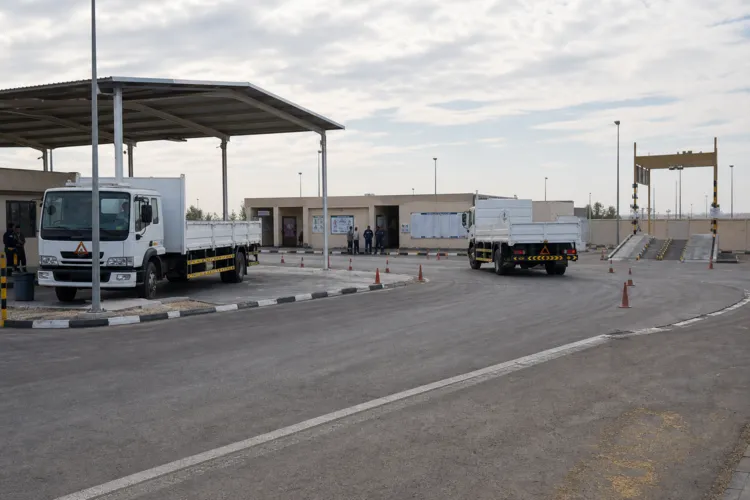
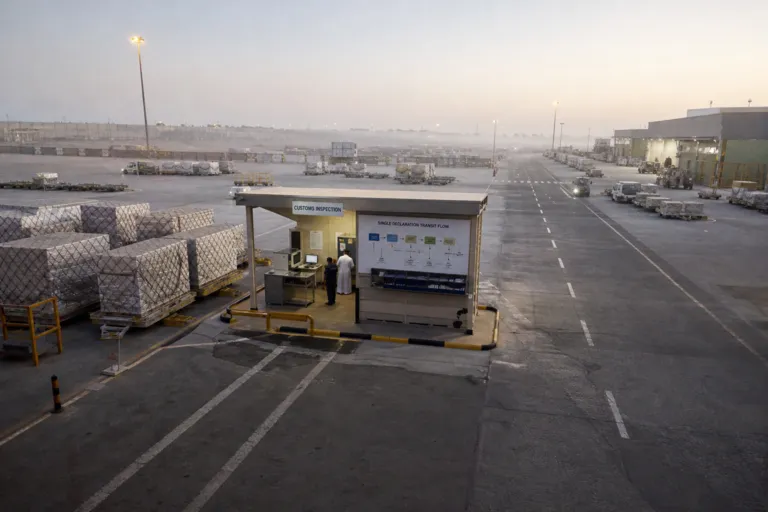
In March 2026, Saudia Cargo, the Saudi Ports Authority (Mawani), and ZATCA launched a sea-to-air logistics corridor through Saudi Arabia’s western ports. Ocean cargo arrives at Red Sea gateways, chiefly Jeddah Islamic Port, and then transfers to air freight for onward distribution across the region and into Africa and Europe. The operational idea is straightforward, but the differentiator is administrative: ZATCA links the sea and air gateways under a single transit framework, enabling one declaration with pre-clearance and smart inspection rather than two separate clearances. This is the core of a Saudi sea-to-air customs declaration approach that is designed to remove friction at the modal handoff.
The corridor is being positioned for time-sensitive freight such as pharmaceuticals, perishables, and high-value e-commerce. The stated appeal is a box moving from berth to runway in a fraction of the usual dwell time, combining sea rates for most of the journey with air speed on the final leg. Saudia Cargo then feeds shipments into a network reaching roughly 100 airport destinations, widening routing options for shippers that need speed without relying on end-to-end air cargo. The initiative is also framed as a hub play rather than a one-off service, built to scale repeatable transit flows through Saudi gateways.
Why Routing Choices Are Shifting Toward Saudi Gateways
Shipper attention has shifted in 2026 as risk considerations reprice Gulf routings. One source ties this change to uncertainty around the Strait of Hormuz, which pushed cargo owners to seek gateways that do not depend on a single chokepoint. In parallel, a separate report describes the Strait of Hormuz as being under an effective Iranian blockade since early March and notes it is a passage through which roughly 20% of global seaborne oil and 20% of global liquefied natural gas transits daily. Against that backdrop, Saudi Arabia is described as a beneficiary as volume moves onto land bridges and toward ports facing away from the strait, including options on the Red Sea coast.
Capacity and connectivity on the Red Sea side are part of the corridor story. Jeddah Islamic Port handled just over 3 million TEU in 2024 and now carries capacity above 10 million TEU, with King Abdullah Port adding another 5 million, according to the same logistics trends source. Mawani has also supported feeder services such as the Red Sea Express, linking Jeddah and Yanbu with Egypt’s Ain Sokhna and Jordan’s Aqaba. For inland positioning, another industry source points to Riyadh’s inland clearance complex with 950,000 TEUs capacity, described as a way to shift container flow off congested quays and move inventory closer to the Kingdom’s largest consumption cluster.
The sea-to-air corridor sits inside Saudi Arabia’s National Transport and Logistics Strategy, launched in June 2021 under Vision 2030. The program is backed with about USD 133 billion of planned investment and includes a stated aim of becoming a top-ten global logistics hub connecting three continents. Multiple sources also emphasize geography as a structural advantage, noting that nearly 13% of global trade flows through corridors along Saudi Arabia’s Arabian Gulf and Red Sea. For context on multimodal performance, global sea-air logistics research describes sea-air as typically cutting pure ocean transit times by 40–60% while maintaining 70–80% cost savings versus exclusive air cargo, underscoring why hybrid routings gain attention when speed and cost must be balanced.
What is Saudi Arabia’s single-declaration sea-to-air corridor?
How does the customs setup reduce delays in sea-to-air transfers?
Which Saudi port and air network elements are highlighted for the corridor?
What capacity figures are cited for Jeddah and nearby Saudi Red Sea infrastructure?
How should shippers think about a Saudi sea-to-air customs declaration in today’s routing environment?
Talk to us for your needs in:
- Identifying Suitable Warehouse Sites in Saudi Arabia
- Customized Logistics and Supply Chain Analytics
- Logistics Network Design and Optimization
- Green Supply Chain and Sustainable Logistics Solutions
- Supply Chain Risk Management and Compliance
- Advanced Supply Chain Resilience and Agility
- Logistics Market Research and Strategic Analysis
- In-Depth Market Survey for Logistics
- Market Intelligence and Insights in Logistics
- Feasibility Study and Assessment in Logistics
- Integrated Warehousing Management Solutions
- Smart Warehousing and Automation Systems
- Sustainable and Green Warehousing Practices
- Port and Airport Logistics Optimization
- Digital Logistics Solutions
- Saudi Logistics Benchmarking