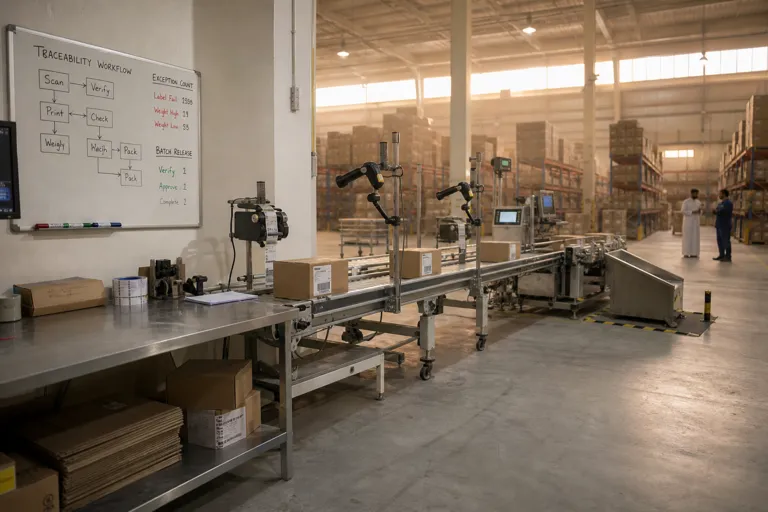
Saudi Arabia is frequently discussed as an early mover on pharmaceutical serialization within the GCC. A market report notes that GCC countries, particularly Saudi Arabia and the United Arab Emirates, have mandated RFID-based serialization for pharmaceutical products at distribution and warehouse levels, citing the Saudi Food and Drug Authority (SFDA) and the UAE Ministry of Health. For pharma distributors and 3PLs, that shifts the operational question from “Do we need traceability?” to “Are our warehouse processes, scanning points, and data flows ready to handle serialized units consistently?” In practice, readiness is not only about printing codes upstream. It is about receiving, storing, picking, shipping, and reconciling serialized product data without disrupting throughput.
At the core, serialization assigns a unique identifier to every saleable unit. A serialization guide describes how this identifier is built from a product identifier, a lot number, and an expiration date, then encoded into a 2D DataMatrix barcode on the package. It also emphasizes that events involving the unit, such as commissioning, shipping, receiving, and dispensing, get reported so a full chain of custody can be reconstructed. For distributors and 3PLs, this means inbound receiving needs to capture package-level identifiers, and outbound shipping needs to send accurate event information to the next trading partner. The same guide frames the value clearly: the ability to scan a single package and verify authenticity, status, and whether it has been reported stolen, diverted, or recalled.
Serialization Readiness for Distributors and 3PLs: What to Build First
Readiness is an operational program, not a single IT project. A DSCSA vs. EU FMD comparison article outlines the building blocks ops teams must align: packaging equipment, clean master data, systems integration, partner connectivity, testing, and trained teams. Even when you are not the manufacturer, distributors and 3PLs still depend on clean product and partner master data to keep serialized events usable across systems. Another industry article adds that compliance infrastructure must share extensive master data (product, partner, and company) and transactional event information coupled to operational triggers. Practically, that points to disciplined onboarding and data governance, plus warehouse workflows that reliably trigger the right events at receiving and shipping.
Global comparisons can help planning, as long as the geography is explicit. In the United States, DSCSA is a federal law signed in 2013 with a ten-year implementation timeline, and one source notes FDA delayed the final enforcement deadline by a year to November 27, 2024. Another guide states that FDA exemptions from specified section 582 requirements ran through May 27, 2025 for manufacturers and repackagers, August 27, 2025 for wholesale distributors, and November 27, 2025 for dispensers with 26 or more full-time employees, while a limited small-dispenser exemption continues through November 27, 2027 under stated eligibility conditions. A wholesaler-focused DSCSA guide also highlights August 27, 2025 as the key wholesaler date and describes a mandatory transition to a fully electronic, interoperable system, with secure EPCIS data exchange and package-level verification for every transaction.
To operationalize SFDA drug track and trace expectations, distributors and 3PLs can borrow the same “critical path” mindset described in the DSCSA vs. EU FMD guide: partner connectivity can be faster through shared network onboarding than bespoke point-to-point links, and readiness gaps can disrupt compliant product movement. In parallel, serialization guides stress why unit-level traceability matters: it supports patient safety, counterfeit prevention, and more precise recalls by identifying specific units instead of pulling entire lots. For logistics teams, the practical output is a warehouse that can ingest serialized identifiers, maintain integrity through internal moves, and exchange the right event data to keep product flowing without exceptions.
How should distributors interpret SFDA drug track and trace readiness at the warehouse level?
What data elements are typically tied to a serialized unit identifier?
Why do partner connections matter so much for serialization programs?
Which DSCSA dates are useful as global context for planning serialization operations?
Talk to us for your needs in:
- Identifying Suitable Warehouse Sites in Saudi Arabia
- Customized Logistics and Supply Chain Analytics
- Logistics Network Design and Optimization
- Green Supply Chain and Sustainable Logistics Solutions
- Supply Chain Risk Management and Compliance
- Advanced Supply Chain Resilience and Agility
- Logistics Market Research and Strategic Analysis
- In-Depth Market Survey for Logistics
- Market Intelligence and Insights in Logistics
- Feasibility Study and Assessment in Logistics
- Integrated Warehousing Management Solutions
- Smart Warehousing and Automation Systems
- Sustainable and Green Warehousing Practices
- Port and Airport Logistics Optimization
- Digital Logistics Solutions
- Saudi Logistics Benchmarking