Trucking contracts in Saudi Arabia are being rewritten around diesel volatility. In an annual review, Saudi Aramco raised diesel prices by 7.8% to SR1.79 per litre, and industry players described this as part of a multi-year transition away from heavily subsidised fuel. Logistics providers have responded by rethinking routing, asset utilisation, and contract structures, because road freight dominates domestic cargo movement, connecting ports such as Jeddah Islamic Port and King Abdulaziz Port in Dammam with manufacturing zones and distribution centres nationwide. In this environment, the safest commercial question is not whether diesel will move again, but how your agreements will adapt when it does.
That shift is clearer when viewed against the earlier price regime. Diesel prices in Saudi Arabia remained unchanged for decades prior to 2015, fixed at SR0.25 per litre. The first major reset came in December 2015, when prices jumped by 80% to SR0.45 per litre as part of wider reforms to fuel and electricity prices. The 2026 revision was framed as a signal that diesel pricing has largely transitioned to a market-linked framework. For shippers and carriers, this makes predictability a contract-design problem, not a forecasting exercise, especially where domestic lanes and dedicated capacity rely on stable line-haul pricing.
How to Build Fuel Surcharge Clauses That Hold Up
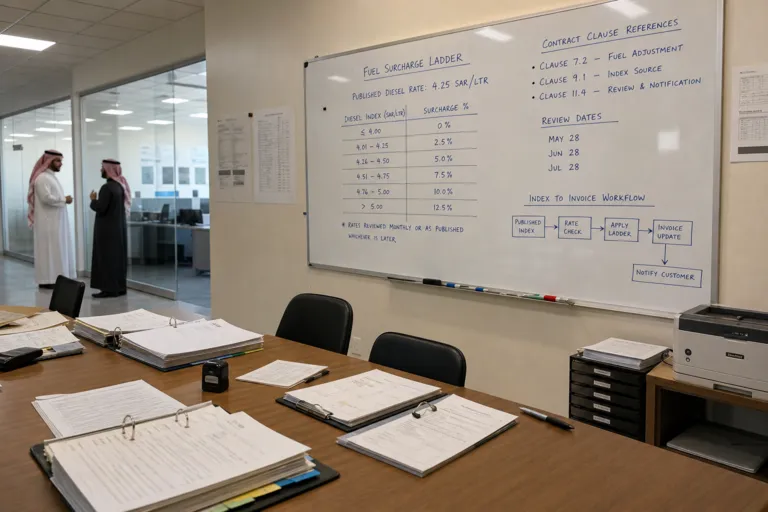
A workable approach is to index a fuel surcharge to an observable diesel benchmark and let it move automatically. One industry playbook describes a surcharge indexed to actual diesel costs as a way to protect both the carrier and the shipper: when fuel rises, the surcharge adjusts; when it drops, the cost declines too. In Saudi Arabia, large logistics providers are increasingly shifting to fuel surcharge models indexed to Aramco’s published rates, explicitly transferring part of the volatility to customers. Contract language should define the reference price source, the adjustment frequency, and how the surcharge is applied on top of a base rate, so the mechanism replaces repeated renegotiations.
Global supply events are another reason to formalize the mechanism. A regional example noted that the UAE scaled back offshore production and Saudi Arabia joined the cuts days later, while attacks on infrastructure near refineries added pressure on global supply; the trucking industry felt ripple effects as pump prices began climbing. Separate macro analysis also notes that major crude producers with substantial domestic refining capacity, such as Saudi Arabia and Canada, are structurally better positioned to absorb a supply shock than economies reliant on imported refined products. But being better positioned does not remove exposure; it simply changes how quickly higher feedstock costs flow through freight pricing and customer conversations.
Operators should also align surcharge clauses with how fuel actually behaves in cost stacks and markets. In the US, using line items from the American Transportation Research Institute’s Operational Costs of Trucking report, fuel is calculated at roughly a fifth of average marginal cost per mile, and that share climbs whenever diesel spikes; while this is North American context, it illustrates why carriers protect margins through fuel surcharges and frequent repricing. For Saudi diesel price trucking costs, the practical takeaway is to keep the base rate focused on service and capacity, and keep fuel treated as a transparent variable tied to the agreed benchmark. That structure supports growth, in a market IMARC values at USD 74.7 Billion in 2025, expected to reach USD 136.1 Billion at a CAGR of 6.90% during 2026-2034.
What changed in Saudi Arabia’s diesel pricing in 2026?
How can contracts handle Saudi diesel price and trucking cost volatility without constant renegotiation?
What were Saudi Arabia’s historical fixed diesel price points mentioned in the sources?
Why do fuel surcharges matter during supply shocks?
Talk to us for your needs in:
- Identifying Suitable Warehouse Sites in Saudi Arabia
- Customized Logistics and Supply Chain Analytics
- Logistics Network Design and Optimization
- Green Supply Chain and Sustainable Logistics Solutions
- Supply Chain Risk Management and Compliance
- Advanced Supply Chain Resilience and Agility
- Logistics Market Research and Strategic Analysis
- In-Depth Market Survey for Logistics
- Market Intelligence and Insights in Logistics
- Feasibility Study and Assessment in Logistics
- Integrated Warehousing Management Solutions
- Smart Warehousing and Automation Systems
- Sustainable and Green Warehousing Practices
- Port and Airport Logistics Optimization
- Digital Logistics Solutions
- Saudi Logistics Benchmarking