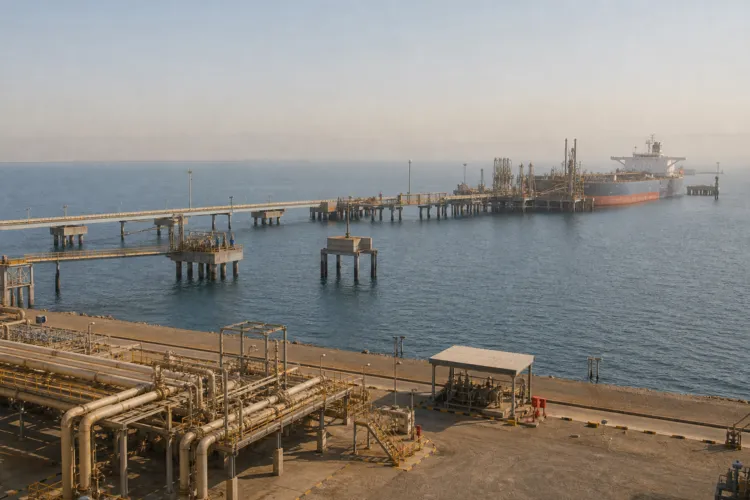
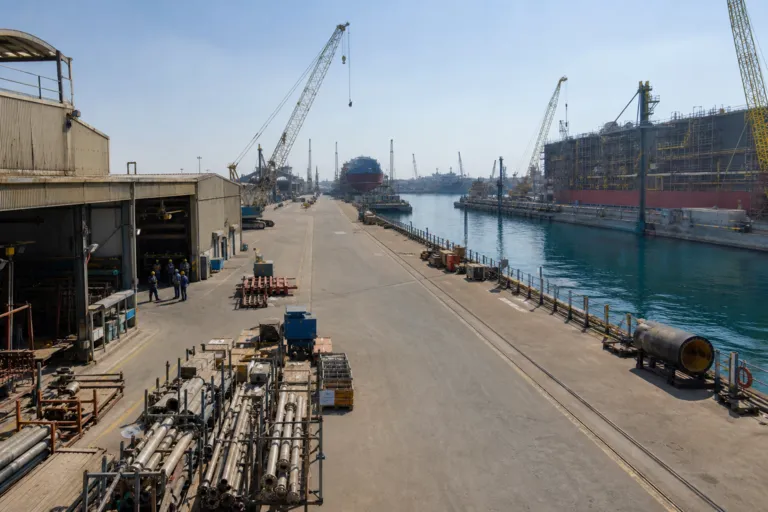
Saudi Arabia’s localization push in maritime industries is increasingly tied to Ras Al-Khair. The King Salman Global Maritime Industries Complex is a shipyard in Ras Al-Khair that began development after a November 2015 memorandum of understanding between Saudi Aramco and Hyundai Heavy Industries (HHI) on developing marine industry in the Kingdom, including a large shipyard. In January 2016, the partnership expanded with another MoU that included the National Shipping Company of Saudi Arabia (Bahri) and Maritime Offshore Limited (a Lamprell subsidiary), alongside Saudi Aramco and HHI. These early steps frame localization as a supply chain strategy, not only an infrastructure project.
Ras Al-Khair’s yard buildout also has defined logistics implications because it concentrates shipbuilding, repair, and offshore work in one place. The Wikipedia entry describes four major operating areas: shipbuilding, ship repair, oil rig construction, and oil rig support. It also states the facility will be about 4.96 square kilometres (1,230 acres) with several dry docks and at least 15 separate piers. Separately, Grokipedia characterizes the complex as spanning approximately 5 by 4 kilometers and supporting shipbuilding, repair, maintenance, and fabrication of offshore structures and rigs. For planning Ras Al Khair maritime yard logistics, these stated zones and waterfront assets are a direct cue about material flows, berth scheduling, and contractor staging.
From Construction Contracts to Local Content: What Changes in the Supply Chain
Multiple sources connect physical capacity to an explicit localization narrative. A Saudi market research article describes IMI’s Ras Al-Khair shipyard as “the largest full-service maritime facility in the MENA region,” and says full operations are scheduled for 2026 for the shipyard and 2027 for an engine plant. It also lists expected assets once completed: three large docks, four Goliath cranes, and seven berths, enabling construction of up to 40 vessels annually. The same source links supply chain depth to newbuild programs and offshore capability, citing an IMI and ARO agreement for a jack-up rig, KINGDOM 4, and noting KINGDOM 3 as the first offshore jack-up drilling rig built in Saudi Arabia.
Localization is reinforced by manufacturing that is planned to be co-located at Ras Al-Khair. Wikipedia reports a July 2017 MoU for a $400 million factory to build medium speed marine diesel engines at the complex, involving HHI, Saudi Aramco, and Dussur. Grokipedia also notes a July 2017 MoU for manufacturing 2-stroke and 4-stroke marine engines and pumps co-located at the complex. This kind of proximity can tighten lead times for critical equipment and shift procurement toward domestic production pathways. It also aligns with Wikipedia’s estimate that, when complete, the facility could increase Saudi Arabia’s GDP by $17 billion, decrease imports by $12 billion, and support 80,000 jobs nationally.
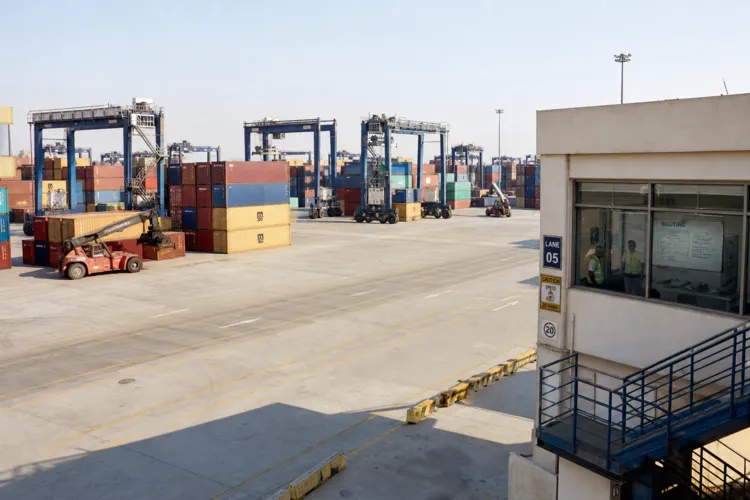
Supply chain localization at the yard is also shaped by the wider national logistics context. The Vision 2030 investment guide states Saudi Arabia has 3,800 kilometres of coastline and that the port system handled approximately 350 million tonnes of cargo and over nine million TEUs in container throughput in recent years. It adds that Mawani is targeting the doubling of container handling capacity to approximately twenty-five million TEUs. The same guide describes the Red Sea as carrying approximately twelve to fifteen percent of global trade by value, framing why Saudi investments connect ports, terminals, shipbuilding, repair yards, offshore services, and logistics. In parallel, a Ras Al-Khair SEZ article highlights a ship lift capacity of 31,200 tons and claims proximity to the world’s largest oil and gas fields can reduce supply chain costs by 30%.
What is the King Salman Global Maritime Industries Complex in Ras Al-Khair?
Which companies were involved in early agreements to develop the Ras Al-Khair maritime yard?
What capacities are cited for the Ras Al-Khair shipyard buildout?
How does Ras Al Khair maritime yard logistics connect to localization of the supply chain?
What national port and trade context supports the localization push?
Talk to us for your needs in:
- Identifying Suitable Warehouse Sites in Saudi Arabia
- Customized Logistics and Supply Chain Analytics
- Logistics Network Design and Optimization
- Green Supply Chain and Sustainable Logistics Solutions
- Supply Chain Risk Management and Compliance
- Advanced Supply Chain Resilience and Agility
- Logistics Market Research and Strategic Analysis
- In-Depth Market Survey for Logistics
- Market Intelligence and Insights in Logistics
- Feasibility Study and Assessment in Logistics
- Integrated Warehousing Management Solutions
- Smart Warehousing and Automation Systems
- Sustainable and Green Warehousing Practices
- Port and Airport Logistics Optimization
- Digital Logistics Solutions
- Saudi Logistics Benchmarking