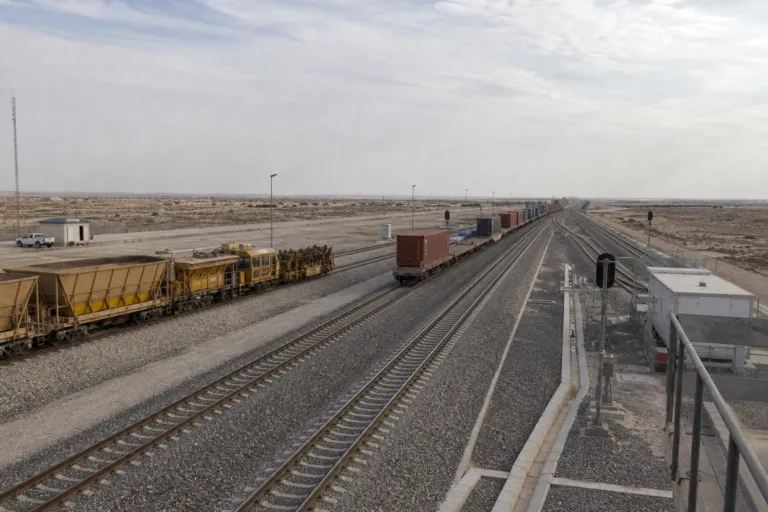
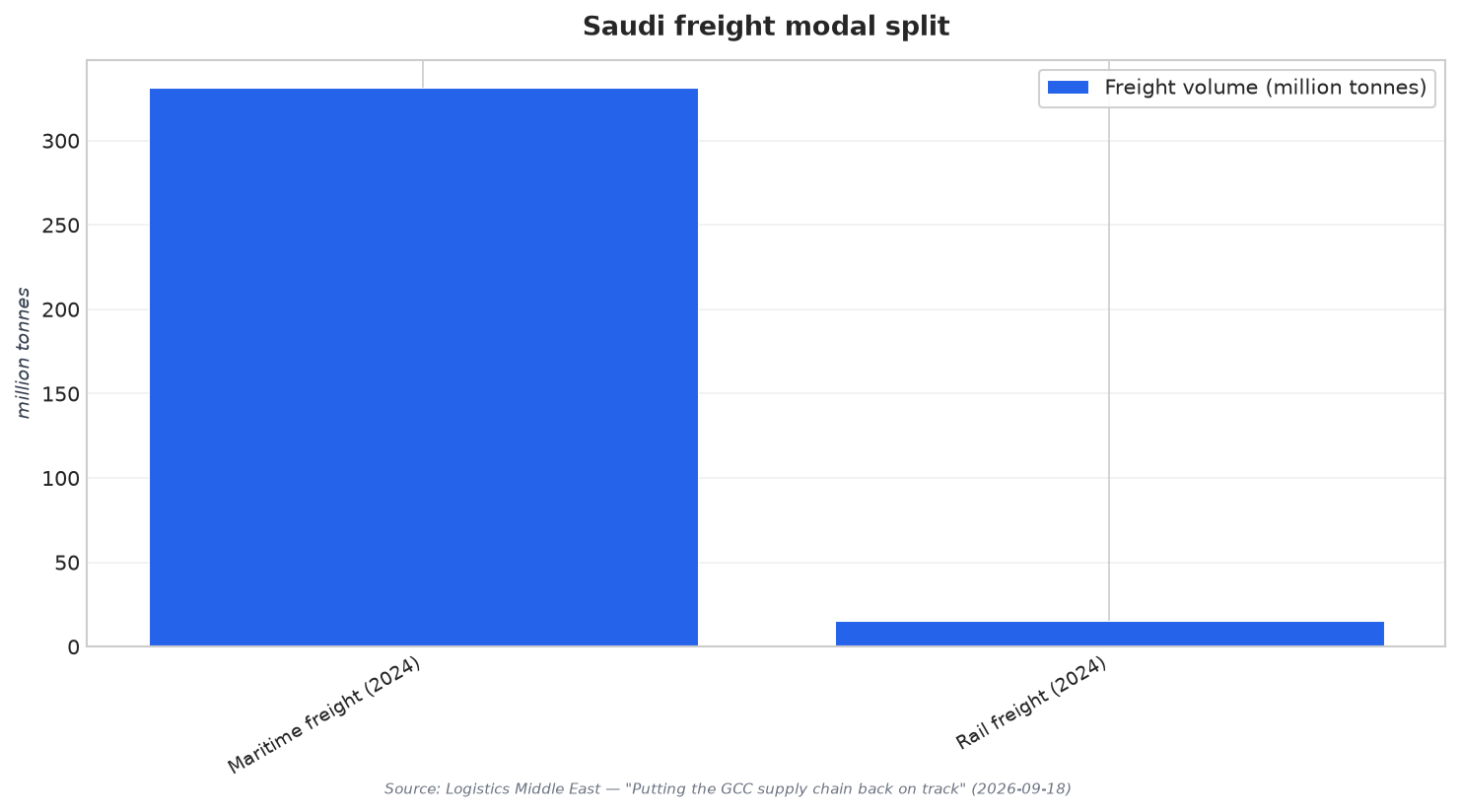
For shippers in the Kingdom, GCC railway Saudi section progress matters most where it creates usable links between existing lines and commercial gateways. Saudi Arabia’s latest published logistics statistics highlight why modal options are under scrutiny: 331.3 million tonnes of freight moved through maritime routes in 2024, compared with 15.6 million tonnes by rail in the same year. The same reporting also notes a 2025 Saudi Arabian Railways (SAR) figure of more than 30 million tonnes, which frames rail’s growing role even as shipping remains dominant. In 2026, disruption across the Gulf’s maritime gateways intensified attention on inland alternatives, even if rail cannot absorb the volumes carried by ships.
At the regional level, the Gulf Railway (also called the GCC Railway) is described as a proposed system to connect all six GCC member states, with a stated total length of 2,177 km and an estimated cost of US$250 billion. Another regional source describes a unified railway stretching approximately 2,117 kilometres from Kuwait to Oman, connecting Saudi Arabia, the UAE, Qatar, Bahrain, Kuwait, and Oman through an interoperable freight and passenger network. Even with differences in stated length across sources, both point to the same core concept: each country builds its own portion, and the value comes from cross-border continuity. Several sections are still under construction, and national projects are progressing at different speeds, which keeps shipper planning focused on what is actually deliverable.
Saudi Links That Change Routing Logic for Cargo Owners
Inside Saudi Arabia, the most specific near-term milestone in the sources is the Riyadh Rail Link. By the end of August, SAR was preparing to award the main design-and-build contract for this 35 km double-track line connecting the North-South Railway with the Eastern Railway network, with commercial proposals opened in August. That kind of connector is what turns separate rail assets into a network shippers can use. Reporting also describes the Landbridge being delivered in phases, with current reporting indicating completion before 2034, while individual sections move on separate timetables. If those connections materialize, the routing logic changes: cargo arriving at a Gulf port could travel across Saudi Arabia by rail toward Jeddah, and cargo entering through the Red Sea could move toward Riyadh and the Eastern Province without having to make the entire journey by road.
A connected Gulf rail system also sits within a wider logistics market that is still heavily road-led today. In a 2025 snapshot of the GCC logistics market, roadways lead transportation mode at 47.3%, while 3PL leads the model type at 51.8%. The same source puts the GCC logistics market at USD 114.56 Billion in 2025, with a projection of USD 182.01 Billion by 2034 at a CAGR of 5.01% during 2026–2034, and notes Saudi Arabia as the leading country market at 39.5% in 2025. For shippers, these figures underline why rail is often framed as a complement: it can reduce reliance on single corridors and improve inland connectivity, while road and 3PL networks remain central to distribution and final delivery.
Operationally, cross-border efficiency is not only about tracks. A separate GCC freight and logistics analysis highlights customs union harmonization through an integrated customs tariff and expanding digital data exchange that simplifies documentation and reduces redundant inspections, shortening intra-GCC transit times and lowering dwell costs. In parallel, a Saudi-focused analysis argues the Kingdom can expand its role by leveraging Red Sea access and building integrated sea-land corridors linking western ports to domestic and GCC markets, while balancing port costs, inland efficiency, and border processes. It also states that SAR is launching five new freight corridors linking the West and East coasts, according to SPA. Taken together, the connected-rail upside for Saudi shippers is clearer scheduling options between ports and inland hubs, plus the ability to pivot when maritime chokepoints or market shocks test traditional routings.
What does GCC railway Saudi section progress mean in practical terms for shippers?
How large is freight rail today compared with maritime freight in Saudi Arabia?
How long is the GCC Railway, according to published sources?
What is the stated cost estimate for the GCC Railway project?
Why does customs and border alignment matter alongside rail buildout?
Talk to us for your needs in:
- Identifying Suitable Warehouse Sites in Saudi Arabia
- Customized Logistics and Supply Chain Analytics
- Logistics Network Design and Optimization
- Green Supply Chain and Sustainable Logistics Solutions
- Supply Chain Risk Management and Compliance
- Advanced Supply Chain Resilience and Agility
- Logistics Market Research and Strategic Analysis
- In-Depth Market Survey for Logistics
- Market Intelligence and Insights in Logistics
- Feasibility Study and Assessment in Logistics
- Integrated Warehousing Management Solutions
- Smart Warehousing and Automation Systems
- Sustainable and Green Warehousing Practices
- Port and Airport Logistics Optimization
- Digital Logistics Solutions
- Saudi Logistics Benchmarking