The EU introduced CBAM in 2023 to combat carbon leakage and to phase out historic support tools under the EU Emissions Trading System (EU ETS), including free allocation of EU Allowances and national indirect cost compensation. The mechanism ran a transitional phase from 1 October 2023 to 31 December 2025, when importers reported emissions but paid no charge. As of 1 January 2026, CBAM applies under its definitive regime. That change matters to Saudi supply chains because CBAM introduces obligations for EU importers, including authorisation requirements, reporting, and the purchase and surrender of CBAM certificates that correspond to embedded emissions in imported goods.
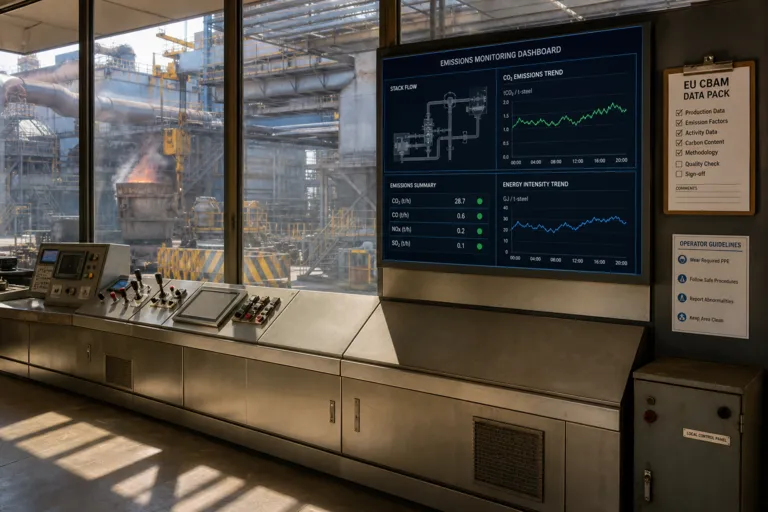
For EU CBAM Saudi exporters, the central reality is that the EU charges the importer, but the importer’s ability to price actual emissions depends on data from the Saudi installation that made the product. CBAM covers six sectors: cement, iron and steel, aluminium, fertilisers, hydrogen and electricity. Importers bringing in more than 50 tonnes must be authorised declarants and surrender certificates for the embedded carbon in covered goods, while importers bringing in 50 tonnes or less a year (counted across iron, steel, aluminium, fertiliser, and cement goods) are exempt. Spectreco notes that if a buyer cannot get a verified carbon figure from its supplier, it must use a default value with a mark-up, increasing costs compared with verified actuals.
What Changes in 2026: From Reporting to Verified, Installation-Level Numbers
The definitive phase adds urgency because the financial obligations will be rolled out over a nine-year period, and CBAM certificate pricing is linked to EU ETS allowance auction prices. Spectreco reports that the 2026 CBAM certificate price follows the quarterly average of EU ETS auction prices, while default values are country-specific and may fall back to the average of the ten highest-emitting exporting countries where data is thin, with a mark-up that starts at 10 percent in 2026 for most goods. Key compliance dates also shape supply-chain planning: certificate sales open on 1 February 2027, and the first annual declaration covering 2026 imports is due by 30 September 2027. As a result, procurement teams will ask for verified emissions data long before declaration deadlines.
The exposure is concentrated in specific Saudi product groups and in a handful of CBAM chapters. Spectreco stresses that most polymers and organic chemicals sit outside CBAM today, and that crude oil and refined products are not covered, making the 2026 exposure narrower and more concentrated in metals than many industrial CFOs assume. Trade figures illustrate the stakes for EU-facing relationships: the EU imported US$385 million of goods under the aluminium chapter from Saudi Arabia in 2025, including US$235 million of unwrought metal. Separately, a Saudi–EU trade snapshot for 2024 put total bilateral goods trade at about €69.9 billion, with EU imports from Saudi Arabia of €33.07 billion and EU exports to Saudi Arabia of €36.84 billion; Saudi exports to the EU rose 7.5% year-on-year from 2023 to 2024.
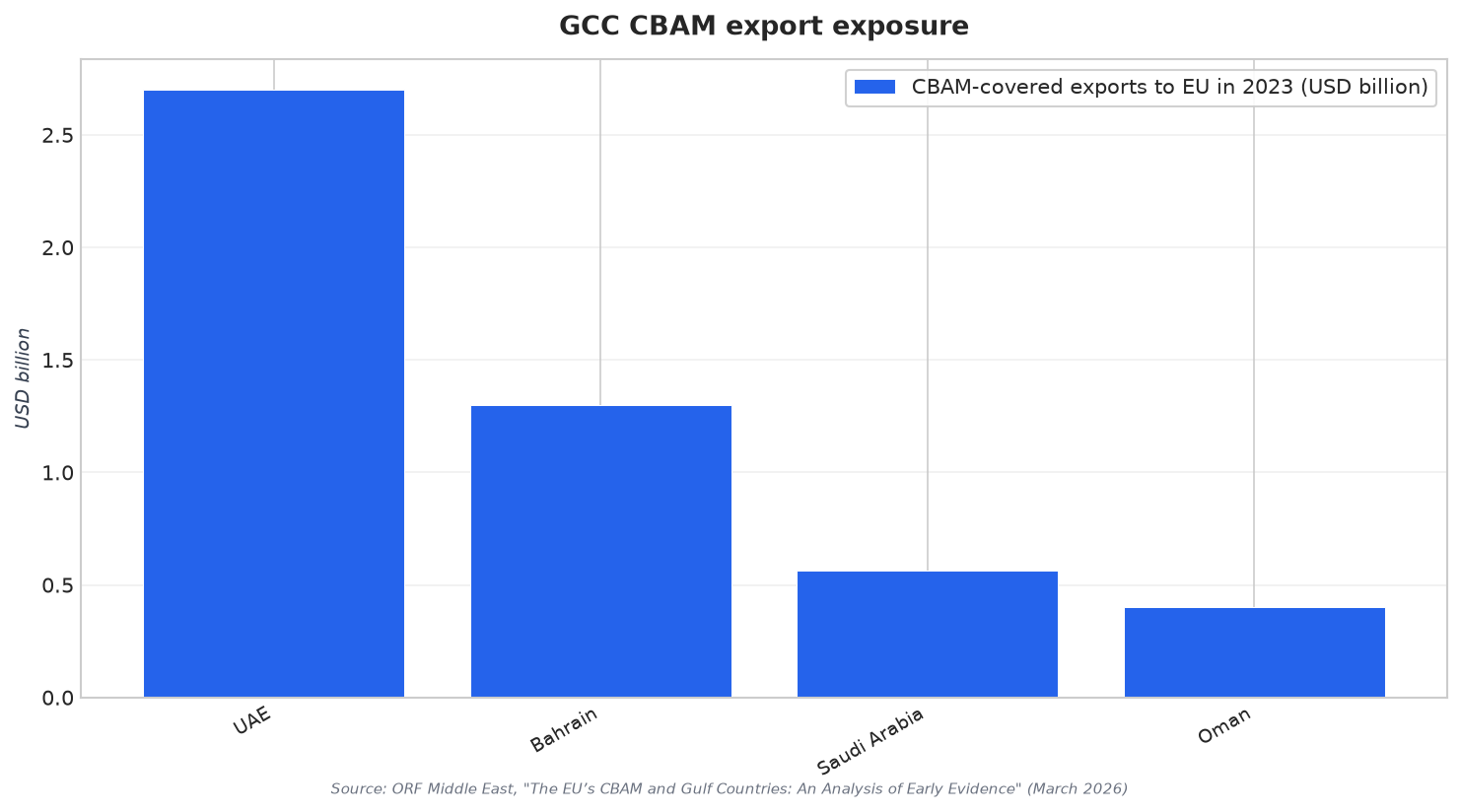
Modelled impacts underline why emissions data quality becomes a commercial issue, not just compliance paperwork. ORF Middle East reported that in 2023 Saudi Arabia exported US$565 million of goods covered by CBAM to the EU, while exposure for GCC countries is highly concentrated in aluminium. Under modelling cited by Spectreco, the CBAM charge on GCC aluminium, on current direct-emissions rules, is projected to rise from roughly US$4 per tonne in 2026 to nearly US$350 per tonne in 2034, described as an ad valorem burden moving from 0.2 percent to 12.7 percent. ORF also notes that indirect emissions account for a large share of aluminium production and may be included in CBAM in the future; with indirect emissions included, Saudi Arabia’s primary aluminium CO2 intensity is cited at about 10.0 CO2e/t Al, compared with 12.0 in China and 13.8 in India, reinforcing why verified plant-level data can support market positioning.
When did the CBAM definitive regime start, and what changed?
Which product sectors matter most for Saudi exporters under CBAM today?
Why are verified emissions figures so important for Saudi supply chains selling into the EU?
What are the first key compliance dates EU importers will work toward?
How exposed are EU CBAM Saudi exporters compared with other GCC exporters?
Talk to us for your needs in:
- Identifying Suitable Warehouse Sites in Saudi Arabia
- Customized Logistics and Supply Chain Analytics
- Logistics Network Design and Optimization
- Green Supply Chain and Sustainable Logistics Solutions
- Supply Chain Risk Management and Compliance
- Advanced Supply Chain Resilience and Agility
- Logistics Market Research and Strategic Analysis
- In-Depth Market Survey for Logistics
- Market Intelligence and Insights in Logistics
- Feasibility Study and Assessment in Logistics
- Integrated Warehousing Management Solutions
- Smart Warehousing and Automation Systems
- Sustainable and Green Warehousing Practices
- Port and Airport Logistics Optimization
- Digital Logistics Solutions
- Saudi Logistics Benchmarking