Cyber risk in Saudi logistics systems is rising as supply chains run on interconnected digital services, partner portals, and data flows that must stay available and trustworthy. Saudi Arabia frames cybersecurity as a national priority through the National Cybersecurity Authority (NCA), described as the national authority in charge of cybersecurity in the Kingdom and the national reference in all its affairs. The NCA’s stated aim is to strengthen cybersecurity to safeguard the State’s vital interests, national security, critical infrastructures, priority sectors, and government services and activities. For logistics operators, this broad scope matters because logistics touches government services, transport-linked operations, and third-party ecosystems that can create weak points if security is treated as documentation instead of day-to-day practice.
Saudi Arabia’s threat context is not abstract. One cited watershed event is the 2012 Shamoon attack on Saudi Aramco, which destroyed data on approximately 35,000 workstations. Sources also describe the Kingdom as an attractive target for state-sponsored hackers, cybercriminal organizations, and hacktivists, especially as digital transformation expands the attack surface. While that example is not specific to logistics, it is a useful reminder of potential operational disruption and data loss risks that can carry over to any digitally dependent sector. In this environment, logistics leaders often need to map cyber risk across vendors, transport management platforms, and customer integrations, because the chain is only as resilient as its connected endpoints.
What NCA Compliance Means for Logistics Operators
The NCA’s framework direction is increasingly explicit. The Essential Cybersecurity Controls (ECC) set baseline requirements for government entities and critical national infrastructure operators, spanning governance, defence, resilience, and third-party management domains. Additional control frameworks cover specific areas, including Critical Systems Cybersecurity Controls, Cloud Cybersecurity Controls, and Data Cybersecurity Controls. For private sector firms that are not classified as Critical National Infrastructure, the NCA introduced the Non-Critical Information Infrastructure Cybersecurity Controls (NCNICC), and sources explicitly list logistics and supply chain companies as in-scope examples. This matters for Saudi logistics cybersecurity under NCA expectations because customers, partners, or regulators may review an organization’s compliance with these controls, pushing companies to improve scope definition, asset inventory, and evidence management.
In 2026, sources describe a major regulatory shift: the NCA now requires all private companies to meet baseline cybersecurity controls, not only those managing critical infrastructure. The same source defines Class A (Large) as organizations with 250+ employees or SAR 200 million+ in revenue, and says independent audits are mandatory for this tier. Class B (SME) has scaled requirements, with audits recommended but not mandatory. Minimum controls listed include MFA, data encryption, regular backups, and incident logging. For logistics operators with complex subcontracting and high transaction volumes, these minimums can become practical “table stakes” for commercial trust, tender eligibility, and partner onboarding, not just a compliance checkbox.
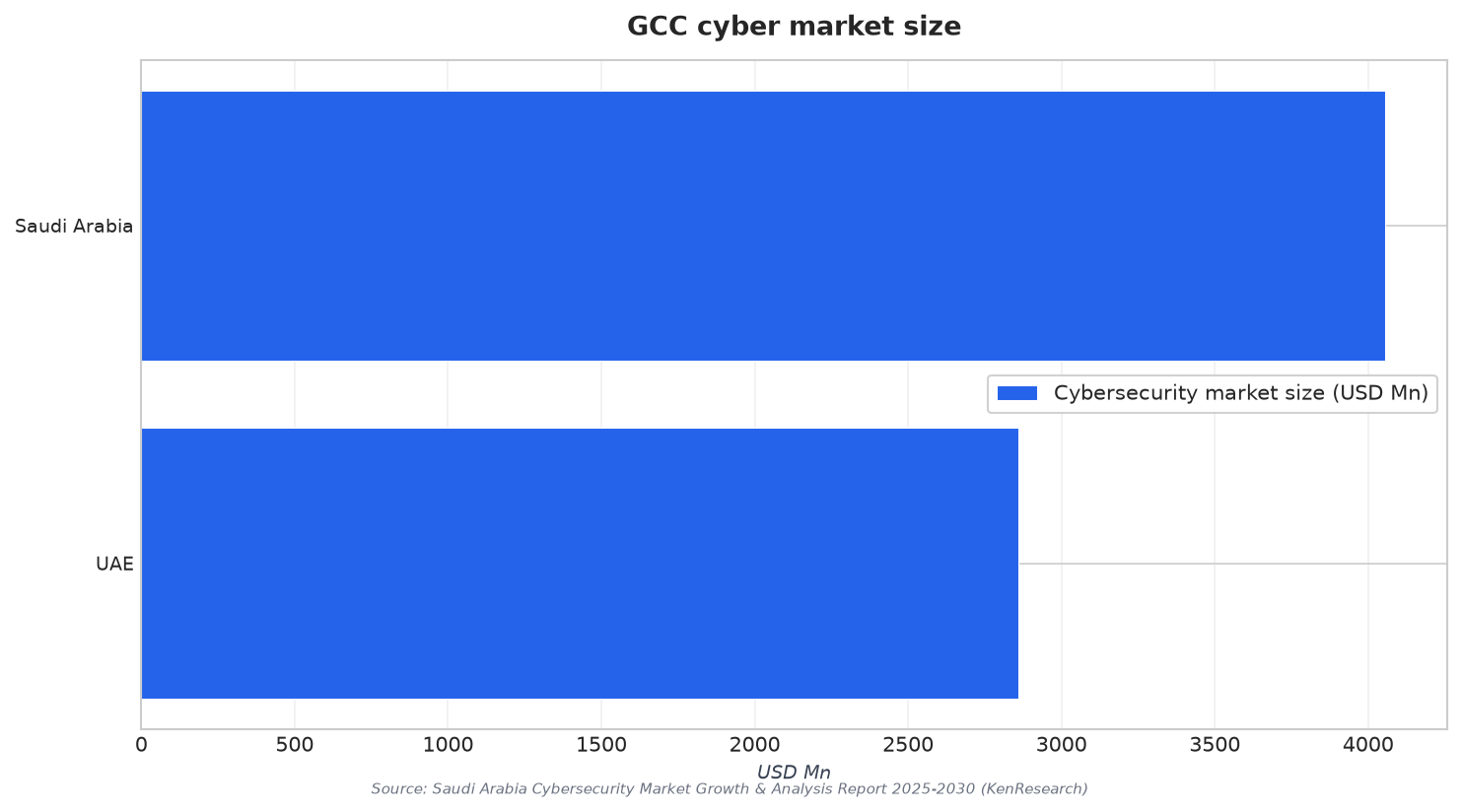
Market signals reinforce the compliance push. One report attributes to NCA market measurement a 12.0% figure for the 2024 Saudi Arabia cybersecurity market, notes that private entities accounted for 68% of Saudi cybersecurity spending in 2024, and states that NCA recorded 353 registered providers by end-2023. The same report also references Saudi Arabia at USD 4,055 Mn in 2024 within a selected GCC peer set, compared with the UAE at USD 2,860 Mn, and cites a 14.0% CAGR for 2025–2030 for Saudi Arabia versus 11.8% for the UAE and 10.9% for Qatar. For logistics firms, the takeaway is not only spending growth, but that NCA compliance and local delivery capacity are described as entry barriers, making structured control adoption and audit readiness a practical operating requirement.
What is the NCA’s role in Saudi Arabia’s cybersecurity landscape?
Which NCA framework can apply to private logistics and supply chain companies that are not critical infrastructure?
What changed in 2026 for private sector NCA compliance and audits?
What minimum controls are listed for private companies under the 2026 shift?
How should Saudi logistics cybersecurity under NCA expectations be approached in practice?
Talk to us for your needs in:
- Identifying Suitable Warehouse Sites in Saudi Arabia
- Customized Logistics and Supply Chain Analytics
- Logistics Network Design and Optimization
- Green Supply Chain and Sustainable Logistics Solutions
- Supply Chain Risk Management and Compliance
- Advanced Supply Chain Resilience and Agility
- Logistics Market Research and Strategic Analysis
- In-Depth Market Survey for Logistics
- Market Intelligence and Insights in Logistics
- Feasibility Study and Assessment in Logistics
- Integrated Warehousing Management Solutions
- Smart Warehousing and Automation Systems
- Sustainable and Green Warehousing Practices
- Port and Airport Logistics Optimization
- Digital Logistics Solutions
- Saudi Logistics Benchmarking