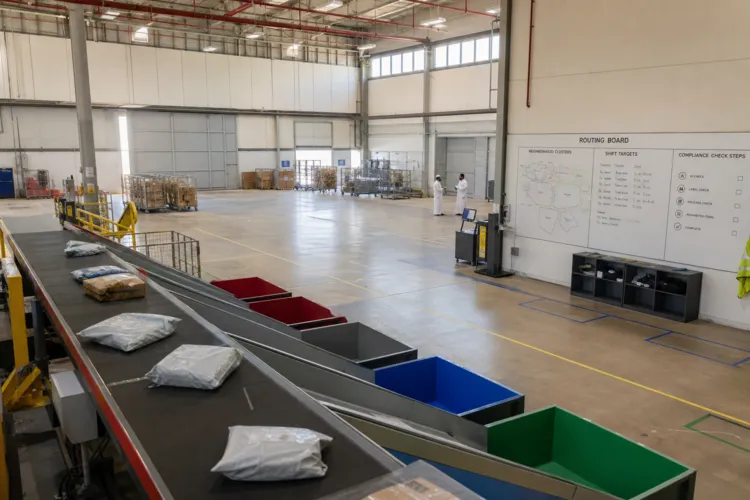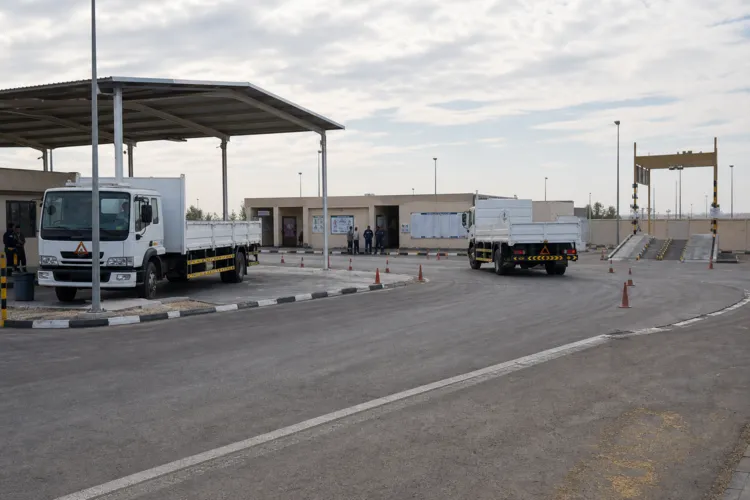
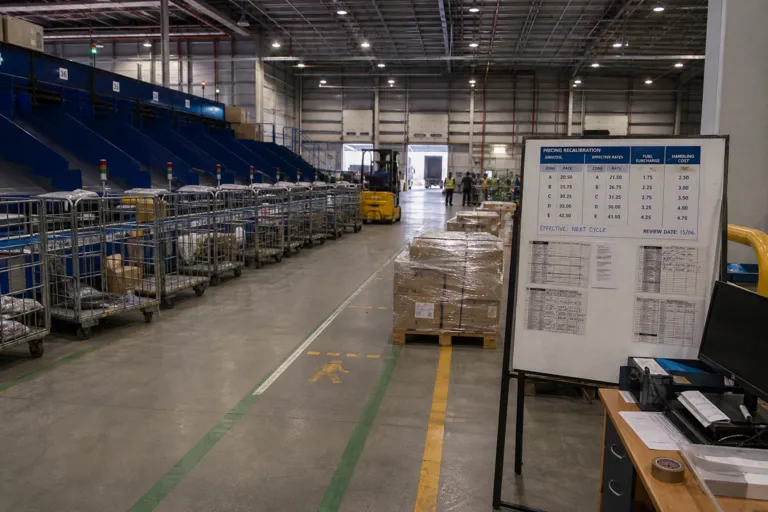
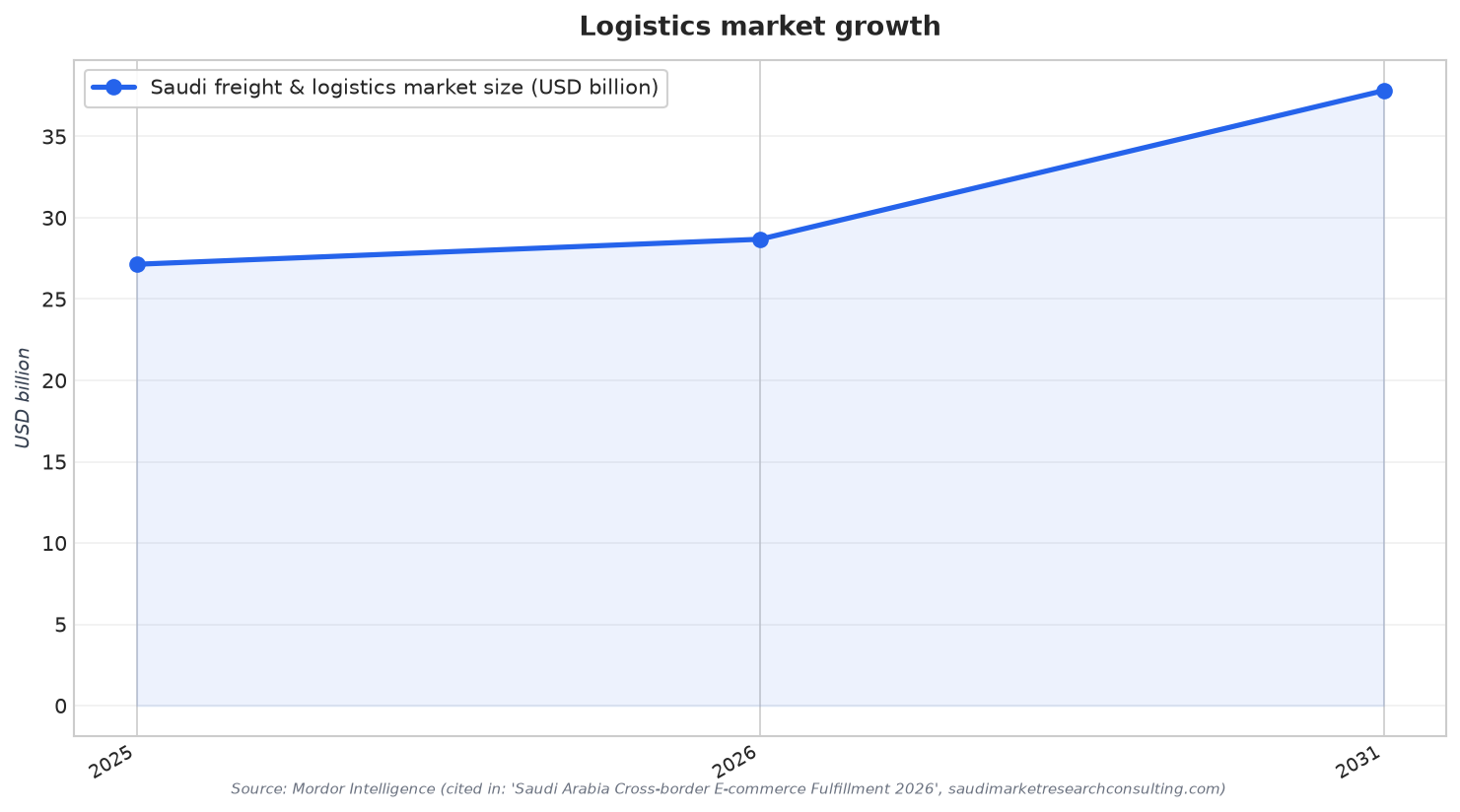
For Saudi 3PLs, cross-border fulfillment pricing is increasingly defined by what happens after the “paper” cost layer is reduced. The Saudi Arabia freight and logistics market is valued at USD 27.14 billion in 2025, estimated at USD 28.68 billion in 2026, and forecast to reach USD 37.82 billion by 2031, with a 2026–2031 CAGR of 5.69%. Within that shift, freight transport held 58.92% market share in 2025, while Courier, Express, and Parcel (CEP) is forecast to grow at a 6.45% CAGR from 2026 to 2031. As global e-commerce inflows push networks toward “always-on parcel systems,” Saudi 3PLs face tighter scan-and-track expectations and a higher penalty for customs or sorting delays, which forces pricing models to focus on controllable execution costs.
The Saudi export fee removal impact shows up most clearly in how providers justify line items. If one category of fees is no longer available to recover costs, pricing pressure shifts into areas customers already scrutinize: border predictability, dwell time, and turnaround. Digital clearance is part of this re-basing of service economics. MarkWide Research notes the Saudi Customs Authority’s Bayan single-window platform as a digitized clearance system that improves predictability for cross-border freight operators. Mordor Intelligence also points to port digitization benefits that “materially” cut demurrage costs, improve truck turnaround, and increase asset utilization, especially when 3PLs integrate port APIs into TMS platforms for real-time visibility and faster clearance cycles. In practical terms, “fee-based” pricing gives way to time-based and performance-based pricing, because time efficiency becomes the lever that can be converted into pricing leverage.
Why Cross-Border Fulfillment Prices Are Moving Toward Time-and-Capacity Math
As fee structures change, capacity and mode decisions become more prominent in fulfillment pricing. In CEP, domestic deliveries represented 65.05% of segment revenue in 2025, but international CEP traffic is projected to grow at a 6.69% CAGR between 2026 and 2031. Road freight held a 41.55% revenue share in 2025, yet air freight is projected to expand at a 6.78% CAGR over 2026–2031, aligning with cross-border parcel needs when speed is worth the premium. Warehousing capacity also matters because cross-border fulfillment needs customs-ready inventory positioning: non-temperature-controlled warehouses held a 77.25% share in 2025, while temperature-controlled capacity is forecast to climb at a 6.48% CAGR (2026–2031). As these mixes evolve, Saudi 3PL pricing becomes less about standardized fees and more about the cost of allocating scarce speed, temperature compliance, and customs-capable space to each shipper and SKU profile.
Infrastructure and policy changes reinforce this shift toward execution-driven pricing. Mordor Intelligence links Vision 2030’s infrastructure drive to USD 133.3 billion of approved airport, rail, and port outlays, and highlights bonded-zone e-commerce hubs that can accelerate cross-border fulfillment efficiency. Ken Research separately notes a plan to establish 59 logistics zones by 2030. In contract logistics specifically, the market was valued at USD 1.23 billion in 2025 and is estimated to grow from USD 1.27 billion in 2026 to USD 1.51 billion by 2031 (3.52% CAGR). Transportation captured 64.30% of that market share in 2025, while agreements longer than three years held a 55.40% share. Those long-duration, transport-heavy contracts push 3PLs to build pricing logic around measurable throughput, utilization, and service levels rather than legacy administrative charges.
At the same time, cost pressure is rising in places that can’t be wished away by removing fees. Mordor Intelligence reports that heavy construction traffic around NEOM and Qiddiya is extending urban delivery times by 25–40%, leading 3PLs to incur higher operating costs from night-shift premiums, micro-hub rentals, and expanded small-truck fleets, with elevated costs expected to persist until major construction slows after 2028. The same source notes that congestion imbalances can shrink international forwarding profitability by as much as five points during peak cycles. Against this backdrop, scrapped export service fees don’t automatically translate into cheaper end-to-end fulfillment. Instead, they reshuffle pricing toward the costs that remain: speed buffers, last-mile variability, and the technology needed to keep cross-border promises consistent.
What does the Saudi export fee removal impact change for 3PL pricing?
Which Saudi logistics segments show the strongest cross-border pressure?
How do infrastructure programs influence cross-border fulfillment pricing in Saudi Arabia?
What cost pressures still squeeze 3PL margins even when fees are reduced?
Talk to us for your needs in:
- Identifying Suitable Warehouse Sites in Saudi Arabia
- Customized Logistics and Supply Chain Analytics
- Logistics Network Design and Optimization
- Green Supply Chain and Sustainable Logistics Solutions
- Supply Chain Risk Management and Compliance
- Advanced Supply Chain Resilience and Agility
- Logistics Market Research and Strategic Analysis
- In-Depth Market Survey for Logistics
- Market Intelligence and Insights in Logistics
- Feasibility Study and Assessment in Logistics
- Integrated Warehousing Management Solutions
- Smart Warehousing and Automation Systems
- Sustainable and Green Warehousing Practices
- Port and Airport Logistics Optimization
- Digital Logistics Solutions
- Saudi Logistics Benchmarking