Saudi Arabia’s mandatory e-invoicing started on 4 December 2021, and Phase 2 (the Integration Phase) has been ongoing from 1 January 2023. In 2026, Phase 2 is no longer limited to large organizations, because SMEs are being brought into the system as the rollout continues in numbered waves. The operational impact shows up fastest in trade and shipping. Phase 2 requires direct integration with ZATCA’s Fatoora platform so invoices can be validated or reported in real time. When that validation fails, the problem is not only accounting. It can become a shipment problem.
Phase 2 changes what “ready to invoice” means. For B2B and B2G standard tax invoices, the workflow is clearance: the invoice must be submitted to ZATCA in real time, and it is only legally valid after it returns with a “Cleared” status. For B2C simplified tax invoices, the workflow is reporting within 24 hours of issuance. Technically, invoices must be produced as XML (or PDF/A-3 with embedded XML) and include required identifiers such as a UUID, a cryptographic stamp (digital signature), a QR code, and a sequential invoice number. Missing fields, formatting gaps, or identifier mistakes can be enough to stop the process at submission time.
Why Rejections Now Spill Into Customs Clearance
Customs processes are increasingly unforgiving when invoices are not Phase 2 compliant. A 2026 Saudi customs clearance guide states that Phase 2 requirements are enforced and that invoices not in the correct XML/PDF-A3 format, or lacking required QR codes and data fields, will cause clearance rejection. The same guide says that under ZATCA’s improved clearance program, the number of documents physically submitted has been reduced from 12 to just 2: the invoice and the bill of lading, while other documents are exchanged through FASAH. That simplification can accelerate flows, but it also concentrates risk on the invoice. When the invoice is wrong, there is less room to improvise at the port.
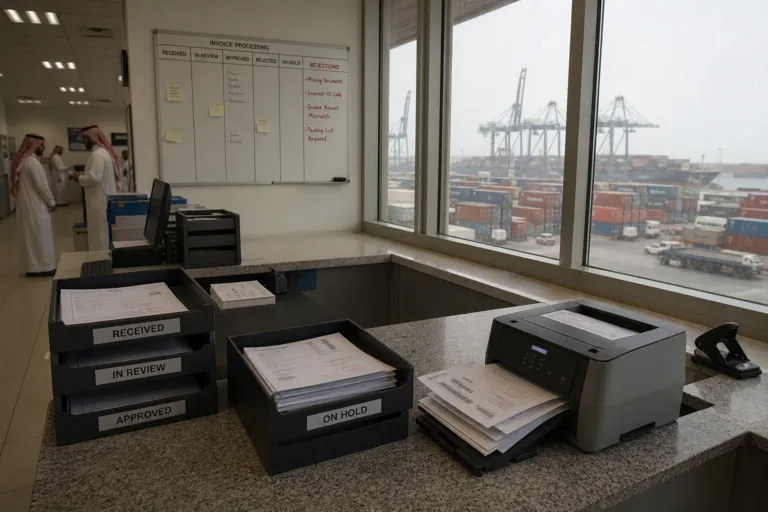
The finance impact feeds the logistics impact. A Phase 2 rejection is not merely an error message. One compliance alert guide says each rejected invoice means a payment delay of 3 to 5 days and adds an extra hour or two to correct and resubmit. It also notes that a rejected invoice cannot be edited and resent as-is; the correction is handled by issuing a credit note and then creating a new, correct invoice. Another 2026 requirements brief warns that if a supplier has passed its Phase 2 integration deadline, the buyer may only accept cleared Phase 2 invoices from that supplier, and accepting a non-compliant or Phase 1 invoice can mean a total loss of the 15% input VAT deduction for that transaction. Together, these rules turn invoicing mistakes into shipment holds, disputes, and rework.
Wave 24 makes this a broad-based issue in 2026. A Wave 24 guide calls it the largest wave so far and states that the eligibility threshold is reduced to SAR 375,000, with businesses required to integrate with Fatoora by 30 June 2026. The same source says a penalty cancellation initiative expires permanently on 30 June 2026, the same date as the Wave 24 integration deadline, and advises training finance and operations teams on the clearance workflow, the 24-hour reporting obligation, and handling ZATCA rejection codes. For ZATCA Phase 2 e-invoicing logistics, the takeaway is simple: compliance is no longer back-office. It is a prerequisite for keeping goods moving.
What does a Phase 2 e-invoice rejection mean for day-to-day operations?
Why can rejected e-invoices disrupt customs clearance in Saudi Arabia in 2026?
What is the key Wave 24 deadline businesses must meet in 2026?
How does Phase 2 change what makes an invoice legally valid for B2B transactions?
What should teams focus on to reduce issues in ZATCA Phase 2 e-invoicing logistics?
Talk to us for your needs in:
- Identifying Suitable Warehouse Sites in Saudi Arabia
- Customized Logistics and Supply Chain Analytics
- Logistics Network Design and Optimization
- Green Supply Chain and Sustainable Logistics Solutions
- Supply Chain Risk Management and Compliance
- Advanced Supply Chain Resilience and Agility
- Logistics Market Research and Strategic Analysis
- In-Depth Market Survey for Logistics
- Market Intelligence and Insights in Logistics
- Feasibility Study and Assessment in Logistics
- Integrated Warehousing Management Solutions
- Smart Warehousing and Automation Systems
- Sustainable and Green Warehousing Practices
- Port and Airport Logistics Optimization
- Digital Logistics Solutions
- Saudi Logistics Benchmarking