Saudi Arabia’s NEOM is positioning Oxagon Port as a technology-forward logistics node on the Red Sea, and recent reporting points to a pivotal milestone: the opening phase of an all-electric, automated container terminal with full operations scheduled for 2026. Newsweek cites NEOM saying construction at the port has reached 68% completion, alongside the launch of initial port operations and services. The same source describes a fully automated logistics and industrial hub powered by renewable energy, with AI-driven port operations. The site’s location is framed as strategic on a busy maritime route connecting Asia, Africa, and Europe, with NEOM also highlighting a July trial shipment that cut transit time by half on an Egypt-to-Iraq movement via Safaga Port, the Port of NEOM, and then by land.
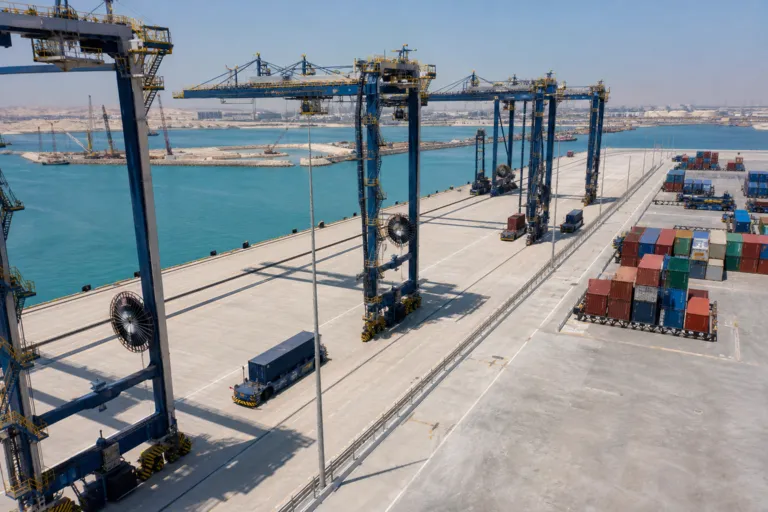
In infrastructure terms, the marine works are already substantial. Newsweek reports that BESIX delivered more than 4 kilometers of quay wall and seven berths, with depths ranging from 10.5 to 18.5 meters. It also describes a 900-meter-long terminal designed to use advanced automated systems to move containers efficiently and handle up to 1.5 million 20-foot containers per year. Separately, analysis at vision2030.ai echoes the same 68% completion figure and details the physical configuration: a 900-meter terminal and an 18.5-meter-deep marine basin, plus Saudi Arabia’s first fully automated Ship-to-Shore cranes. That source states ZPMC is providing 10 STS gantry cranes, 30 electric rubber-tired gantry cranes, and 6 automated rail-mounted gantry cranes, reinforcing the “all-electric” direction through electrified yard equipment.
From “Floating City” Branding to Deliverable Port Operations
Oxagon is widely branded as a floating industrial city, but not every source describes the same near-term reality. Constructionreviewonline characterizes Oxagon as a 48-square-kilometer coastal industrial and logistics hub within a broader 200–250 square kilometer economic zone, shaped as a floating octagon and operating on 100% renewable energy. In contrast, a vision2030.ai analysis argues Oxagon is “no longer best understood as a floating city,” stating that as of the first quarter of 2026 no procurement activity has been recorded for the floating platform and no floating structure has been built, tested, or prototyped at the Oxagon site. That same analysis says the floating platform has been pushed to the early 2030s with no confirmed construction start date, while the port works proceed as terrestrial delivery.
Against that backdrop, the practical story for shippers and manufacturers centers on the port’s 2026 readiness. The vision2030.ai analysis states full container operations at 1.5 million TEU annual capacity are scheduled for 2026, matching Newsweek’s annual throughput figure for the terminal. The analysis also references a second terminal design for up to 10 million TEUs annually, positioning the initial opening as a first step rather than an endpoint. For the broader industrial ecosystem, Newsweek notes the Neom Green Hydrogen Company is constructing what it calls the world’s largest green-hydrogen megawatt plant in Oxagon, and vision2030.ai adds that the NEOM Green Hydrogen plant is an $8.4 billion joint venture between NEOM, Air Products, and ACWA Power that is 80% to 90% complete within the Oxagon zone.
For readers tracking the Oxagon container terminal 2026 milestone, the key takeaway is that the “floating logistics era” is being expressed through automated, electrified cargo handling and a buildout that is already measurable on the ground. Newsweek reports that Oxagon has begun operating Saudi Arabia’s first fully automated, remote-controlled cranes, while vision2030.ai specifies the equipment package and the 900-meter terminal layout. Together, the sources describe a port that is “open for business for cargo shipments” as it approaches full container terminal operations. The result is a logistics narrative anchored less in concept renderings and more in quay walls, berth depths, crane automation, and a defined 2026 operational target.
When are full container operations scheduled at Oxagon’s new terminal?
What is the designed annual capacity of the Oxagon container terminal?
How large are the quay wall and berth works delivered for Oxagon Port?
Is Oxagon being built as a floating city right now?
What is included in the automated crane package described for the 2026 terminal launch?
Talk to us for your needs in:
- Identifying Suitable Warehouse Sites in Saudi Arabia
- Customized Logistics and Supply Chain Analytics
- Logistics Network Design and Optimization
- Green Supply Chain and Sustainable Logistics Solutions
- Supply Chain Risk Management and Compliance
- Advanced Supply Chain Resilience and Agility
- Logistics Market Research and Strategic Analysis
- In-Depth Market Survey for Logistics
- Market Intelligence and Insights in Logistics
- Feasibility Study and Assessment in Logistics
- Integrated Warehousing Management Solutions
- Smart Warehousing and Automation Systems
- Sustainable and Green Warehousing Practices
- Port and Airport Logistics Optimization
- Digital Logistics Solutions
- Saudi Logistics Benchmarking