Saudi Arabia’s decision to grant women the right to drive on public roads in 2018 was a practical labor-market turning point, not only a social milestone. As women gained independent mobility, the potential hiring base for transport, transit, and logistics roles widened. Vision 2030 reforms sit behind that shift. Independent analysis of the “Vision 2030 2024 Annual Report” found that 80% of key performance indicators under Vision Realization Programs have been achieved and another 13% are on track. For employers, that broader execution matters because it shapes commuting, training access, and retention across service sectors where staffing is critical.
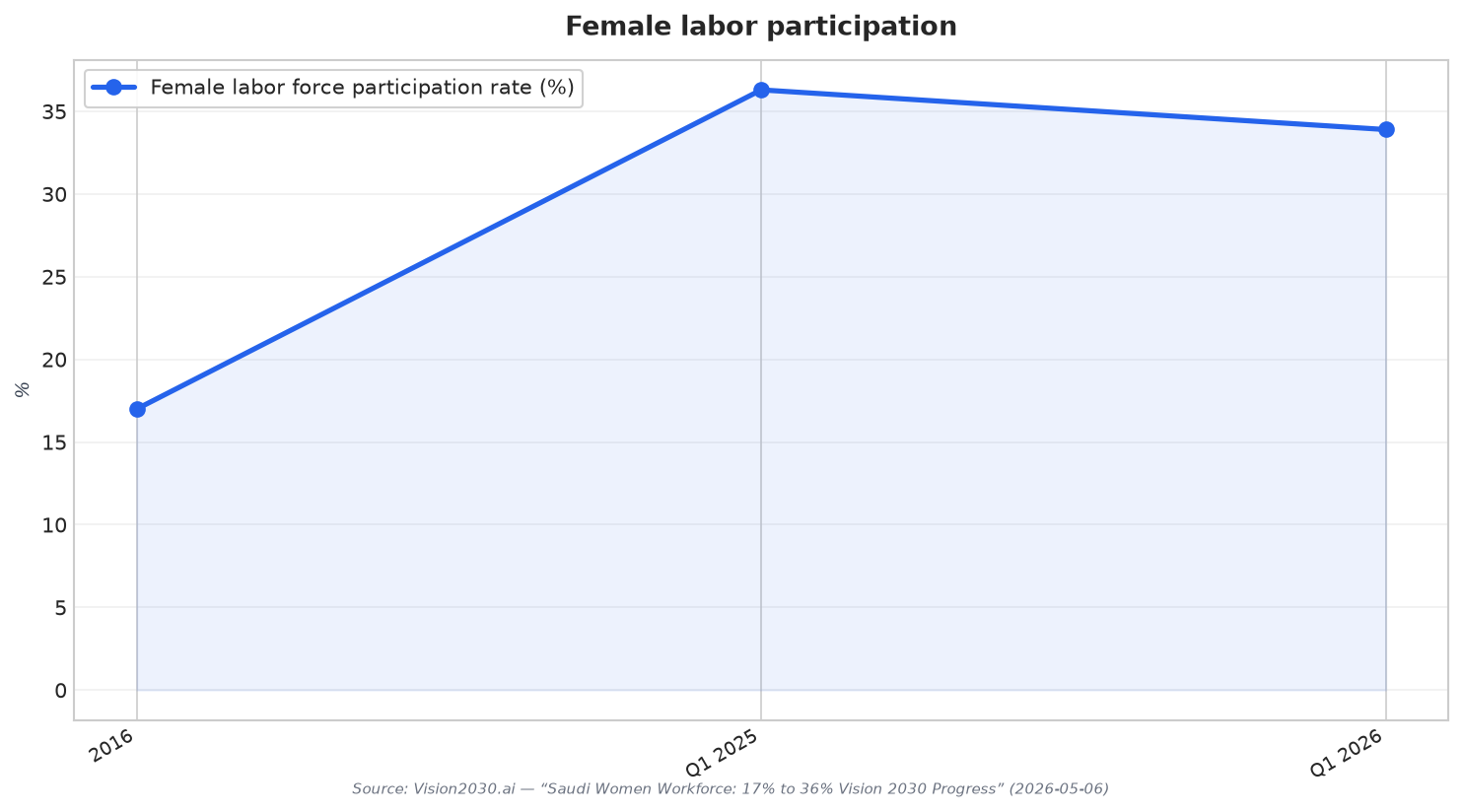
The clearest signal is labor supply. AGSI notes female labor force participation doubled to nearly 35% between 2017 and 2021, then stayed in the 35%–36% range afterward. Vision2030.ai also frames the change as structural, reporting an increase from 17% to 36%, exceeding the 30% target. A separate Vision2030.ai analysis adds timing detail: participation rose from about 17% in 2016 to 36.3% in Q1 2025, then fell to 33.9% by Q1 2026. It also states more than one million Saudi women entered the labor force in the three years following the 2018 driving reform alone.
From Mobility to Employability: Why Driving Access Changes Hiring
Mobility affects whether people can take jobs with early starts, long shifts, or locations away from dense transit. PLOS One reports that over 83% agreed driving expands job opportunities and encourages labor market participation. The same study explains why: independent driving can reduce commuting costs linked to private drivers, increase temporal flexibility for irregular or longer working hours, and expand the spatial range of accessible jobs when public transport is limited. This is the pathway that can strengthen recruitment for logistics, delivery, and other roles where reliable, flexible travel is part of staying employed.
Licensing and real-world driving habits also point to scale. House of Saud reports that as of 2025, Saudi Arabia has approximately 2.5 million female drivers holding valid licences, including roughly 728,000 in Riyadh, 801,000 in the Mecca region, 427,000 in the Eastern Province, and 204,000 in Medina. It adds that female drivers represent an estimated 28% of all licensed drivers nationally. GWI also reports that half of Saudi women now drive at least once a week. For recruiters thinking about Saudi women truck drivers, these figures show a broad base of licensed drivers and frequent drivers that can feed training pipelines.
Programs and market structure influence whether that potential becomes job placements. Vision2030.ai highlights the Qurrah childcare program as supporting over 100,000 working mothers and the Wusool transportation program as enabling female workforce access in non-metro areas. The same scorecard reports unemployment falling from 11.6% to 7% and private sector Saudisation rising from 20% to 32% through Nitaqat enforcement. On the demand side, Grand View Research reports Saudi Arabia accounted for 2.3% of global public transportation market revenue in 2023, while “offline” was the largest segment with an 82.56% revenue share in 2023. Together, these conditions shape how quickly operators can staff growing networks and back-office operations, while building clearer pathways into professional driving roles.
How did the 2018 driving reform affect women’s labor supply in Saudi Arabia?
How many women hold driving licences in Saudi Arabia?
What evidence suggests driving improves job access for Saudi women?
What conditions can help expand pathways for Saudi women truck drivers?
How often do Saudi women drive now?
Talk to us for your needs in:
- Identifying Suitable Warehouse Sites in Saudi Arabia
- Customized Logistics and Supply Chain Analytics
- Logistics Network Design and Optimization
- Green Supply Chain and Sustainable Logistics Solutions
- Supply Chain Risk Management and Compliance
- Advanced Supply Chain Resilience and Agility
- Logistics Market Research and Strategic Analysis
- In-Depth Market Survey for Logistics
- Market Intelligence and Insights in Logistics
- Feasibility Study and Assessment in Logistics
- Integrated Warehousing Management Solutions
- Smart Warehousing and Automation Systems
- Sustainable and Green Warehousing Practices
- Port and Airport Logistics Optimization
- Digital Logistics Solutions
- Saudi Logistics Benchmarking