Saudi Arabia is racing to turn mining into a “third pillar” of the economy alongside hydrocarbons and petrochemicals. Multiple sources value the Kingdom’s mineral wealth at $2.5 trillion, following revaluations tied to new discoveries and deeper surveying across the Arabian Shield. This push is happening as global competition for critical mineral supply security intensifies, and countries want to reduce single-source dependency in processing and refining.
Vision 2030 links mining to industry and trade by focusing on extraction, processing, and the logistics needed to move materials to market. Saudi Arabia has more than 45 identified minerals, including gold, copper, and uranium. The goal is not only to find and mine more ore, but to build reliable routes from mine sites to processing plants and then to export points.
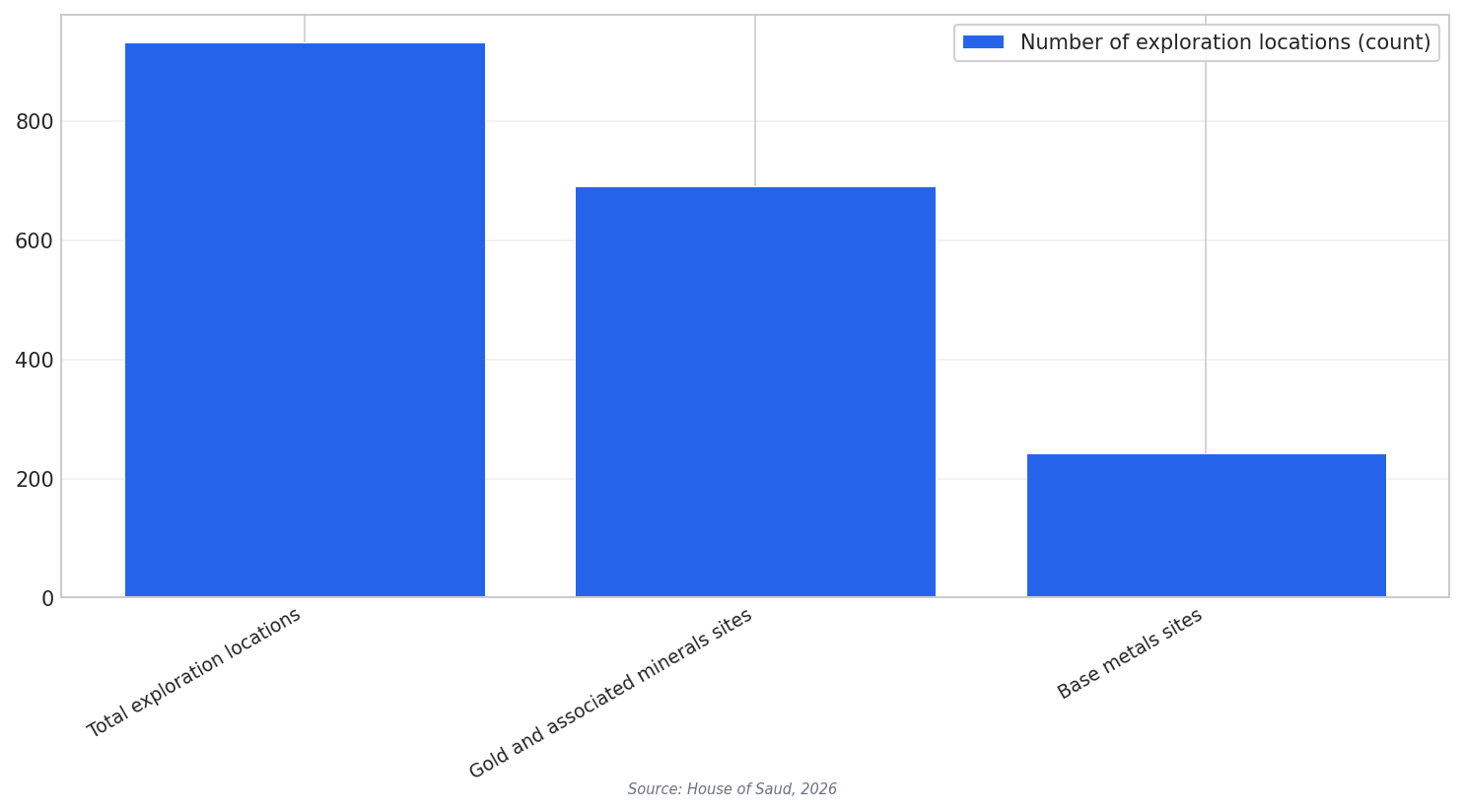
Saudi exploration is scaling fast. The Saudi Geological Survey has identified 933 exploration locations at different stages. This includes 691 sites for gold and associated minerals and 242 sites for base metals such as zinc and copper. These site counts show how wide the pipeline is, and why a mining logistics export corridor must cover many locations, not just a few flagship mines.
Building the Corridor: Laws, Rail Links, and Industrial Hubs
Policy changes are supporting faster development and smoother project delivery. Vision 2030’s mining strategy introduced a new mining investment law that reduced the tax rate to 20 percent from 45 percent to spur investment and align with global standards. The number of mining licenses issued now exceeds 2,000, according to official data. More licenses can mean more mine development, and that increases demand for transport capacity, utilities, and export-ready industrial sites.
Saudi Arabia is also investing in integrated systems that connect extraction, refining, and shipping. Infrastructure investments cited in the sources include the North-South Railway and industrial hubs such as Ras Al Khair, described as linking mining, refining, and export logistics into a unified industrial network. One example of integration is the Wa’ad Al Shamal phosphate complex, which combines mining, processing, and fertilizer production, with investment exceeding $8 billion and output surpassing 3 million tonnes of phosphate-based fertilizers annually.
Large players are planning at scale, which shapes corridor needs. Ma’aden announced a $110 billion investment plan in January 2026, targeting higher output across gold, phosphate, and aluminium, and developing eight megaprojects over the next decade. Separately, Arab News reported a $100 billion investment plan targeting critical minerals by 2035. Together, these plans point to sustained demand for logistics networks that can move bulk minerals and processed materials reliably.
What is the Saudi mining logistics export corridor meant to support?
How large is Saudi Arabia’s estimated mineral wealth?
How many exploration locations has the Saudi Geological Survey identified?
Which infrastructure projects are cited as linking mining to export logistics?
Talk to us for your needs in:
- Identifying Suitable Warehouse Sites in Saudi Arabia
- Customized Logistics and Supply Chain Analytics
- Logistics Network Design and Optimization
- Green Supply Chain and Sustainable Logistics Solutions
- Supply Chain Risk Management and Compliance
- Advanced Supply Chain Resilience and Agility
- Logistics Market Research and Strategic Analysis
- In-Depth Market Survey for Logistics
- Market Intelligence and Insights in Logistics
- Feasibility Study and Assessment in Logistics
- Integrated Warehousing Management Solutions
- Smart Warehousing and Automation Systems
- Sustainable and Green Warehousing Practices
- Port and Airport Logistics Optimization
- Digital Logistics Solutions
- Saudi Logistics Benchmarking