GCC sustainable freight decarbonization is moving from a niche topic to a core logistics issue. PwC Middle East warns that without incentives, emissions from new truck sales could exceed 54 million tonnes of CO2 by 2035. The same PwC research says strong government action can change the outcome, especially when electrification is paired with cleaner fuels and a shift to lower-emission freight modes.
PwC Middle East sets a clear comparison. With strong government action, including policy, regulation, and incentives, emissions could fall by 4.7% by 2035. In a business-as-usual scenario, emissions drop just 1.3%. The gap shows why decisive policy matters for heavy transport in the region.
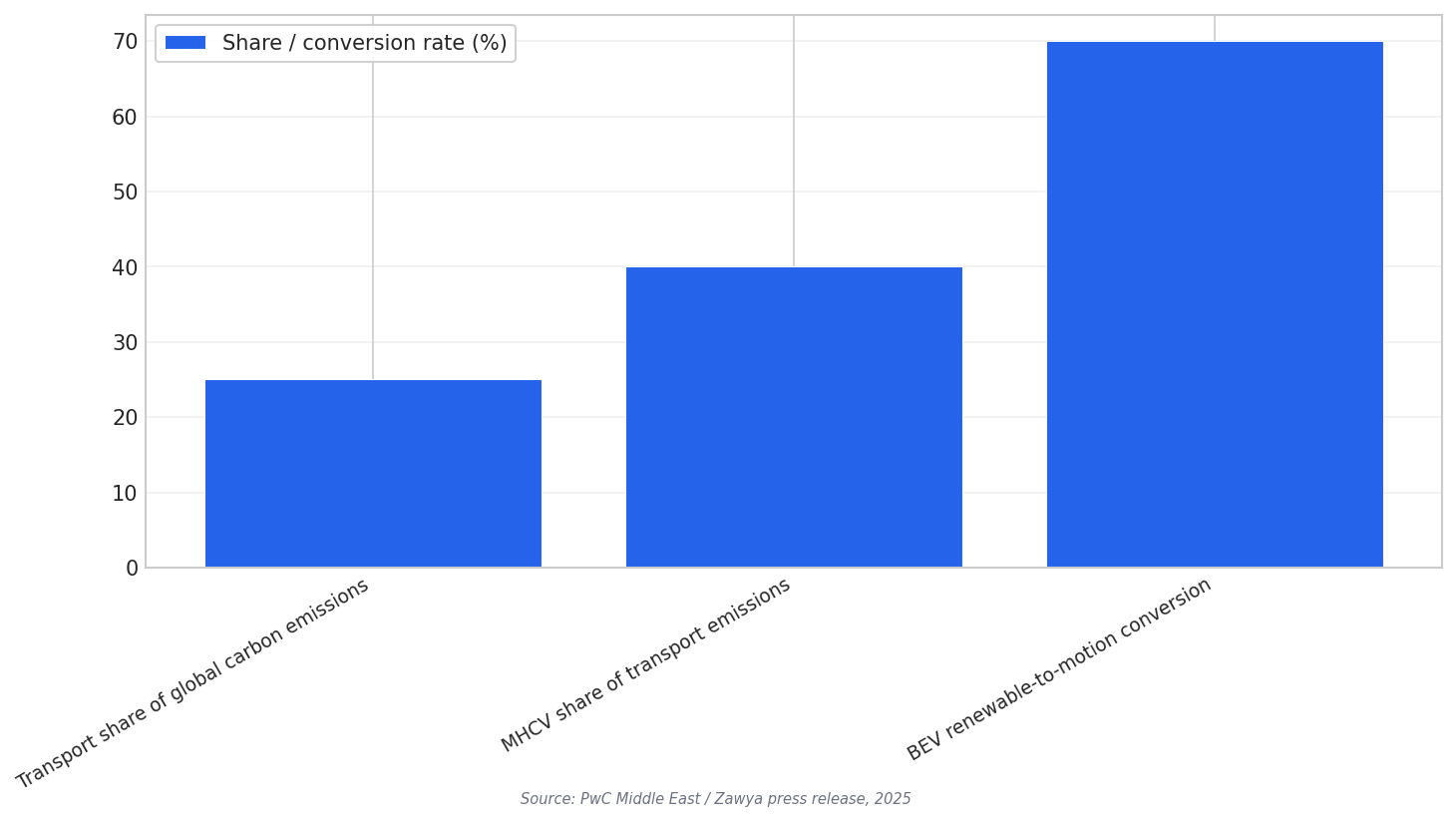
Other figures in the same sources help explain why freight is under pressure to change. PwC notes transport generates around a quarter of global carbon emissions. Medium- and heavy-duty vehicles are responsible for 40% because they rely on diesel and spend long hours on the road. That is why decarbonising heavy transport is positioned as critical to reaching net zero goals.
What Must Change to Reach 2035 Targets
PwC highlights two connected problems: supply and scale. Across the UAE, Saudi Arabia, and Qatar, electric heavy-duty truck availability in the GCC remains limited, with 70% fewer models than in Europe. That points to a simple need: expand supply and attract manufacturers, so fleets have real choices when they plan renewals.
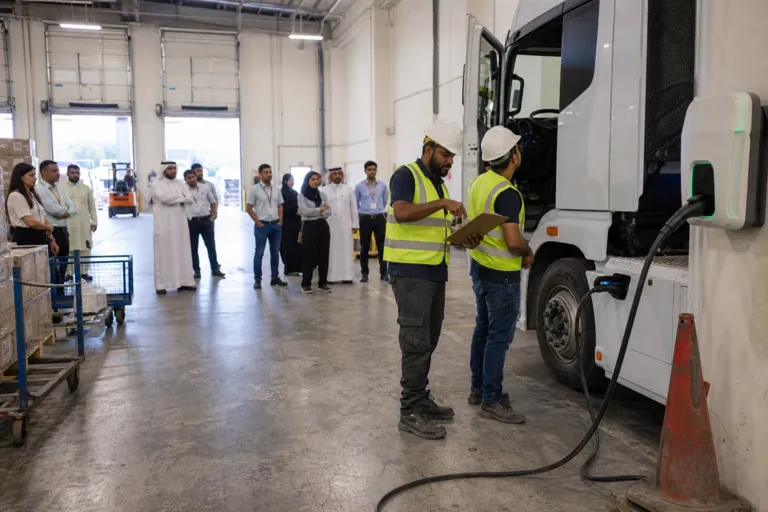
On technology, PwC describes a transition toward battery-electric and hydrogen fuel cell trucks. The Zawya summary also explains why battery-electric trucks can be attractive: BEVs convert around 70% of renewable energy into motion. If governments align incentives, investment, and regulation, PwC argues that zero-emission trucks can outpace combustion-engine trucks not only environmentally but commercially.
But trucks are only one part of a freight system. PwC links higher CO2 cuts to accelerated electrification combined with cleaner fuels and modal shifts. The International Council on Clean Transportation also argues that holistic approaches are needed, including modal shift and intermodal transportation, not just truck technology. For companies, programs such as Smart Freight Centre’s trainings and tools can help build a sustainable logistics roadmap and support transparent emissions accounting using the GLEC Framework and ISO standards.
What does PwC Middle East project for truck CO2 in the GCC by 2035?
Why is GCC sustainable freight decarbonization urgent now?
How limited is the zero-emission heavy truck market in the GCC today?
What makes battery-electric trucks attractive for decarbonising freight?
Talk to us for your needs in:
- Identifying Suitable Warehouse Sites in Saudi Arabia
- Customized Logistics and Supply Chain Analytics
- Logistics Network Design and Optimization
- Green Supply Chain and Sustainable Logistics Solutions
- Supply Chain Risk Management and Compliance
- Advanced Supply Chain Resilience and Agility
- Logistics Market Research and Strategic Analysis
- In-Depth Market Survey for Logistics
- Market Intelligence and Insights in Logistics
- Feasibility Study and Assessment in Logistics
- Integrated Warehousing Management Solutions
- Smart Warehousing and Automation Systems
- Sustainable and Green Warehousing Practices
- Port and Airport Logistics Optimization
- Digital Logistics Solutions
- Saudi Logistics Benchmarking