Saudi Arabia’s Saudization program (Nitaqat) is entering a sharper phase in 2026. The change is not only about company-wide ratios. Sources describe a shift toward profession-level mandates that can close specific job titles to expats. For logistics hiring, this matters because logistics teams rely on many support roles around operations, documents, and coordination.
One clear signal is the April 2026 wave: 69 additional administrative support professions moved to 100% Saudization. Multiple sources state this update is effective 5 April 2026. Another source adds that some jobs are Saudized immediately from the decision date, while the remaining jobs have a 6-month grace period. This is why role titles, contracts, and job descriptions can become hiring risks if they fall into restricted categories.
Across the same set of sources, there are several profession-based rules and counts worth tracking: 69 administrative support professions were added at 100% Saudization, 269+ professions now carry quotas, and there is a three-year plan from 2026 to 2028 targeting 340,000+ additional private-sector jobs for Saudi nationals.
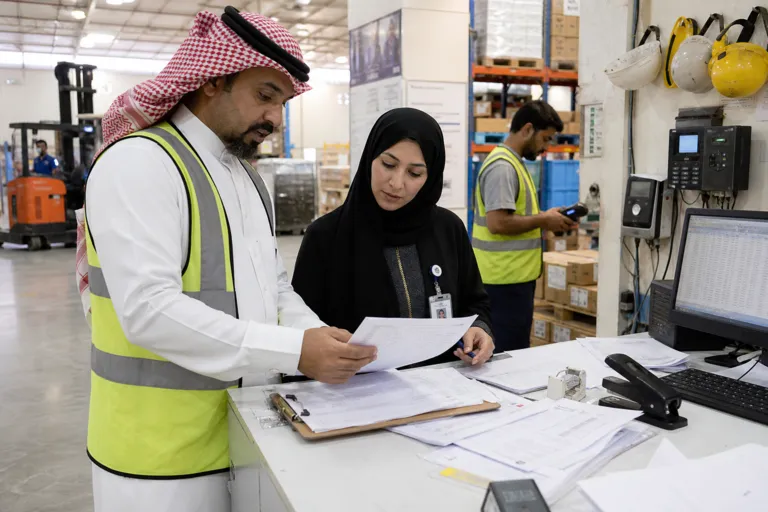
For logistics employers, the “administrative support” label is the practical danger zone. The listed examples in the sources include secretarial work, translation, and data entry, alongside administrative support. These are common tasks inside logistics: shipment documentation, basic reporting, vendor communication, and coordination. If a logistics company keeps these functions under titles that fall into the 69-role list, it may be forced into Saudi-only hiring for those positions.
What Logistics HR Teams Should Change Now
First, treat Saudization as a structural shift, not a short-term trend. One source warns expats to verify not only the company, but also that the role offered is not in a restricted category that can affect a work permit application or renewal. That same logic applies to employers: if a job is restricted, filling it with a non-Saudi candidate can create downstream issues.
Second, plan for role-by-role compliance. A source explains that flexibility is narrowing as rules move from company-level quotas to profession-level mandates. In addition, sources advise confirming enforcement dates via official channels like the MHRSD portal or the Qiwa platform because implementation dates can shift. For logistics hiring, that means auditing job titles, mapping real tasks to official categories, and aligning contracts to the correct classification before recruiting.
What does the 2026 update mean for the Saudization logistics workforce 2026 planning?
When do the 69 Saudi-only roles take effect?
Which types of tasks are highlighted as part of the administrative support wave?
Is Saudization in 2026 only about broad sector bans?
Talk to us for your needs in:
- Identifying Suitable Warehouse Sites in Saudi Arabia
- Customized Logistics and Supply Chain Analytics
- Logistics Network Design and Optimization
- Green Supply Chain and Sustainable Logistics Solutions
- Supply Chain Risk Management and Compliance
- Advanced Supply Chain Resilience and Agility
- Logistics Market Research and Strategic Analysis
- In-Depth Market Survey for Logistics
- Market Intelligence and Insights in Logistics
- Feasibility Study and Assessment in Logistics
- Integrated Warehousing Management Solutions
- Smart Warehousing and Automation Systems
- Sustainable and Green Warehousing Practices
- Port and Airport Logistics Optimization
- Digital Logistics Solutions
- Saudi Logistics Benchmarking