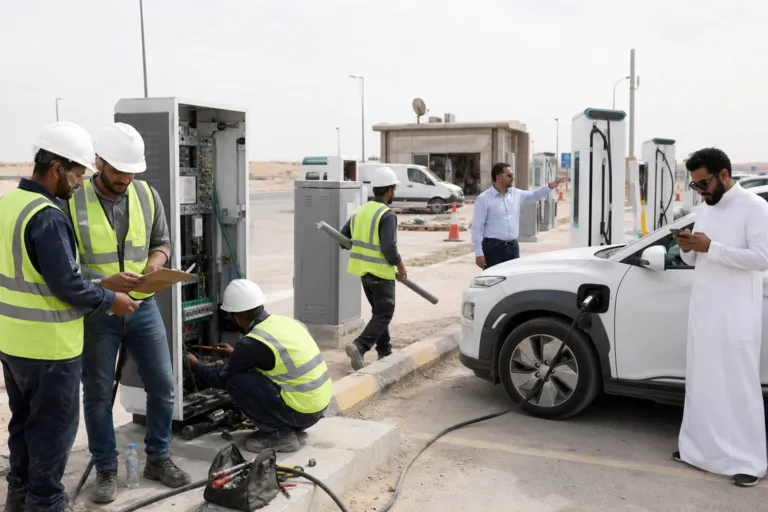
Saudi Arabia is pushing electric mobility as part of Vision 2030. The goal is to diversify the economy and reduce carbon emissions. EVIQ is central to this shift. It is backed by the Public Investment Fund (PIF) and Saudi Electricity Company. For EV charging infrastructure logistics Saudi, the big need is simple: drivers and fleets must see chargers where they travel, live, and work.
Public charging access is a key baseline for confidence. By the end of 2023, Saudi Arabia had around 285 public charging points, mostly slow chargers, based on PwC reporting cited by CNN. EVIQ opened its first fast charging station in Riyadh in January 2024. It also has an expansion plan to deploy 5,000 fast chargers across 1,000 locations by 2030. These numbers show the shift from early coverage to national network planning.
The chart compares three figures stated across the sources: around 285 public charging points by end-2023, EVIQ’s plan for 1,000 locations by 2030, and EVIQ’s target of 5,000 fast chargers by 2030.
Logistics improves when charging is not limited to city centers. EVIQ is rolling out highway charging stations to support long-distance travel. A Saudi mobility consulting report highlights EVIQ’s first highway charging station on the Riyadh–Qassim route. It also points to a wider plan to cover corridors linking Riyadh, Jeddah, and Al-Madinah. This type of corridor coverage matters for commercial routes that rely on predictable stops.
NHC Destinations: Turning Urban Projects Into Charging-Ready Zones
Charging access also depends on where people live. At Cityscape Global 2025, the National Housing Company (NHC) and EVIQ signed a strategic agreement to develop EV charging infrastructure across NHC destinations. The focus is on deploying EV charging services within NHC projects and integrating EVIQ solutions into urban developments. The stated aim includes easier access for residents and progress toward national net-zero emissions goals.
Fleet demand is another driver. Saudi Arabia has an interim goal: 30% of Riyadh’s vehicles powered by electricity by 2030, cited in multiple sources. The Futurism market article also notes Riyadh’s fleet electrification program includes 560 electric buses. As fleets scale up, charging must be reliable in depots, workplaces, and public sites, not only in private homes.
The EV ecosystem is expanding alongside charging. EV Infrastructure News reports Lucid Motors’ factory at King Abdullah Economic City is set to produce up to 150,000 EVs annually, while another Futurism article describes Lucid’s facility as capable of producing 155,000 vehicles annually. Ceer is also mentioned as focusing on electric sedans and SUVs tailored to the local market. For EV charging infrastructure logistics Saudi, this ecosystem approach can help align vehicle supply, fleet demand, and charger placement on real routes.
What is EVIQ building in Saudi Arabia?
How does EV charging infrastructure logistics Saudi improve with highway chargers?
What does the NHC partnership change for residents?
What is Riyadh’s EV target mentioned in the sources?
Talk to us for your needs in:
- Identifying Suitable Warehouse Sites in Saudi Arabia
- Customized Logistics and Supply Chain Analytics
- Logistics Network Design and Optimization
- Green Supply Chain and Sustainable Logistics Solutions
- Supply Chain Risk Management and Compliance
- Advanced Supply Chain Resilience and Agility
- Logistics Market Research and Strategic Analysis
- In-Depth Market Survey for Logistics
- Market Intelligence and Insights in Logistics
- Feasibility Study and Assessment in Logistics
- Integrated Warehousing Management Solutions
- Smart Warehousing and Automation Systems
- Sustainable and Green Warehousing Practices
- Port and Airport Logistics Optimization
- Digital Logistics Solutions
- Saudi Logistics Benchmarking