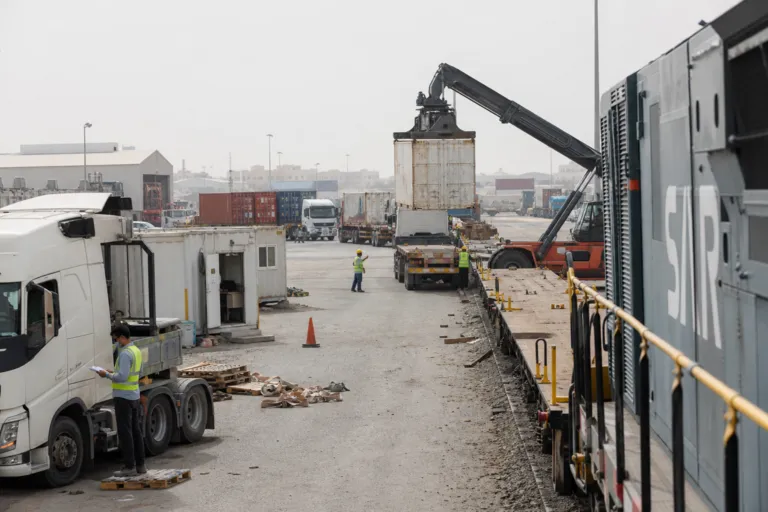
Saudi Arabian Railways (SAR) announced five integrated freight logistics corridors to strengthen trade flows through the Kingdom’s ports. The network links ports on the Arabian Gulf with central and northern Saudi Arabia. It also extends to Red Sea ports and to neighboring countries to the north. The focus is smoother cargo movement using a multimodal system that combines road and rail.
The SAR multimodal logistics corridors 2026 plan is positioned as a supply chain efficiency push. It aligns with Saudi Vision 2030 and the National Transport and Logistics Strategy. SAR described the corridors as an integrated package of logistics solutions. CEO Bashar Al-Malik said the aim is better reliability under varying conditions, supported by coordination between transport modes and regulatory authorities.
SAR expects the new corridors to facilitate the movement of approximately 400 freight-truck-equivalent containers through the Kingdom’s ports within a transit window of no more than 36 hours. This is presented as a way to improve cargo flow efficiency across routes. The corridors are also expected to eliminate thousands of truck trips from roads, raise road safety levels, and reduce carbon emissions.
What the Five Corridors Connect and Why It Matters
The five corridors cover several key commercial areas. The Eastern Corridor links Dammam with Riyadh. It is positioned as a dedicated lane for petrochemicals and containerised goods. The Red Sea Corridor connects Jeddah directly to Riyadh, offering an alternative path for trade moving through the western coast.
The Southern Corridor extends the network to Jazan Economic City. It is described as channeling agricultural produce, minerals, and manufactured goods toward central Saudi Arabia. The Northern Corridor runs from Tabuk to Riyadh. It aims to boost trade with markets across the Middle East and support the movement of minerals and raw materials from the north. The Western Corridor connects Mecca and Jeddah to improve efficiency between two commercially significant cities.
Operations are managed through an integrated system that includes the Riyadh Dry Port and SAR freight yards in Dammam, Jubail, Ras Al-Khair, Al-Kharj, Hail, and Qurayyat. SAR says this setup improves connectivity between ports and local and international industrial and economic hubs. Separately, SAR also announced a new rail freight service on a 1700km route from the Port of King Abdulaziz in Dammam, Jubail Commercial Port, and King Fahd Industrial Port, continuing north to Al-Haditha and Jordan.
What are the SAR multimodal logistics corridors 2026?
How fast are the new corridors expected to move cargo?
Which key cities and areas do the five corridors connect?
What facilities help manage these corridors?
What benefits does SAR expect beyond faster logistics?
Talk to us for your needs in:
- Identifying Suitable Warehouse Sites in Saudi Arabia
- Customized Logistics and Supply Chain Analytics
- Logistics Network Design and Optimization
- Green Supply Chain and Sustainable Logistics Solutions
- Supply Chain Risk Management and Compliance
- Advanced Supply Chain Resilience and Agility
- Logistics Market Research and Strategic Analysis
- In-Depth Market Survey for Logistics
- Market Intelligence and Insights in Logistics
- Feasibility Study and Assessment in Logistics
- Integrated Warehousing Management Solutions
- Smart Warehousing and Automation Systems
- Sustainable and Green Warehousing Practices
- Port and Airport Logistics Optimization
- Digital Logistics Solutions
- Saudi Logistics Benchmarking