Saudi Arabia has positioned its western coastline as a practical bypass for regional trade as conflict disrupts shipping through the Strait of Hormuz. On March 12, 2026, Transport Minister Saleh Al-Jasser launched the Logistics Corridors Initiative during a field visit to Jeddah Islamic Port, setting up dedicated operational pathways to receive containers and commercial cargo redirected from the Kingdom’s eastern ports and from ports across the six GCC member states. The goal is continuity. With eastern facilities such as Dammam and Jubail facing the same Hormuz restrictions affecting other Gulf gateways, Saudi Arabia’s Red Sea ports operate outside the immediate conflict zone and can keep cargo moving to regional and international markets.
The operational idea is simple but expansive: move freight away from the disrupted waterway and into a managed set of routes that link sea, land, and air. In practice, Jeddah Islamic Port and other west coast ports were described by officials as already accommodating shipments redirected from the east while also serving as connectors for Gulf cargo to wider markets without transiting the strait. The initiative was launched alongside the Zakat, Tax and Customs Authority (ZATCA) and Mawani, Saudi Arabia’s state ports authority, indicating that the corridors are not only about port entry but also about keeping clearance and onward movement functioning under pressure.
How the Reroute Works: Ports, Overland Links, and Sea-to-Air
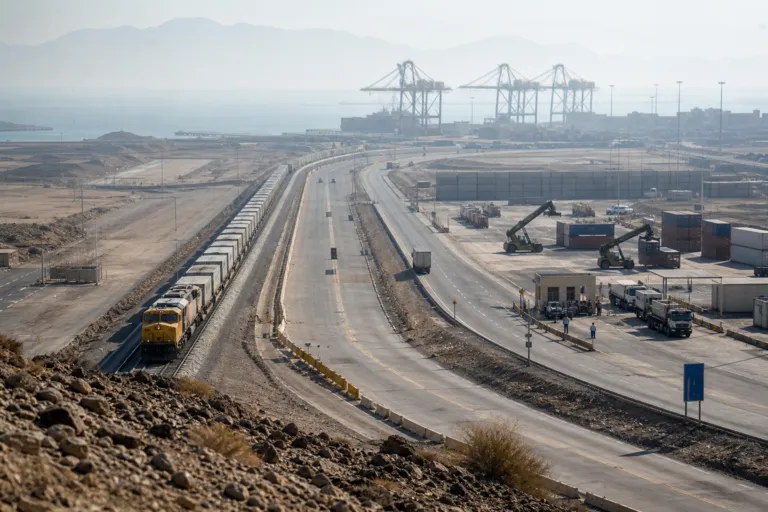
Saudi Arabia’s rerouting strategy leans heavily on infrastructure that crosses the peninsula. One overland pillar is the road connection between Dammam and Jeddah, described at approximately 1,400 kilometers. Another is the Saudi Railway Company’s freight network, which has opened a 1,700-kilometre rail freight corridor stretching from Eastern Province ports to the Jordanian border. The Logistics Corridors Initiative aims to optimize these connections as part of the broader effort to accelerate cargo movements between Saudi ports, reduce delays, and improve supply-chain efficiency as freight flows shift within the region.
Market signals also show how quickly attention shifted to the Red Sea gateways. In reporting that tracked vessel activity, Xeneta’s eeSea liner database indicated five vessels at berth in Jeddah and another four waiting to be docked. It also showed a further 25 vessels en route to the port and due to arrive by the end of the month, with 16 assigned to scheduled services that regularly call and nine unassigned to services, suggesting inducement sailings. As the disruption widened, carriers and shippers adjusted. Japanese carrier ONE requested that Gulf shippers return empty containers to either the Omani port of Sohar or Jeddah.
The corridor concept extends beyond ship-to-truck or ship-to-rail. Sources also describe sea-air and air freight elements, with Saudia Cargo introducing new sea-to-air logistics routes designed to keep cargo moving through Saudi Arabia and onward to global markets. Saudia Cargo described the launch as a proactive response to regional developments affecting shipping patterns and international flight schedules, built to safeguard supply chain continuity and shift inbound maritime shipments into a faster air bridge. This layered approach is central to what many refer to as the Saudi Red Sea corridors initiative: a practical reroute that relies on Jeddah Islamic Port and other west coast ports to stabilize flows when Gulf routes are constrained.
What is Saudi Arabia’s Logistics Corridors Initiative designed to do?
When was the initiative launched and who announced it?
What overland links support the rerouting to the Red Sea?
What evidence suggests increased vessel activity at Jeddah Islamic Port?
How does the Saudi Red Sea corridors initiative include air freight?
Talk to us for your needs in:
- Identifying Suitable Warehouse Sites in Saudi Arabia
- Customized Logistics and Supply Chain Analytics
- Logistics Network Design and Optimization
- Green Supply Chain and Sustainable Logistics Solutions
- Supply Chain Risk Management and Compliance
- Advanced Supply Chain Resilience and Agility
- Logistics Market Research and Strategic Analysis
- In-Depth Market Survey for Logistics
- Market Intelligence and Insights in Logistics
- Feasibility Study and Assessment in Logistics
- Integrated Warehousing Management Solutions
- Smart Warehousing and Automation Systems
- Sustainable and Green Warehousing Practices
- Port and Airport Logistics Optimization
- Digital Logistics Solutions
- Saudi Logistics Benchmarking