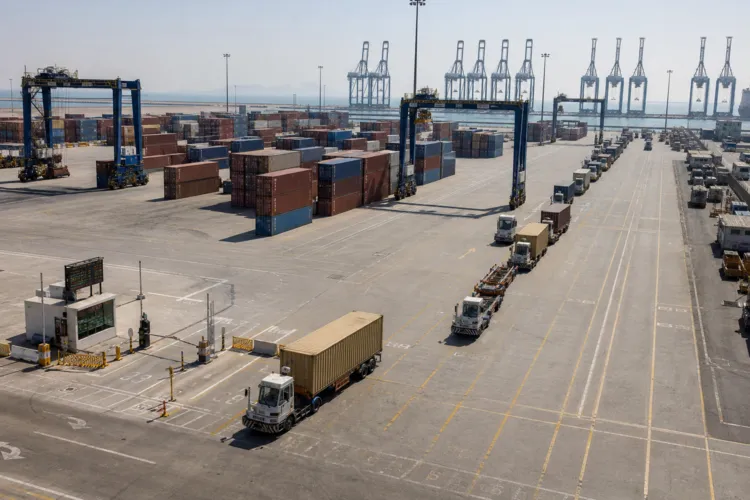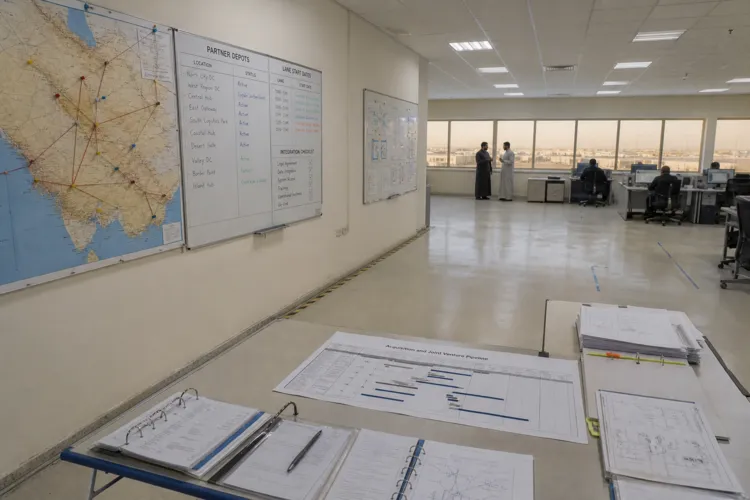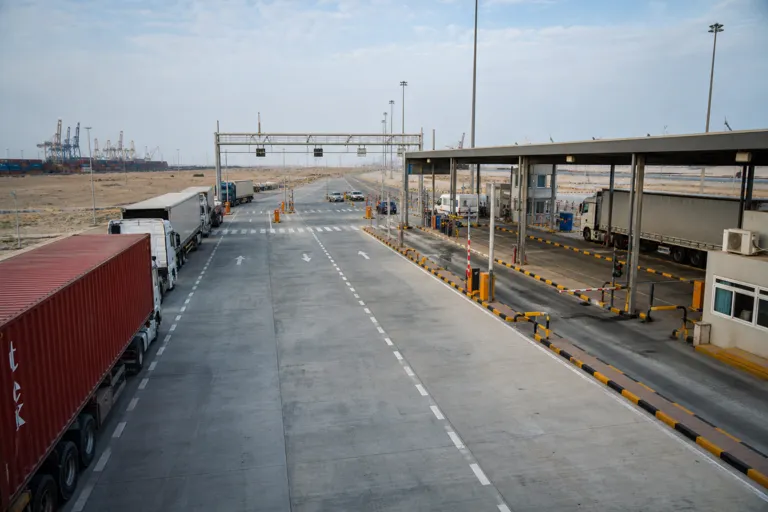
King Abdullah Port has moved quickly to capture a new stream of regional transit traffic as shipping disruptions reshape Gulf trade. At the Saudi Maritime and Logistics Congress in Jeddah, the port’s CEO Jay New said the port had handled little of this overland transit cargo seven or eight months earlier. Since then, King Abdullah Port established a dedicated facility designed specifically for cargo moving across Saudi Arabia to the UAE, Qatar, Bahrain, and Kuwait. The facility includes covered warehousing, customs inspection arrangements, and truck collection, creating a more structured process for cargo owners and forwarders that need a predictable Red Sea-to-GCC route.
The logic is straightforward: the Strait of Hormuz is a single maritime gateway for several national economies, including Qatar, Kuwait, and Bahrain, and it has faced elevated stress since late February 2026 as container diversions surged. Drewry data cited by Cyprus Shipping News frames the wider exposure: ports in the Persian Gulf make up about 3.5% of global port handling (2024 figures), yet the Persian Gulf still handles approximately 33 mTEU annually across UAE, Saudi, Kuwaiti, Qatari, and Bahraini Gulf-side terminals. Jebel Ali alone processes around 15.5 mTEU per year, with Khalifa Port adding 6.6 mTEU in 2025, underscoring why any constraint on the Gulf gateway quickly becomes a supply-chain issue for import-dependent markets.
Why Saudi Red Sea Corridors Are Becoming the Practical Workaround
Saudi Arabia’s logistics-corridors programmes explicitly link Red Sea ports, including Jeddah and King Abdullah, to neighbouring Gulf states via designated trucking routes under bonded-transit regimes, according to Strategy International. The same source describes road freight as the primary mode for intra-GCC goods movement and notes that Saudi Arabia’s Red Sea ports and road network have become the “main alternative logistics corridor in the Gulf during wartime and a lifeline for other GCC countries.” Houseofsaud.com adds that Qatar, Bahrain, and Kuwait face acute need because they are nearly 100 percent dependent on maritime access through the Strait of Hormuz for commercial imports and have minimal alternative routes, while the UAE’s Jebel Ali—reported there as handling 14.1 million TEUs in 2024—has been heavily affected by the shutdown.
Operationally, facilitation measures are also tightening the timeline for cross-border moves. Transportation News and Trends reports that a single customs declaration can cover both legs of a sea-to-air corridor, and that GCC transport ministers approved a facilitation package that raised the operational age for cross-border trucks to 22 years and granted a 60-day storage-fee exemption on GCC imports and exports. It also notes the creation of dedicated storage and redistribution zones inside King Abdulaziz Port in Dammam and that empty refrigerated trucks were cleared to enter and collect regional cargo. Together, these steps complement the port-level buildout at King Abdullah Port by reducing friction at handoffs, inspections, and storage points that can otherwise slow bonded transit.
For shippers, the new reality is a network decision balancing Red Sea exposure, Gulf exposure, and inland capacity. GoFreight reports that European cargo routed via Suez and the Red Sea into the Gulf can be rerouted around the Cape of Good Hope, adding 10 to 14 days of transit, while carriers hesitant about Hormuz often use Salalah for transshipment with feeders onward to Jebel Ali, Dammam, and Bahrain. At the same time, Saudi ports are expanding service options: Ship Management International reports Saudi Arabia has added more than 33 new maritime shipping services since the start of 2026, and that Jeddah handled a record 540,107 containers in July. In that context, the King Abdullah Port GCC transit cargo facility is not just extra warehousing; it is a purpose-built bridge between Red Sea vessel calls and overland distribution into four Gulf markets that urgently need alternatives.
What did King Abdullah Port build for GCC-bound transit freight?
Why is overland transit from the Red Sea to the Gulf getting more attention in 2026?
Which GCC countries are highlighted as destinations for this transit cargo flow?
What figures show how concentrated Gulf container handling is in major hubs?
How does the King Abdullah Port GCC transit cargo setup fit into wider corridor reforms?
Talk to us for your needs in:
- Identifying Suitable Warehouse Sites in Saudi Arabia
- Customized Logistics and Supply Chain Analytics
- Logistics Network Design and Optimization
- Green Supply Chain and Sustainable Logistics Solutions
- Supply Chain Risk Management and Compliance
- Advanced Supply Chain Resilience and Agility
- Logistics Market Research and Strategic Analysis
- In-Depth Market Survey for Logistics
- Market Intelligence and Insights in Logistics
- Feasibility Study and Assessment in Logistics
- Integrated Warehousing Management Solutions
- Smart Warehousing and Automation Systems
- Sustainable and Green Warehousing Practices
- Port and Airport Logistics Optimization
- Digital Logistics Solutions
- Saudi Logistics Benchmarking