Saudi Arabia is upgrading how it stores and moves temperature-sensitive medicines. The pressure comes from vaccines, biologics, and insulin that must stay within strict temperature ranges from warehouse to delivery. In this context, the Kingdom’s cold chain pharmaceutical logistics market was valued at USD 143.1 million in 2025 and is estimated to reach USD 318.4 million by 2034, exhibiting a CAGR of 9.29% from 2026–2034. Growth drivers described in the sources include healthcare investment under Vision 2030, the expansion of e-pharmacies, and stricter requirements around product integrity.
Demand signals also show why compliant cold chain capacity matters for daily patient needs, not only for campaigns. The International Diabetes Federation notes that 23.1% of Saudi adults live with diabetes, equating to over 5.3 million cases. That supports steady throughput for insulin and other cold-stored treatments, especially as new healthcare centers expand into remote regions. At the same time, online medicine buying changes delivery patterns. The e-pharmacy market reached USD 969.3 million, and that scale pushes operators toward dependable temperature-controlled distribution, including insulated packaging and real-time temperature sensors for door-to-door delivery.
Compliance-First Cold Chain Design: Monitoring, Packaging, and Cost Control
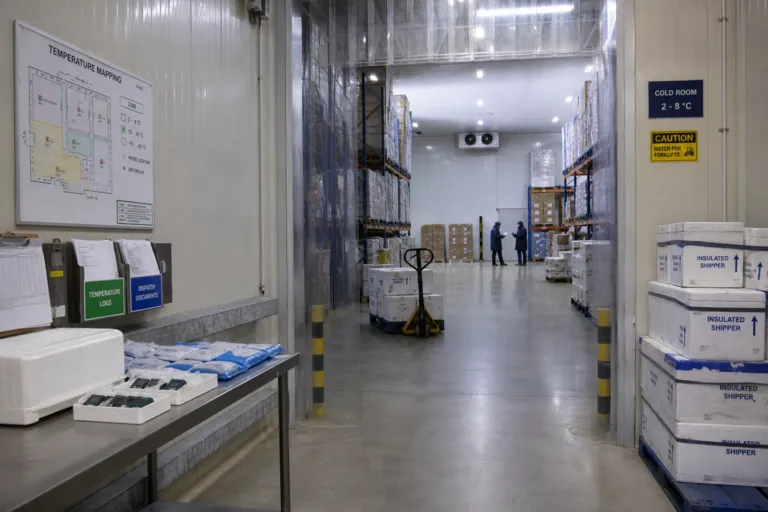
For 2026 execution, a compliance-first cold chain design increasingly centers on visibility. Global pharmaceutical cold chain logistics analysis highlights advanced monitoring technologies such as IoT-enabled sensors, real-time tracking, and data loggers as tools to reduce temperature excursions and support regulatory documentation. The same sources flag that high operating costs and stringent compliance remain barriers, especially where validated storage, transport, and documentation systems are required. Service providers that standardize lane qualification, temperature mapping, and exception handling can build reliability while managing the operational burden that comes with regulated handling.
Packaging choices are part of the compliance system, not an afterthought. The global cold chain packaging market was valued at USD 34.28 billion in 2025 and is anticipated to reach USD 100.00 billion by 2035, growing at a CAGR of 11.3%. The sources also describe Saudi Arabia’s investments in specialized packaging for pharmaceuticals, biologics, and vaccines, alongside stringent SFDA rules. In April 2024, CSafe expanded its portfolio by introducing three new cold chain packaging technologies that incorporate real-time data tracking for visibility during shipping. For operators, this links packaging, monitoring, and audit readiness into one shipment workflow.
Saudi pharma cold chain 2026 planning also benefits from understanding global benchmarks without confusing them for local facts. Globally, the pharmaceutical cold chain logistics market reached US$ 22.75 billion in 2025 and is expected to grow to US$ 44.1 billion by 2033, at a CAGR of 9.12% during 2026–2033. In the broader cold chain universe, global market sizing varies by source: one report values the global cold chain market at USD 371.1 billion in 2025, while another puts the global cold chain logistics market at USD 436.30 billion in 2025. Both cite pharmaceuticals as a driver. For Saudi Arabia, the practical takeaway is clear: invest in validated temperature control, monitoring, and specialized transport to meet strict product-integrity expectations as volumes and delivery models evolve.
What is the size outlook for Saudi Arabia’s cold chain pharmaceutical logistics market?
Why does insulin demand matter for cold chain distribution in Saudi Arabia?
How does e-pharmacy growth change cold chain requirements?
What capabilities support compliance in a 2026 Saudi pharma cold chain program?
What do the sources say about cold chain packaging trends linked to pharmaceuticals?
Talk to us for your needs in:
- Identifying Suitable Warehouse Sites in Saudi Arabia
- Customized Logistics and Supply Chain Analytics
- Logistics Network Design and Optimization
- Green Supply Chain and Sustainable Logistics Solutions
- Supply Chain Risk Management and Compliance
- Advanced Supply Chain Resilience and Agility
- Logistics Market Research and Strategic Analysis
- In-Depth Market Survey for Logistics
- Market Intelligence and Insights in Logistics
- Feasibility Study and Assessment in Logistics
- Integrated Warehousing Management Solutions
- Smart Warehousing and Automation Systems
- Sustainable and Green Warehousing Practices
- Port and Airport Logistics Optimization
- Digital Logistics Solutions
- Saudi Logistics Benchmarking