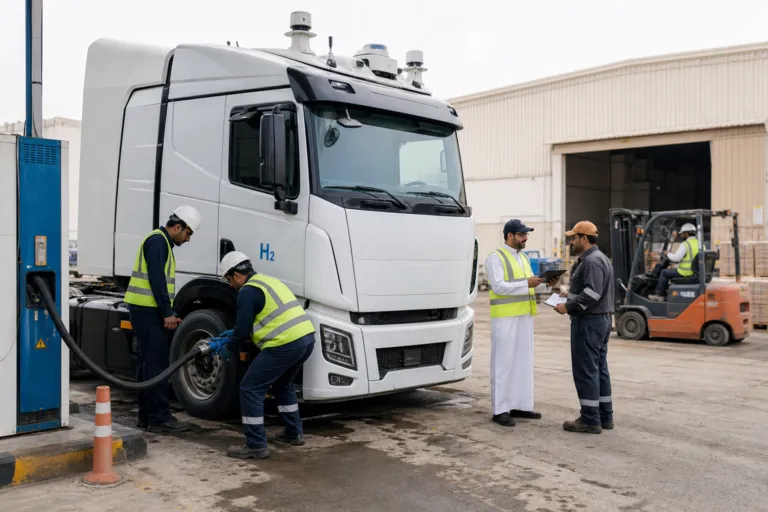
Saudi Arabia has moved hydrogen and autonomy from concept to route-level testing. On June 4, 2026, the Transport General Authority (TGA) announced the rollout of the Kingdom’s first hydrogen-powered heavy-duty truck with autonomous driving, deployed with Procter & Gamble Limited, local distributor Ismail Abudawood Group, and autonomy supplier Hyperview. Multiple outlets describe the system as multi-level or Level 4-capable, aimed at long-haul logistics routes and supported by software updates and AI. Under the hood, reporting attributes propulsion to a proton exchange membrane (PEM) fuel cell and high-pressure hydrogen storage. HydrogenFuelNews also specifies 350 bar hydrogen storage in its account.
Range is one of the headline proof points, and early coverage shows why pilots matter. MadhyamamOnline, MJENGOHUB, and AutoNotion report an operational range near 1,500 km (about 930 miles) on a single tank, while HydrogenFuelNews cites earlier Hyperview tests showing up to 450 km. AutoNotion also points to an earlier version displayed at Riyadh’s Future Minerals Forum in January 2025, described as carrying a 240-kW fuel cell, 59 kilograms of usable hydrogen, and a 72-kWh battery, good for about 800 km at the time. The pilot is where these figures get reconciled under real routes, loads, and conditions.
Why This Pilot Changes the Commercial Conversation
The strategic signal is not only the vehicle tech, but the customer and regulator alignment around it. Several sources frame P&G as an “anchor shipper,” and that matters because consumer-goods logistics is built on predictable routes, timing, and cost discipline. The same pilot is positioned as supporting the National Transport and Logistics Strategy and Saudi Vision 2030, with backing reported from the Ministry of Energy and the Ministry of Transport and Logistic Services. For practitioners, that combination can lower perceived execution risk: regulators approve, ministries support, a distributor runs local operations, and a multinational commits freight volume to a live test.
The test is also designed to collect operational evidence, not just publicity. HydrogenFuelNews reports the team will look at energy use patterns, refueling habits, and how well autonomous features perform in Saudi Arabia’s hot, dusty climate. Blab Tech states the pilot is scheduled to run for 12 months, after which authorities will review results and decide next steps for scaling hydrogen-powered freight. Both HydrogenFuelNews and Blab Tech suggest that if total ownership costs or cost-competitiveness look favorable compared with diesel, the TGA may speed up or issue long-term licences for hydrogen autonomous fleets.
Infrastructure and supply ambition sit behind the trial. ArabWheels cites the U.S. International Trade Administration noting the Kingdom announced plans to invest $147 billion in transport and logistics by 2030 as part of becoming a regional logistics hub, framing the pilot as more than an emissions story. Blab Tech adds context on hydrogen supply, noting the NEOM Green Hydrogen plant aims to produce up to 600 tonnes of hydrogen per day. Put together, the Saudi autonomous hydrogen truck pilot becomes a checkpoint for whether fleets can trust uptime, refueling availability, and maintenance support—because scaling will be decided by performance under load, heat, and real delivery schedules, not launch-day claims.
What is Saudi Arabia testing in its autonomous hydrogen truck pilot?
How far can the truck go on one tank, based on current reporting?
How long will the Saudi trial run before authorities decide next steps?
What technical approach powers the truck?
Why does P&G’s involvement matter for heavy freight adoption?
Talk to us for your needs in:
- Identifying Suitable Warehouse Sites in Saudi Arabia
- Customized Logistics and Supply Chain Analytics
- Logistics Network Design and Optimization
- Green Supply Chain and Sustainable Logistics Solutions
- Supply Chain Risk Management and Compliance
- Advanced Supply Chain Resilience and Agility
- Logistics Market Research and Strategic Analysis
- In-Depth Market Survey for Logistics
- Market Intelligence and Insights in Logistics
- Feasibility Study and Assessment in Logistics
- Integrated Warehousing Management Solutions
- Smart Warehousing and Automation Systems
- Sustainable and Green Warehousing Practices
- Port and Airport Logistics Optimization
- Digital Logistics Solutions
- Saudi Logistics Benchmarking