
As Red Sea shipping delays continue to disrupt global trade, air cargo is becoming the lifeline for Saudi Arabia’s giga-projects. Maritime transit times are now averaging 10–14 days longer than pre-2023 levels. This is critical for projects like NEOM, where advanced construction materials such as smart glass and sensors must arrive on tight schedules.
In this environment, Saudia Cargo expansion 2026 is not just a growth story. It is a strategic response to urgent national deadlines.
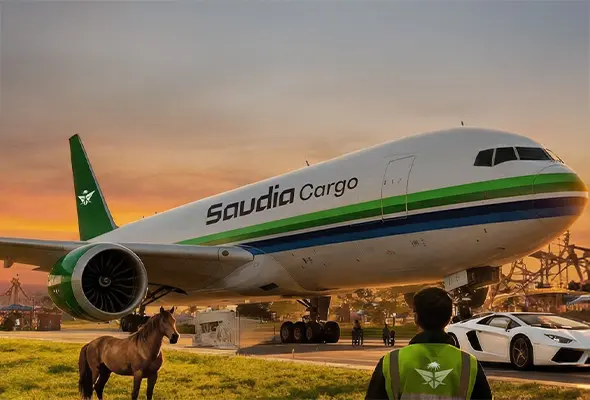
Source: Saudia Cargo
In 2025, Saudia Cargo transported more than 573,000 tonnes of cargo across approximately 4,000 flights. Even more impressive, it achieved over 90% on-time performance. That level of reliability is essential when every day of delay can affect billion-dollar construction timelines.
Despite a slight 0.8% dip in total volume, cargo throughput held steady. This stability shows resilience during regional disruption. It also signals readiness for scale as 2026 approaches.
High-value shipments now represent 54% of Saudia Cargo’s revenues. This shift reflects the growing demand for sensitive and high-tech goods. E-commerce cargo alone grew 23%, reaching over 64,000 tonnes. These trends align closely with giga-project requirements, where materials are not bulky commodities but advanced, high-value components.
To prepare for future demand, Saudia Cargo has leased two Airbus A330-300F freighters from ASL Aviation for delivery in 2026. These aircraft are specifically aimed at boosting global logistics capacity, especially for high-value shipments. Two additional freighters may seem modest, but in tight cargo markets, every widebody aircraft significantly increases uplift capacity and route flexibility.
Network expansion is also underway. New permanent routes to Zhengzhou in China and Milan in Italy strengthen connectivity with key manufacturing and industrial hubs. This wider network reduces dependency on single trade lanes and improves routing options during disruption.
Sea-Air Becomes the New Standard
With Red Sea disruptions affecting around 12% of global trade flows, logistics players are adapting fast. Air cargo demand for time-sensitive goods in the Middle East has increased by 20–30%. One solution now becoming standard is the “Sea-Air” model.
Under this approach, goods are shipped by sea to Dubai and then flown to Riyadh. This hybrid model cuts delivery times by 40–50% compared to traditional all-sea routes. For projects facing strict milestones, this time saving can be decisive.
Saudi Arabia is building the infrastructure to support this shift. Riyadh and Jeddah airports are expanding cargo facilities to handle more than 1.5 million tonnes annually by late 2026. This large-scale capacity upgrade signals long-term commitment to air freight as a strategic logistics pillar.
Customer satisfaction also reflects this transformation. Saudia Cargo achieved a Net Promoter Score of 57 in 2025. In logistics, this is a strong indicator of reliability and service quality. It matters especially when transporting delicate items like sensors, precision components, and smart construction materials.
The Saudia Cargo expansion 2026 strategy combines fleet growth, network diversification, airport infrastructure upgrades, and multimodal solutions. Together, these elements form a flexible logistics ecosystem. For urgent projects like NEOM, where delays are costly, air cargo is no longer an emergency backup. It is becoming the primary channel for critical materials.
As maritime uncertainty persists, the sky is no longer the expensive alternative. It is the dependable route for Saudi Arabia’s next phase of development.
Talk to us for your needs in:
- Identifying Suitable Warehouse Sites in Saudi Arabia
- Customized Logistics and Supply Chain Analytics
- Logistics Network Design and Optimization
- Green Supply Chain and Sustainable Logistics Solutions
- Supply Chain Risk Management and Compliance
- Advanced Supply Chain Resilience and Agility
- Logistics Market Research and Strategic Analysis
- In-Depth Market Survey for Logistics
- Market Intelligence and Insights in Logistics
- Feasibility Study and Assessment in Logistics
- Integrated Warehousing Management Solutions
- Smart Warehousing and Automation Systems
- Sustainable and Green Warehousing Practices
- Port and Airport Logistics Optimization
- Digital Logistics Solutions
- Saudi Logistics Benchmarking